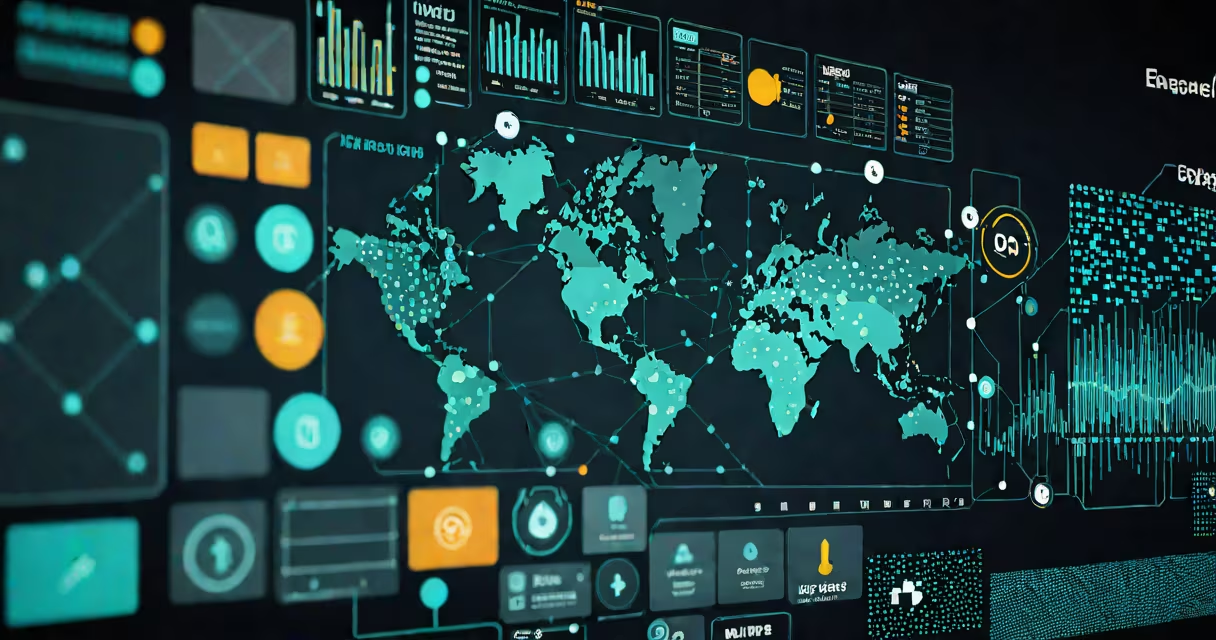
Examples of big data include massive datasets generated by social media platforms, financial transactions, sensor networks, and online retail systems. These collections exceed terabytes to petabytes in size and require advanced tools for storage, processing, and analysis.
Big data refers to datasets too large or complex for traditional database systems to handle. The term applies not just to volume but also to velocity (speed of generation), variety (format diversity), and veracity (data quality). Real-world examples demonstrate how organizations extract value from these challenges.
Big data systems ingest data continuously from multiple sources-web clicks, IoT devices, mobile apps, and transaction records. They store it in distributed systems like Hadoop or cloud-based data lakes. Processing happens using frameworks such as Apache Spark, which analyze patterns across billions of rows in minutes.
For example, a ride-sharing app collects location updates from millions of users every second. This stream of GPS coordinates, pickup times, and driver ratings forms a high-velocity dataset. Algorithms analyze this data to predict demand surges, improve routing, and adjust pricing dynamically.
Without big data infrastructure, real-time decision-making at scale would be impossible. Traditional databases cannot process such volumes efficiently. Big data pipelines move data from ingestion to insight in near real time.
Big data arises from diverse domains. The following table outlines major categories, their typical data formats, and representative use cases.
| Type | Data Format | Example Use Case |
|---|---|---|
| Social Media Streams | Text, images, video, metadata | Twitter sentiment analysis during elections |
| Financial Transactions | Structured tables, logs | Fraud detection in credit card systems |
| IoT Sensor Networks | Time-series telemetry | Smart factory predictive maintenance |
| Web Clickstreams | Log files, JSON events | Netflix recommendation engine |
| Medical Imaging | High-resolution scans, DICOM files | AI-assisted tumor detection in radiology |
Each category generates data at different speeds and scales. Social media produces high-velocity, unstructured data. Financial systems generate structured, high-frequency data. Medical imaging involves large binary files with precise timing requirements.
Retailers use big data to personalize shopping experiences. Amazon analyzes browsing history, purchase patterns, and product reviews to recommend items. Their system processes over 200 million customer interactions daily, adjusting recommendations in real time based on behavioral signals.
Healthcare institutions apply big data to improve patient outcomes. Johns Hopkins Medicine uses electronic health records (EHRs), genomic data, and wearable device inputs to identify early signs of sepsis. A 2021 study published in JAMA Network Open showed that machine learning models trained on big data reduced sepsis mortality by 18% compared to standard protocols.
Financial firms rely on big data for risk modeling. JPMorgan Chase deploys algorithms to scan global news feeds, stock trades, and economic indicators. When unusual activity spikes-such as sudden currency fluctuations-the system flags potential market disruptions within seconds.
Many assume big data means simply "a lot of data." That's incorrect. Volume alone doesn't define big data. A company storing 10 terabytes of old sales reports isn't doing big data-it's managing legacy archives. True big data requires continuous flow, complexity, and actionable insights.
Another error is equating big data with artificial intelligence. While AI often consumes big data, they're distinct. Big data is about scale and structure of input. AI is about the model's ability to learn and adapt. You can perform statistical analysis on big data without using machine learning at all.
A lesser-known fact: not all big data is digital. Satellite imagery, audio recordings from surveillance drones, and even physical inventory logs scanned via barcode readers contribute to big data ecosystems. The key is not the medium but the volume, speed, and analytical purpose.
I once helped design a traffic monitoring system for a mid-sized city. We deployed 120 cameras and 300 loop detectors across intersections. Over seven days, the system captured 1.4 billion data points-vehicle counts, average speeds, stop durations, and congestion patterns.
We processed this using Apache Kafka for streaming ingestion and Spark for aggregation. The output identified peak congestion windows and suggested optimal signal timing adjustments. After implementation, average commute times dropped by 12% during rush hours. The project proved that even modest-scale urban data can yield measurable impact when analyzed properly.
Effective big data projects depend on the right tools. Platforms like Apache Flink, Databricks, and Snowflake enable scalable processing. Visualization tools such as Tableau and Power BI turn raw results into actionable dashboards. Explore modern big data tools and workflows for implementation guidance.
These examples illustrate that big data isn't theoretical-it powers real decisions across sectors. From predicting disease outbreaks to optimizing delivery routes, the applications are both vast and tangible.
When evaluating what are examples of big data, focus on scale, timeliness, and purpose. Not every large dataset qualifies. Only those that drive insight through advanced analysis belong in the category.