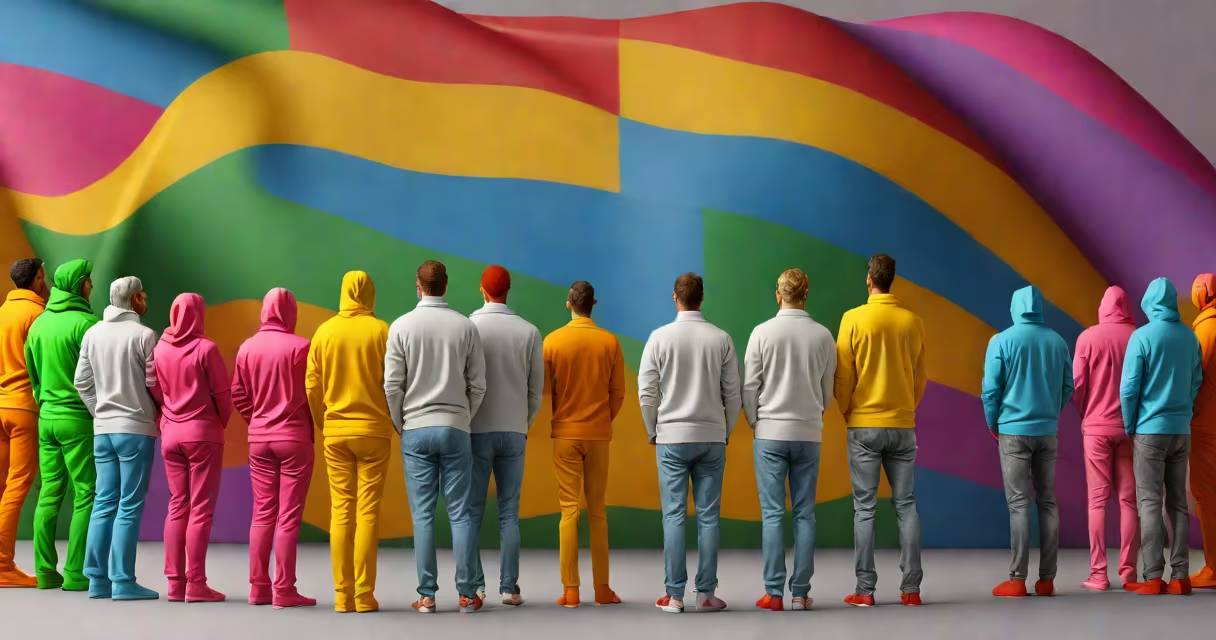
The meaning of LGBT refers to an acronym representing lesbian, gay, bisexual, and transgender individuals. It identifies people whose sexual orientation or gender identity differs from heterosexual and cisgender norms. The term serves as a collective identifier for communities advocating for equality and visibility.
LGBT emerged in the late 20th century as a way to unify diverse identities under a single structure. It gained widespread use in activism, education, and public policy during the 1990s. According to the Human Rights Campaign, the acronym was adopted to reduce stigma and promote inclusion in healthcare, workplaces, and schools.
Each letter stands for a distinct identity:
These identities exist independently and collectively. A person may identify as only one part of the acronym or multiple parts. For example, a woman who is attracted to women and identifies as female is a lesbian. A man who is attracted to both men and women and identifies as male is bisexual. A person assigned male at birth who lives as a woman is transgender.
The acronym has evolved over time. Some organizations now use LGBTQ+ to include queer, questioning, and other identities. Others extend it further to LGBTQIA+, adding intersex, asexual, and other identities. The addition of the plus sign acknowledges the diversity beyond the original four letters.
| Acronym | Meaning | Common Misconception |
|---|---|---|
| LGBT | Lesbian, Gay, Bisexual, Transgender | Assumes all members are attracted to the same gender or share the same life experience. |
| LGBTQ+ | Includes queer, questioning, and other identities | Implies all identities are interchangeable or equally represented. |
| LGBTQIA+ | Adds intersex, asexual, and other identities | Overlooks regional and cultural differences in usage. |
Many people misunderstand the acronym as a political label rather than a descriptor of identity. The term is not a lifestyle choice or a trend. It reflects lived realities shaped by biology, culture, and personal experience. The American Psychological Association states that sexual orientation and gender identity are not decisions but core aspects of human identity.
One common confusion is equating "gay" with "homosexual." While the terms are often used interchangeably, "gay" is preferred in many contexts due to its positive connotation. "Homosexual" is a clinical term historically associated with pathologizing same-sex attraction. The APA advises using "gay" or "lesbian" in everyday language.
Another misconception is that all transgender people are gay or lesbian. This is false. Gender identity and sexual orientation are separate dimensions. A transgender woman (assigned male at birth, identifies as female) may be attracted to men, women, or both. Her gender identity does not determine her romantic or sexual preferences.
A real-world example illustrates this: In 2016, Caitlyn Jenner publicly came out as transgender. She later stated she was attracted to women, identifying as a lesbian. Her experience shows that being transgender does not imply a specific sexual orientation. Her identity as a lesbian is independent of her gender transition.
When I volunteered at a youth center in Portland, I met a 16-year-old who identified as bisexual and transgender. They used they/them pronouns and dated both boys and girls. Their story challenged assumptions about how identities must align. They said, "I'm not trying to fit into boxes. I'm just me." That moment clarified the purpose of the acronym: to name identities without forcing them into rigid categories.
Some people confuse LGBT with religious or moral beliefs. But the term is not tied to any doctrine. It is a social and medical classification used in research, healthcare, and civil rights advocacy. The World Health Organization removed homosexuality from its list of mental disorders in 1992, affirming that diverse sexual orientations are normal human variation.
Non-obvious fact: The term "transgender" was not widely used until the 1990s. Before that, people described themselves as "transsexual" or "cross-dresser." The shift toward "transgender" reflected a move away from medicalized language and toward self-identification. According to GLAAD's 2020 Media Reference Guide, the term "transgender" now appears in over 80% of U.S. news outlets covering LGBTQ+ issues.
Another distinction: Not all LGBT people identify with pride events. While Pride marches began in 1970 as protests against police violence, participation varies by region, religion, and personal safety. In countries like Uganda and Russia, attending Pride can result in arrest or violence. In contrast, cities like San Francisco and Toronto host large annual celebrations.
The meaning of LGBT lies in recognition, respect, and inclusion. It is not a label to be worn lightly, nor is it a performance. It is a structure for understanding human diversity. When used accurately, it supports dignity, safety, and belonging for millions worldwide.