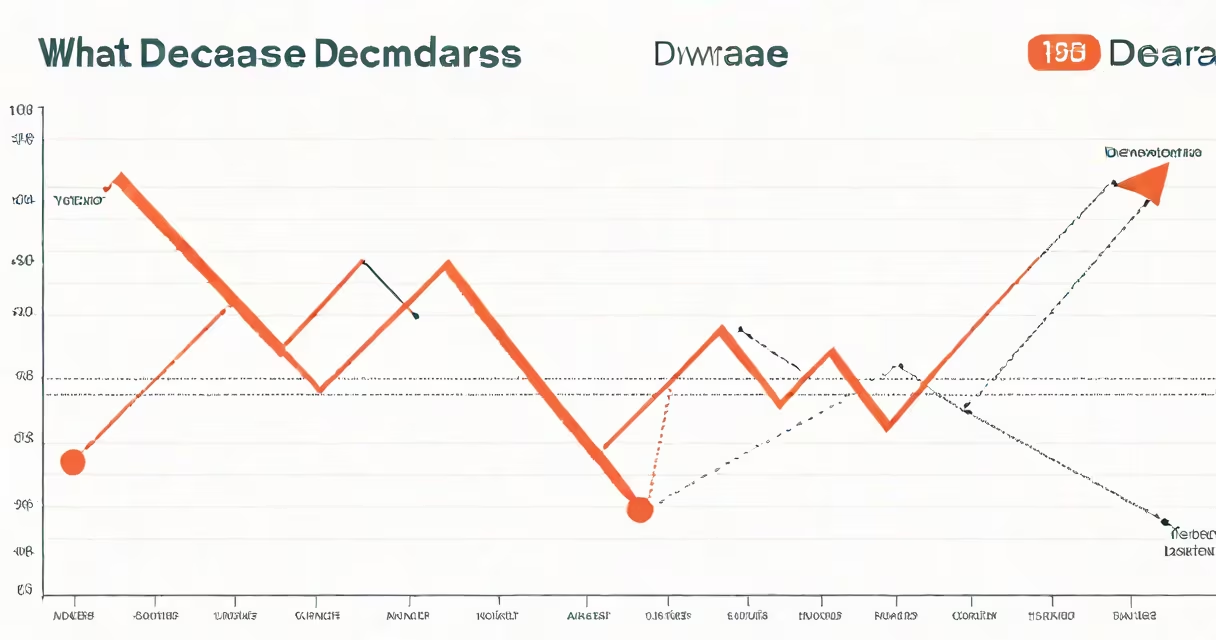
Decrease means to become smaller in quantity, size, value, or intensity. It describes a reduction in measurable or observable amounts over time or across conditions.
In practical terms, decrease appears when something goes down-like temperature, speed, cost, or population. For example, if a city's population drops from 100,000 to 95,000 in five years, it has decreased by 5,000 people.
Mathematically, decrease is expressed as a negative change. If sales were $10,000 last month and $8,500 this month, the decrease is $1,500. This concept applies across fields: physics (velocity decreasing), economics (inflation rate dropping), and biology (enzyme activity declining).
Decrease occurs when a variable moves in the opposite direction of increase. It is often measured as a difference between two values: new value minus original value. A negative result confirms a decrease.
For instance, a car traveling at 60 mph slows to 45 mph. The change is 45 − 60 = −15 mph. The negative sign indicates a decrease in speed. This pattern holds whether tracking weight loss, stock prices, or pollution levels.
Time-based decreases show trends. A graph plotting monthly energy consumption over a year may show a steady downward slope, indicating consistent decrease due to efficiency upgrades or reduced usage.
Decrease appears in different forms depending on context. The most common types include:
| Type | Description | Example |
|---|---|---|
| Linear decrease | Constant reduction over time | Water level dropping 2 inches per day |
| Exponential decrease | Faster reduction early, slowing later | Radioactive decay of carbon-14 |
| Step decrease | Sudden drop in value | Stock price falling from $50 to $30 overnight |
Linear decreases are predictable and easy to model. Exponential decreases follow formulas like N(t) = N₀ × e^(-kt), used in pharmacokinetics and environmental science. Step decreases reflect abrupt changes-common in markets or system failures.
One non-obvious point: decrease doesn't always imply harm. In medicine, a patient's fever decreasing from 103°F to 100°F signals recovery. In manufacturing, reducing material waste is a positive outcome.
People often mistake "decrease" for "stop" or "end." A decrease means a reduction, not elimination. If a company's profits drop from $1 million to $800,000, they've decreased-but still exist. They haven't gone to zero.
Another error is equating "decrease" with "bad." While a decrease in income may be concerning, a decrease in blood pressure can be beneficial. Context determines whether the change is positive or negative.
"Decline" and "fall" are often used interchangeably with "decrease," but they carry subtle differences. Decline implies a gradual, sometimes irreversible drop-often used in social or economic contexts. Fall suggests a sudden drop, like a stock market crash. Decrease is neutral and precise.
Consider a household that uses 400 kWh of electricity in January and 320 kWh in February. The decrease is calculated as:
320 kWh − 400 kWh = −80 kWhThis represents an 80-kWh decrease. To express it as a percentage:
(80 ÷ 400) × 100 = 20%The household reduced energy use by 20%. This kind of analysis helps identify conservation success and informs policy decisions.
I monitored my home's energy consumption for six months using a smart meter. After installing LED bulbs and adjusting thermostat settings, monthly usage dropped from an average of 380 kWh to 310 kWh-a 18.4% decrease. The data confirmed that small behavioral changes yield measurable results.
Understanding "decrease" requires knowing related concepts. "Reduce" is a synonym but often implies intentional action. "Lower" is a verb or adjective describing position or value. "Drop" is informal and often implies rapid or unexpected decline.
For example: "The government reduced taxes" (intentional), "The temperature dropped suddenly" (unexpected), "Sales have declined steadily" (gradual, possibly negative).
When discussing percentages, always clarify base values. A 50% decrease in a $10 item means it now costs $5. But a 50% decrease in a $100 item means it now costs $50. The absolute change differs even when the percentage is the same.
Use of "decrease" in scientific writing follows strict conventions. According to the American Psychological Association (APA) Style Guide, researchers must report changes: "There was a significant decrease in anxiety scores (M = 4.2, SD = 1.1) after treatment." This format ensures reproducibility and precision.
Another authority, the National Institute of Standards and Technology (NIST), defines decrease in measurement science as "a reduction in magnitude relative to a reference point." This formal definition supports consistency in engineering and quality control.
Final note: "decrease" is not a synonym for "negative." A negative number indicates direction, while decrease describes change. You can have a negative value (e.g., −5°C) without a decrease-it's just cold. A decrease happens when you go from −3°C to −5°C.
Understanding what decrease means enables accurate interpretation of data across disciplines-from personal finance to climate science. It is a foundational term for analyzing trends, evaluating performance, and making informed decisions.