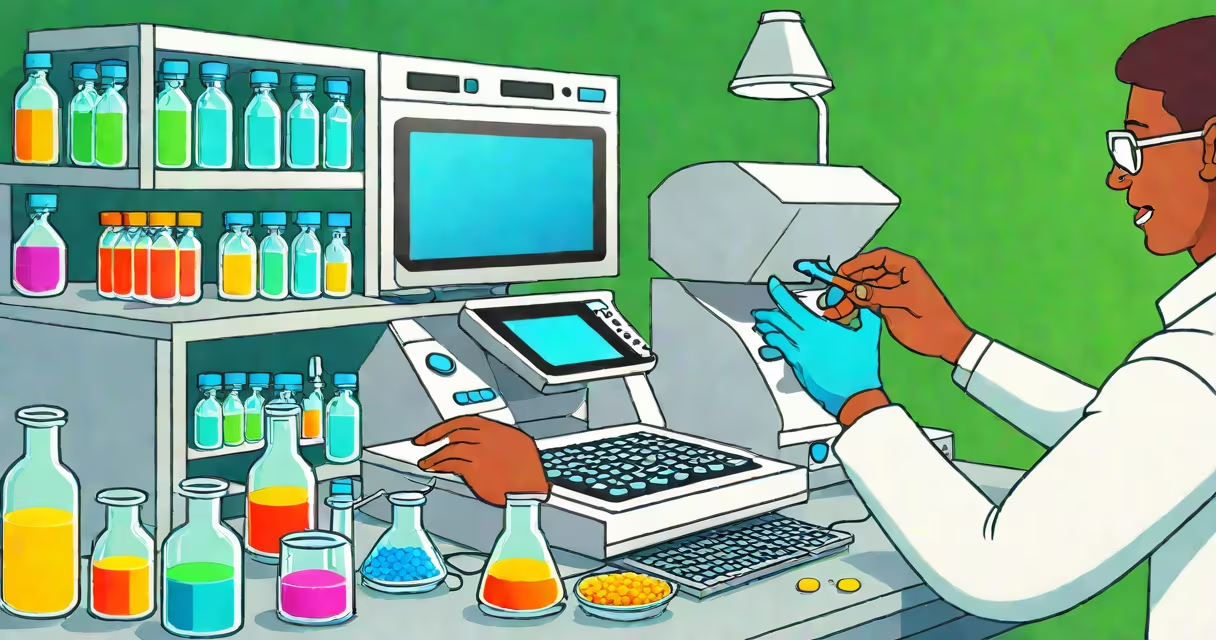
PCR, or polymerase chain reaction, makes millions of copies of a specific DNA segment from a small original sample. It enables scientists to analyze genetic material that would otherwise be too scarce for testing.
PCR works by cycling temperatures to separate DNA strands, bind primers, and extend new strands using a heat-stable enzyme. This process repeats 20-40 times, doubling the target DNA each cycle. After 30 cycles, one DNA molecule becomes about a billion copies.
The technique was developed in 1983 by Kary Mullis, who won the Nobel Prize in Chemistry in 1993 for the breakthrough. Today, PCR is standard in medical diagnostics, criminal investigations, and genetic research.
PCR begins with a DNA sample containing the target sequence. The sample is mixed with primers-short synthetic DNA sequences that match the start and end of the region of interest. A heat-stable DNA polymerase enzyme is added, along with nucleotides (A, T, C, G).
The mixture is placed in a thermal cycler, which automates temperature changes. First, high heat (95°C) separates the double helix into single strands. Then, lower temperature (55-65°C) allows primers to bind to their complementary sequences. Finally, moderate heat (72°C) activates the polymerase to build new strands by adding matching nucleotides.
This three-step cycle runs 20-40 times. Each round doubles the amount of target DNA. After 30 cycles, a single copy becomes 1,073,741,824 copies. The result is enough DNA to detect, sequence, or analyze.
Standard PCR amplifies known DNA regions. Real-time PCR (qPCR) measures DNA quantity during amplification, useful in viral load testing. Reverse transcription PCR (RT-PCR) converts RNA into DNA first, then amplifies it-key for detecting RNA viruses like SARS-CoV-2.
| Type | Use Case | Key Feature |
|---|---|---|
| Standard PCR | Genetic screening, paternity tests | End-point analysis; visualized via gel electrophoresis |
| Real-time PCR (qPCR) | Cancer biomarker quantification, viral load monitoring | Measures fluorescence in real time; provides quantitative results |
| Reverse Transcription PCR (RT-PCR) | SARS-CoV-2 testing, gene expression studies | Converts RNA to cDNA before amplification |
For example, RT-PCR detected SARS-CoV-2 in nasal swabs by converting viral RNA into DNA, then amplifying a specific 100-base-pair segment. The CDC validated this method early in the pandemic, making it the global standard for diagnosis.
PCR does not create new genetic information. It only copies existing sequences. The amplified DNA is identical to the original-no mutations are introduced during the process, assuming proper reagents and conditions.
Many assume PCR detects diseases directly. It doesn't. It amplifies DNA, and a follow-up test-like sequencing or a probe hybridization-must confirm what the DNA codes for. For instance, PCR can show HIV DNA in blood, but a separate assay confirms whether the virus is active.
A lesser-known fact: PCR efficiency drops sharply beyond 40 cycles. Beyond that, non-specific binding increases, leading to false signals. Most labs cap cycles at 35-40 to maintain accuracy. The National Institutes of Health notes that exceeding recommended cycle numbers can produce misleading results in clinical settings.
In a 2018 case, a suspect's DNA was found on a knife used in a murder. Only 10 nanograms of DNA were recovered-too little for direct analysis. Scientists used PCR to amplify 15 short tandem repeat (STR) loci, which are highly variable regions used in identification.
After 32 cycles, the DNA was amplified enough to generate a profile. The profile matched the suspect's database entry with 99.9% confidence. The court admitted the PCR results as evidence. This case illustrates how PCR turns trace biological evidence into actionable data.
I once ran a PCR experiment in a university lab to identify a bacterial contaminant in a cell culture. The initial sample had barely visible DNA under a microscope. After 35 cycles, the product showed a clear band on a gel. The sequence matched *E. coli* in the NCBI database. That moment confirmed contamination-without PCR, we'd have missed it entirely.
PCR is not sequencing. It doesn't read the order of bases-it copies them. Sequencing determines the actual sequence, while PCR makes many copies for later analysis.
It's also not a standalone diagnostic tool. PCR requires context. A positive result means the target DNA is present-but not whether it's functional, harmful, or part of a pathogen. Interpretation depends on additional data.
Some confuse PCR with CRISPR editing. PCR amplifies DNA; CRISPR edits it. They're often used together-PCR verifies edits made by CRISPR-but they serve different purposes.