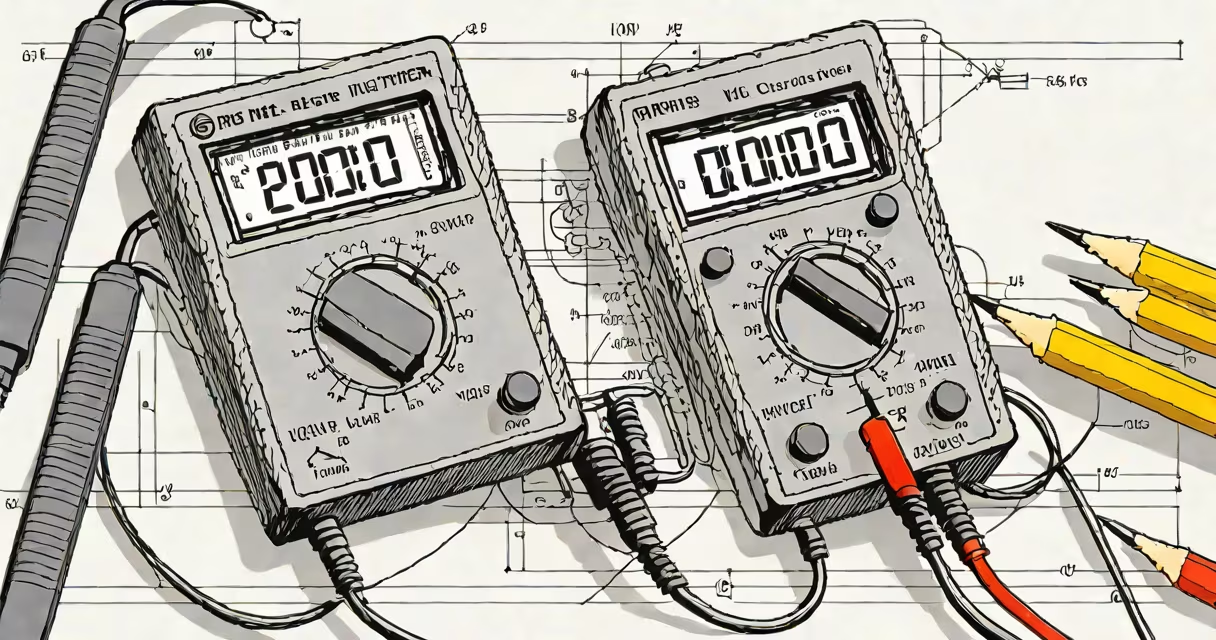
A true RMS meter measures the effective value of an alternating current (AC) signal by calculating the root mean square of the waveform's instantaneous values, providing accurate readings regardless of waveform distortion. This differs from average-responding meters, which assume a pure sine wave and can misread non-sinusoidal signals.
True RMS meters are essential in industrial, HVAC, and electronics work where waveforms often deviate from ideal sine shapes due to variable frequency drives, switching power supplies, or nonlinear loads. They deliver correct measurements of voltage, current, and power under real-world conditions.
For example, a standard average-responding multimeter may read 110 volts on a 120-volt motor with harmonic distortion-but a true RMS meter will show the actual effective voltage, which could be 118 volts. This difference impacts safety, efficiency, and equipment performance.
True RMS meters compute the square root of the average of the squared instantaneous values of a waveform over time. Mathematically, this is expressed as:
VRMS = √(1/T × ∫₀ᵀ v(t)² dt)This method ensures accuracy even when the waveform is clipped, flattened, or contains harmonics. The meter samples the input signal thousands of times per second, squares each sample, averages them, then takes the square root.
Modern true RMS meters use analog multipliers or digital signal processors (DSPs) to perform this calculation in real time. High-end models sample at 100 kHz or higher, capturing fast transients and complex waveforms common in modern power systems.
According to the IEEE Standard 1057-2019 for Digital Multimeters, true RMS instruments must maintain accuracy within ±1% of full scale for sinusoidal inputs and ±2% for non-sinusoidal waveforms up to 1 kHz. This standard defines acceptable performance levels for professional-grade tools.
True RMS meters fall into two categories based on their measurement method:
| Type | Measurement Method | Best For | Accuracy Range |
|---|---|---|---|
| Analog True RMS | Continuous analog computation using multiplier ICs | Industrial control panels, older equipment | ±1.5% typical |
| Digital True RMS | ADC sampling + DSP algorithms | Modern electronics, variable speed drives | ±0.5% to ±1% |
Digital true RMS meters dominate the market today. Brands like Fluke, Keysight, and Hioki produce models rated for frequencies up to 100 kHz and capable of measuring both AC and DC components simultaneously.
For instance, the Fluke 87V True RMS multimeter measures AC voltage from 40 Hz to 100 kHz with 0.5% accuracy. It includes features like auto-ranging, overload protection, and a high-resolution display-critical for troubleshooting variable-frequency drives in manufacturing plants.
Many users assume all digital multimeters are true RMS. That's incorrect. A basic multimeter may claim "RMS" capability but actually measure average voltage and scale it assuming a sine wave. These are called "average-responding RMS-calibrated" meters and fail on non-sinusoidal signals.
For example, a sawtooth waveform with a peak of 10 volts has a true RMS value of approximately 5.77 volts. An average-responding meter calibrated for sine waves would read 6.37 volts-over 10% error. This discrepancy can lead to incorrect fault diagnosis or unsafe equipment operation.
Another misconception is that true RMS meters are only needed for high-frequency applications. In reality, even 60 Hz circuits with dimmer switches, LED lighting, or motor controllers generate harmonic distortion. A true RMS meter catches these issues early.
I once measured a 120 V AC line feeding a commercial kitchen's refrigeration unit. The average-responding meter showed 118 V. The true RMS meter reported 124 V-indicating significant harmonic content. Replacing the faulty contactor resolved a recurring breaker trip. Without true RMS, the issue would have remained undetected.
Use a true RMS meter whenever you're working with:
These systems generate non-sinusoidal waveforms. Even small deviations from a sine wave can cause average-responding meters to report errors exceeding 10%.
The National Fire Protection Association (NFPA) 70E standard requires electricians to use tools that provide accurate measurements during arc flash risk assessments. True RMS meters meet this requirement because they reflect actual energy levels in conductors.
For home users, a true RMS meter is overkill unless dealing with smart home devices, solar inverters, or audio amplifiers. But for professionals, it's not optional-it's a safety requirement.
Understanding the gap between true RMS and average-responding meters clarifies why one is superior in most technical settings.
| Feature | True RMS Meter | Average-Responding Meter |
|---|---|---|
| Waveform Assumption | No assumption; measures actual RMS | Assumes sine wave |
| Measurement Error (on distorted waveforms) | Less than 2% | Can exceed 10% |
| Use Case | Industrial, HVAC, electronics, power quality | Simple AC circuits with clean sine waves |
| Cost | $100-$500+ | $20-$80 |
As a rule, if your test circuit includes any form of electronic load-like a computer, inverter, or dimmer-use a true RMS meter. Otherwise, you risk underestimating voltage, current, or power draw.
For reference, the International Electrotechnical Commission (IEC) 61010-1 specifies safety requirements for electrical test equipment, including true RMS capabilities. Devices labeled "true RMS" must comply with these standards to ensure consistent performance across global markets.
A true RMS meter delivers accurate measurements of AC signals by computing the actual effective value, regardless of waveform shape. It is not a luxury-it is a necessity in modern electrical systems where distortion is common.
Always verify that your multimeter is truly true RMS. Look for the "true RMS" label, check the datasheet for compliance with IEC 61010-1 or IEEE 1057, and avoid relying on "RMS" claims without verification.
For those exploring conditional logic in programming, understanding the concept of accurate measurement parallels the need for precise evaluation in code-just as if true in python requires correct boolean logic, a true RMS meter ensures correct electrical analysis.