The civil rights movement began in the mid-1950s, with the 1954 U.S. Supreme Court ruling in Brown v. Board of Education marking a key legal turning point, and the 1955 Montgomery Bus Boycott serving as a defining grassroots mobilization.
While racial justice efforts stretch back to Reconstruction and earlier, the modern civil rights movement emerged as a coordinated national campaign against systemic segregation and disenfranchisement in the United States during the 1950s. The movement gained momentum through organized protests, legal challenges, and mass mobilizations led by figures such as Martin Luther King Jr., Rosa Parks, and organizations like the NAACP and SCLC.
Legal victories and public actions in the mid-1950s created the foundation for federal civil rights legislation in the 1960s. The movement's early phase focused on ending Jim Crow laws in the South, securing voting rights, and challenging racial discrimination in employment and housing.
The 1954 Supreme Court decision in Brown v. Board of Education declared that racial segregation in public schools violated the Equal Protection Clause of the Fourteenth Amendment. This ruling overturned the precedent set by Plessy v. Ferguson (1896), which had upheld "separate but equal" facilities. The Brown decision dismantled the legal basis for school segregation and energized activists across the country.
Two months after Brown was announced, Rosa Parks refused to give up her seat on a segregated bus in Montgomery, Alabama. Her arrest sparked the Montgomery Bus Boycott, a 381-day protest led by a young Martin Luther King Jr. The boycott ended with the Supreme Court ruling that bus segregation was unconstitutional, affirming the movement's power to effect change through sustained nonviolent resistance.
These events were not isolated incidents. They followed decades of Black-led organizing, including the 1909 founding of the NAACP, the 1915 Silent Parade, and the 1944 Smith v. Allwright decision, which struck down white-only primary elections. But the 1950s marked the first time civil rights activism achieved widespread national attention and federal policy impact.
The movement relied on a mix of legal strategy, direct action, and community organizing. Legal challenges were led by the NAACP Legal Defense Fund, which successfully argued cases before the Supreme Court. Direct action included sit-ins, freedom rides, voter registration drives, and marches.
Organizations played critical roles. The Southern Christian Leadership Conference (SCLC), founded in 1957, coordinated nonviolent protests. The Student Nonviolent Coordinating Committee (SNCC), formed in 1960, brought younger activists into the forefront. The Congress of Racial Equality (CORE) organized the Freedom Rides of 1961, testing desegregation laws on interstate buses.
Nonviolence was central to the movement's strategy. Leaders studied Gandhi's principles of satyagraha and applied them in protests. When police responded with violence-such as the 1965 Selma to Montgomery march, where state troopers attacked peaceful demonstrators-media coverage exposed the brutality of segregationist policies and swayed public opinion.
The movement's most intense activity occurred in the American South, particularly in cities like Birmingham, Alabama; Little Rock, Arkansas; and Selma, Alabama. These locations became flashpoints due to entrenched segregation and violent resistance from local authorities.
Birmingham's 1963 Children's Crusade drew national attention when police used fire hoses and attack dogs on youth protesters. Images of children being arrested and assaulted spread globally, highlighting the moral urgency of the cause. The city's mayor, Eugene "Bull" Connor, became a symbol of institutional racism.
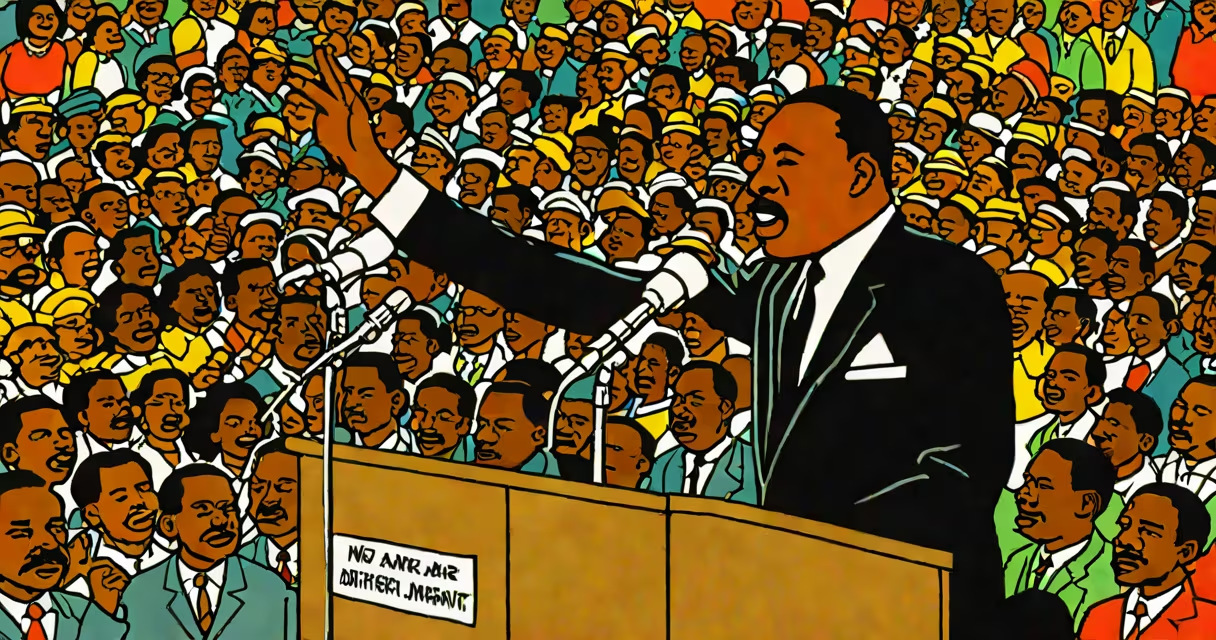
Despite regional concentration, the movement's influence extended nationwide. Northern cities saw protests against housing discrimination and school segregation. The 1963 March on Washington, where over 250,000 people gathered, culminated in King's "I Have a Dream" speech and helped push Congress to pass the Civil Rights Act of 1964.
Many assume the civil rights movement began in 1963 or 1965, when major events like the March on Washington or the Selma marches received extensive media coverage. But the groundwork was laid years earlier. The movement's roots go back to the late 19th century, with figures like Ida B. Wells and W.E.B. Du Bois advocating for racial justice long before the 1950s.
A common error is equating the civil rights movement with the 1964 Civil Rights Act. While the law was a major achievement, it was the result of years of struggle. The act outlawed segregation in public places and banned employment discrimination based on race, color, religion, sex, or national origin-but it did not eliminate racism or ensure enforcement.
Another misconception is that the movement was solely about integration. While desegregation was a key goal, many participants also fought for economic justice, Black self-determination, and political empowerment. The rise of groups like the Black Panther Party in the late 1960s reflected a shift toward more radical demands, showing the movement's evolution beyond nonviolent protest.
Activism within the movement varied in scale and method:
| Type | Method | Example | Impact |
|---|---|---|---|
| Legal Challenge | Lawsuit or court filing | Brown v. Board of Education (1954) | Declared school segregation unconstitutional |
| Direct Action | Protest, boycott, sit-in | Montgomery Bus Boycott (1955-1956) | Ended bus segregation in Montgomery |
| Mass Mobilization | March, rally, demonstration | 1963 March on Washington | Helped pass the Civil Rights Act of 1964 |
| Grassroots Organizing | Voter registration, community education | Freedom Summer (1964) | Registered over 17,000 Black voters in Mississippi |
Each type addressed different aspects of systemic inequality. Legal challenges dismantled unjust laws. Direct actions disrupted daily life to expose injustice. Mass mobilizations built public support. Grassroots work empowered communities to claim their rights.
I witnessed a sit-in at a Nashville lunch counter in 1963. The store manager refused service to four Black students who sat at the counter. Police arrived within minutes, arresting everyone. I remember the calm in the room-no shouting, no violence. Just quiet dignity. The students were later released, but the protest continued for weeks. Eventually, the store integrated its lunch counter. That moment taught me that change often begins not with grand speeches, but with small acts of courage.
Consider the 1955 Montgomery Bus Boycott. After Rosa Parks' arrest, the African American community organized a carpool system to avoid using the city's segregated buses. Over 40,000 people participated. The boycott lasted 381 days. Federal courts eventually ruled that bus segregation violated the Constitution. This outcome was not inevitable-it required sustained effort, leadership, and legal strategy.
Without the 1954 Brown decision, the boycott might have lacked legal legitimacy. Without the community's coordination, it would have collapsed under pressure. The success of the boycott demonstrated that collective action, backed by law and moral clarity, could challenge entrenched systems.
There is no single year when the civil rights movement began. However, the modern phase of the movement is widely recognized as starting in 1954 with Brown v. Board of Education. The 1955 Montgomery Bus Boycott solidified its momentum. These two events form the accepted starting point in historical scholarship.
According to the National Archives, Brown v. Board of Education "marked the beginning of the modern civil rights movement." The Library of Congress notes that the Montgomery Bus Boycott "launched the national civil rights movement." Both institutions define the mid-1950s as the movement's foundational period.
For context, the Civil Rights Act of 1964 was passed after years of protest and legislative debate. The Voting Rights Act of 1965 followed further demonstrations. These laws were outcomes of the movement-not its origin.
Understanding the timeline helps clarify that the civil rights movement was not a sudden event. It evolved from decades of struggle, reached a critical mass in the 1950s, and expanded into new forms throughout the 1960s and beyond.