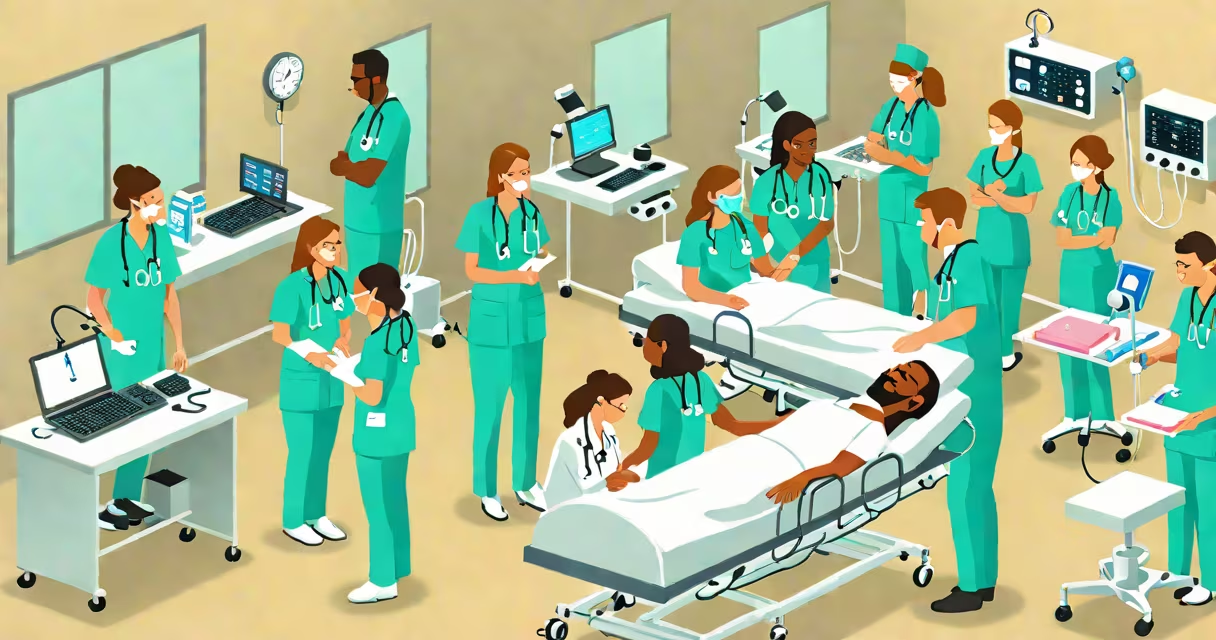
Accelerated nursing is a condensed, full-time educational pathway that allows individuals with a bachelor's degree in a non-nursing field to earn a Bachelor of Science in Nursing (BSN) in 12 to 18 months. These programs compress two to three years of standard nursing curriculum into a single intensive academic cycle, preparing graduates to sit for the NCLEX-RN exam and begin working as registered nurses.
Unlike traditional four-year BSN programs, accelerated nursing tracks start in the summer or fall and run continuously through the year, including weekends and holidays. Students complete clinical rotations in hospitals, clinics, and community health settings while taking advanced coursework in anatomy, pharmacology, maternal-child health, and psychiatric nursing. The intensity demands full-time commitment, with 40 to 60 hours per week spent in class, labs, and clinical placements.
The U.S. Bureau of Labor Statistics reports that registered nurses earned a median annual wage of $77,600 in 2022, with employment projected to grow 6% from 2022 to 2032-faster than average. Accelerated nursing programs serve as a direct route into this growing field, especially for professionals seeking a career shift after completing degrees in biology, psychology, or business.
These programs follow a cohort model, meaning all students progress through the same sequence of courses together. This structure fosters peer collaboration and ensures consistent pacing. Most programs begin with foundational science courses-such as pathophysiology and medical-surgical nursing-before advancing into specialty areas like pediatrics, gerontology, and critical care.
Clinical experiences are embedded throughout the curriculum. For example, a student in an accelerated program at the University of California, San Francisco, completes 1,000 hours of supervised clinical practice across eight different specialties during their 15-month program. These rotations occur in teaching hospitals and outpatient centers, giving students hands-on exposure to real patient populations under faculty supervision.
Admission is highly competitive. Applicants typically need a minimum 3.0 GPA in their undergraduate degree, completed prerequisite courses in chemistry, microbiology, and statistics, and strong performance on the TEAS exam. Some schools require interviews or letters of recommendation. The average acceptance rate for top-tier accelerated programs is below 20%, reflecting high demand and limited seats.
There are two primary types of accelerated nursing programs: those for career changers and those for licensed practical nurses (LPNs) or licensed vocational nurses (LVNs) seeking advancement. The most common form is the post-baccalaureate accelerated BSN, designed for individuals with a bachelor's degree in another discipline.
| Program Type | Duration | Eligibility | Typical Start Date |
|---|---|---|---|
| Post-Baccalaureate Accelerated BSN | 12-18 months | Bachelor's degree in any field; completed prerequisites | Summer or Fall |
| LPN-to-BSN Accelerated Track | 18-24 months | Licensed practical nurse; associate degree or diploma in nursing | Spring or Fall |
Another variation is the RN-to-BSN accelerated program, which allows licensed registered nurses with an associate degree to earn a BSN in 12 to 18 months. These programs often offer online coursework with on-site clinical requirements, making them accessible to working nurses.
A lesser-known but growing option is the accelerated nursing bridge program for individuals with advanced degrees in science or public health. For example, Columbia University offers a 14-month track for PhD holders in biology or environmental science who wish to enter clinical nursing roles.
Many assume accelerated nursing programs are less rigorous than traditional paths. This is incorrect. According to the National League for Nursing, accelerated programs maintain the same academic standards and clinical competencies as standard BSN programs. Graduates pass the NCLEX-RN at rates comparable to their peers-averaging 89% national pass rate in 2023, per the NCSBN.
Another misconception is that these programs only accept recent college graduates. In reality, many applicants are mid-career professionals. A 2022 study published in the Journal of Nursing Education found that 43% of students in accelerated nursing programs were over 30 years old, with backgrounds in engineering, finance, and healthcare administration.
Some confuse accelerated nursing with online nursing degrees. While some accelerated programs offer hybrid formats, they still require in-person clinicals and lab sessions. Fully online programs do not qualify as accelerated nursing unless they meet state board of nursing accreditation standards and include supervised clinical hours.
In 2021, Sarah Thompson, a former marine biologist with a bachelor's in environmental science, enrolled in the accelerated nursing program at George Washington University. She had no prior healthcare experience but completed 15 weeks of pre-requisite courses in human physiology and biostatistics before starting the program.
Over the next 15 months, she took 18 credit hours per semester, attended daily lectures, and completed clinical shifts in internal medicine, emergency care, and obstetrics. Her final semester included a 12-hour shift in the ICU, where she assisted with ventilator management under direct supervision.
After passing the NCLEX-RN on her first attempt, Sarah secured a position as a staff nurse at a Level 1 trauma center in Washington, D.C., earning $82,000 annually. She attributes her success to the program's structured timeline and early clinical immersion.
Accelerated nursing is ideal for individuals with a bachelor's degree who want to transition into healthcare quickly. It appeals to people seeking job stability, higher income potential, and meaningful work. The median salary for RNs exceeds $75,000, and many states offer loan forgiveness for nurses who work in underserved areas.
These programs are not suited for part-time learners or those unable to commit to full-time study. The workload is equivalent to a full-time job, with little time for outside employment. Students must have strong organizational skills, emotional resilience, and access to support systems.
Accelerated nursing is not a shortcut-it is a focused, high-intensity route to becoming a registered nurse. It demands dedication, but for qualified candidates, it delivers a clear path to a stable, impactful career in healthcare.