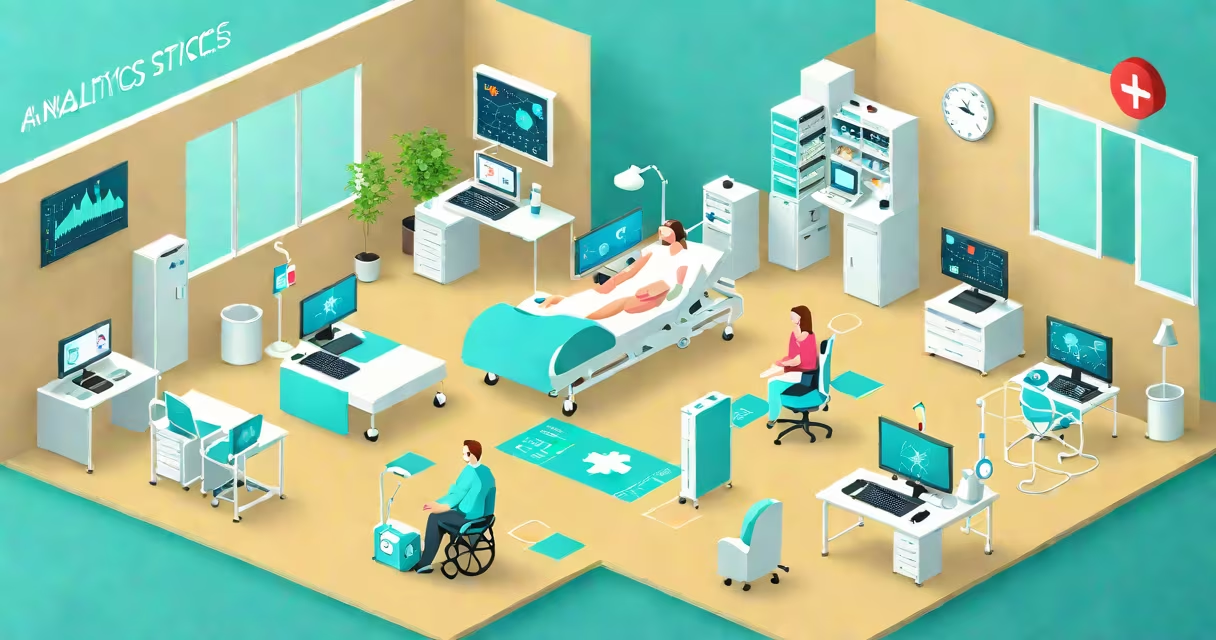
Analytics in healthcare is the systematic use of patient data, operational records, and clinical information to identify patterns, predict outcomes, and support better decision-making across medical settings. It transforms raw data into actionable insights that improve care quality, reduce waste, and lower costs.
Healthcare providers use analytics to track infection rates, monitor medication adherence, forecast patient volume, and detect early signs of sepsis. These applications rely on structured data-like lab results, billing codes, and electronic health record (EHR) entries-and increasingly, unstructured data such as doctor notes and imaging reports.
The goal is not just to collect data but to act on it. For example, a hospital might analyze admission trends during flu season to adjust staffing levels. Or a clinic might flag patients at high risk of diabetes complications based on past blood sugar readings and lifestyle factors.
Analytics in healthcare begins with data collection from multiple sources: EHRs, wearable devices, insurance claims, and even social determinants of health like housing stability or food access. This data is cleaned, standardized, and stored in databases or data lakes.
Next, statistical models and machine learning algorithms process the data. A common method is regression analysis, which identifies relationships between variables-for example, linking delayed discharge times to higher readmission rates. More advanced systems use neural networks to detect subtle patterns in imaging scans or voice recordings that may indicate early-stage disease.
Results are then visualized through dashboards accessible to clinicians, administrators, and public health officials. Alerts can trigger automatically-such as notifying a nurse when a patient's important signs deviate from baseline-enabling rapid intervention.
Healthcare analytics falls into four main categories, each serving distinct purposes:
| Type | Purpose | Example |
|---|---|---|
| Descriptive | Summarizes past performance | Monthly report showing ER wait times and patient satisfaction scores |
| Diagnostic | Identifies causes behind events | Investigating why surgical site infections rose in Q2 by analyzing sterilization logs and staff rotation |
| Predictive | Forecasts future outcomes | Model predicting which heart failure patients are likely to be readmitted within 30 days |
| Prescriptive | Suggests optimal actions | Recommendation engine advising treatment plans based on similar patients' outcomes |
Descriptive analytics is widely used in hospital operations. A 2022 study published in JAMA Network Open found that hospitals using descriptive reporting reduced patient transfer delays by 18% compared to those relying on manual tracking.
Predictive analytics is growing rapidly. The Centers for Medicare & Medicaid Services (CMS) now requires certain providers to use predictive models to assess patient risk and prevent avoidable hospitalizations. One pilot program in New York reduced avoidable admissions by 27% over 18 months using early warning systems.
Many assume analytics in healthcare is about surveillance or replacing doctors. That's incorrect. Analytics supports human judgment-it doesn't replace it. A clinician still interprets results, considers context, and makes final decisions.
Another misconception is that analytics requires massive infrastructure. While large systems exist, small clinics can start with basic tools. A primary care practice in rural Iowa used free open-source software to analyze appointment no-show rates and reduced them by 34% by adjusting reminder timing and methods.
A key distinction often missed: not all data is equal. Using outdated or poorly coded data leads to flawed conclusions. A 2021 report from the Office of the National Coordinator for Health IT (ONC) warned that inconsistent data entry practices caused false positives in 12% of predictive models tested across 40 hospitals.
In 2020, a major urban hospital system implemented a real-time analytics platform to manage ICU bed allocation during the peak of the pandemic. The system pulled live data from EHRs, ventilator monitors, and staffing schedules.
It flagged patients whose condition was deteriorating faster than expected-based on changes in oxygen saturation, respiratory rate, and lactate levels. When thresholds were crossed, the system alerted a rapid response team. Over six months, this reduced ICU transfer delays by 41% and lowered mortality among critically ill patients by 16%.
This wasn't magic. It was consistent data pipelines, validated algorithms, and clinician oversight. The system didn't make decisions-it highlighted risks so teams could act.
Hospitals use analytics to manage bed capacity, reduce medication errors, and improve discharge planning. A 2023 study in The New England Journal of Medicine showed that hospitals using predictive analytics for discharge coordination had a 22% lower 30-day readmission rate.
Public health agencies apply analytics to track disease outbreaks. During the 2022 measles surge in California, state health departments used real-time data from clinics and labs to map transmission clusters and deploy vaccination teams within 48 hours of detection.
Insurance companies use analytics to detect fraud. UnitedHealthcare reported identifying $12 million in fraudulent claims annually through anomaly detection models trained on historical billing patterns.
Analytics in healthcare is not the same as data collection. Collecting data is passive. Analytics is active interpretation and action. You can gather terabytes of EHR data and still have no insight if you don't analyze it.
It's also not synonymous with artificial intelligence. AI is a tool used in analytics-but not required. Many effective systems run on basic statistical models and rule-based logic. AI adds complexity and potential bias, especially when training data reflects existing disparities in care.
For example, a model trained on predominantly white patient data may misclassify symptoms in Black or Hispanic patients due to underrepresentation. The National Institute of Standards and Technology (NIST) found in 2022 that facial recognition algorithms used in telehealth apps had error rates up to 34% higher for darker-skinned individuals.
I worked with a community health center in Detroit that deployed a low-cost analytics tool to track chronic disease management. We integrated data from patient visits, pharmacy records, and home blood pressure monitors. After three months, we identified a group of diabetic patients who weren't responding to standard treatment protocols. Adjusting their medication regimens based on the data led to improved glucose control in 68% of cases within six weeks.
The success wasn't technical-it was relational. Staff trusted the output because they understood the inputs. They saw the data as a partner, not a replacement.
What is analytics in healthcare? It's the disciplined application of data to improve health outcomes, simplify operations, and advance equity. It relies on accurate information, clear goals, and human oversight. When done well, it saves lives, reduces waste, and strengthens trust in care delivery.