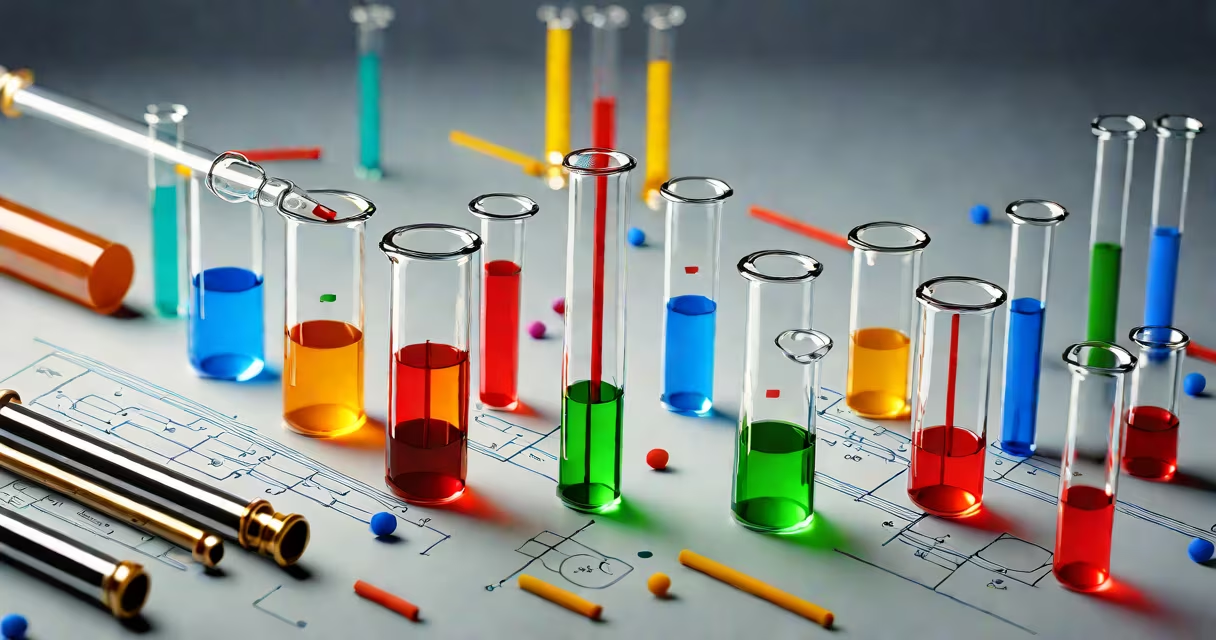
Compounds are pure substances formed when two or more different atoms chemically bond together in a fixed ratio. These bonds result in new substances with distinct physical and chemical properties unlike those of their individual elements. Water (H₂O), for example, is a compound made from hydrogen and oxygen atoms joined by covalent bonds.
Atoms from different elements interact through electron sharing or transfer to achieve stable electron configurations. This process forms chemical bonds-covalent, ionic, or metallic-depending on the atoms involved. The resulting compound has a unique structure and behavior that cannot be predicted by studying the elements alone.
For instance, sodium (Na) is a reactive metal, and chlorine (Cl) is a toxic gas. When they react, they form sodium chloride (NaCl)-common table salt-a stable, edible compound. This illustrates how combining elements creates entirely new materials with practical uses.
Compounds arise through chemical reactions driven by energy changes. Atoms seek lower energy states by gaining, losing, or sharing electrons. In ionic bonding, one atom donates electrons to another, forming positively and negatively charged ions that attract. Sodium and chlorine form Na⁺ and Cl⁻ ions, which crystallize into solid salt.
In covalent bonding, atoms share electrons to fill their outer shells. Water forms when two hydrogen atoms each share an electron with an oxygen atom, creating polar covalent bonds. The shared electrons spend more time near oxygen due to its higher electronegativity, giving water its dipole nature and enabling hydrogen bonding.
Metals often form metallic bonds, where electrons move freely among positively charged atomic cores. While metals themselves aren't compounds, alloys like brass (copper and zinc) exhibit compound-like behavior due to ordered atomic arrangements and altered properties.
Compounds fall into categories based on their bonding and composition. The most common types are ionic, covalent, and coordination compounds.
| Type | Bonding Type | Examples | Properties |
|---|---|---|---|
| Ionic | Electron transfer | Sodium chloride (NaCl), calcium carbonate (CaCO₃) | High melting points, conduct electricity when dissolved |
| Covalent | Electron sharing | Water (H₂O), carbon dioxide (CO₂), methane (CH₄) | Lower melting points, poor electrical conductivity |
| Coordination | Ligand-metal bonds | Hemoglobin, vitamin B₁₂ | Often colored, biologically active |
Each category reflects different electron behaviors and structural outcomes. Ionic compounds typically form crystal lattices, while covalent compounds may exist as gases, liquids, or solids depending on intermolecular forces.
People often confuse mixtures with compounds. A mixture combines substances physically without chemical reaction-like sand and iron filings. No new substance forms, and components retain their original identities. In contrast, compounds involve irreversible chemical changes and fixed ratios.
Another error is assuming all compounds are harmful. Many essential compounds are safe and important. Glucose (C₆H₁₂O₆), for example, powers human cells. Without it, biological processes fail. Similarly, carbon dioxide (CO₂) supports plant photosynthesis and regulates Earth's climate.
A lesser-known fact: some compounds have multiple stable forms called polymorphs. Calcium carbonate exists as calcite, aragonite, and vaterite-each with different crystal structures and solubility rates. This affects mineral formation in oceans and limestone caves.
Compounds appear everywhere in daily life. Table salt (NaCl) seasons food and preserves meat. Carbon dioxide (CO₂) is used in carbonated drinks and fire extinguishers. Aspirin (acetylsalicylic acid) reduces pain and inflammation through targeted biochemical interaction.
Consider the synthesis of ammonia (NH₃) via the Haber-Bosch process. Nitrogen from air and hydrogen from natural gas react under high pressure and temperature to produce ammonia. This compound feeds global agriculture-over 80% of synthetic fertilizers rely on it. Without it, crop yields would drop.
On a personal note, during a college chemistry lab, I synthesized copper(II) sulfate pentahydrate from copper oxide and sulfuric acid. The reaction produced vivid blue crystals-visible evidence of a compound forming through controlled chemical change. The color arose from d-orbital electron transitions in the Cu²⁺ ion, a direct link between atomic structure and macroscopic appearance.
Compounds differ from elements and mixtures in fundamental ways. Elements consist of only one type of atom (e.g., gold, oxygen). Mixtures contain multiple substances physically blended, such as air or trail mix. Compounds require chemical bonding and fixed proportions.
For example, water always contains two hydrogen atoms and one oxygen atom per molecule. Deviations in ratio create different substances-hydrogen peroxide (H₂O₂), which is unstable and corrosive. This fixed stoichiometry defines a compound's identity.
Understanding compounds begins with recognizing that their properties emerge from atomic interactions. The behavior of a compound is not simply the sum of its parts-it's a new reality shaped by electron distribution and spatial arrangement.
What is compounds? They are the building blocks of matter beyond elemental forms-substances created through chemical bonding that define the material world around us.