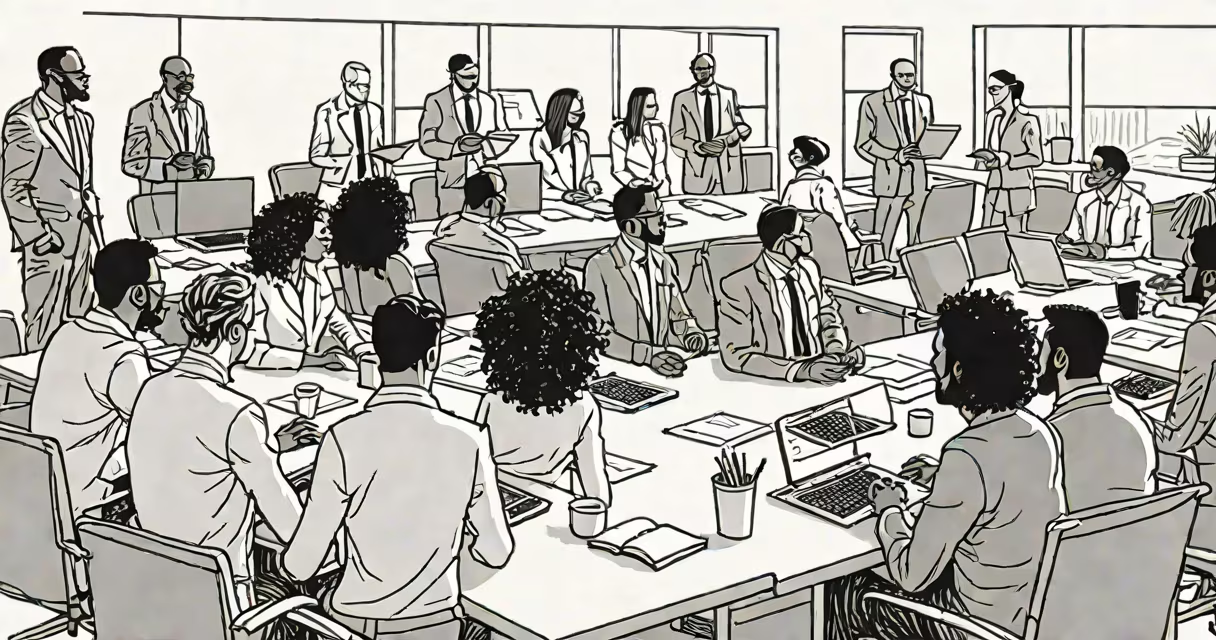
Diversity definition refers to the range of differences among individuals in a group, including race, ethnicity, gender, age, religion, disability, sexual orientation, socioeconomic status, education, and national origin. It describes variation in identity, experience, and perspective that enriches collective decision-making and innovation.
True diversity goes beyond representation. It includes equitable access to opportunity, psychological safety, and the ability of individuals to contribute meaningfully. A team with diverse backgrounds may outperform homogeneous teams in problem-solving, according to research from the Harvard Business Review.
For example, a tech company with engineers from five continents, different religious beliefs, and varied educational paths is more likely to identify edge cases in software design that a homogenous team might overlook. This practical impact underscores why diversity definition matters beyond symbolic inclusion.
Diversity definition operates through structured inclusion. It's not enough to hire people from different backgrounds. Organizations must create systems where those differences lead to better outcomes. This includes equitable hiring, mentorship programs, and feedback mechanisms that reflect lived experiences.
One study by McKinsey & Company analyzed 1,000 companies across eight countries and found that firms in the top quartile for ethnic and cultural diversity on executive teams were 36% more likely to outperform on profitability than those in the bottom quartile. The link between diversity and performance is measurable and consistent across sectors.
When diversity definition is implemented correctly, it reduces groupthink. Teams that share similar life experiences often default to familiar solutions. Diverse teams challenge assumptions. For instance, a product development team with members who grew up in rural and urban areas will consider accessibility features differently, leading to more usable designs.
Diversity isn't a single category. It includes multiple dimensions, each affecting organizational culture and effectiveness.
| Type | Definition | Example |
|---|---|---|
| Cultural | Differences in language, traditions, values, and communication styles. | A marketing team includes members from Japan, Nigeria, and Brazil, adjusting campaign tone for regional norms. |
| Gender | Variation in gender identity and expression. | A hospital leadership team includes male, female, and non-binary physicians, improving patient care for transgender individuals. |
| Age | Differences in generational perspectives and work habits. | A software firm pairs Gen Z developers with Baby Boomer IT managers to balance innovation and stability. |
| Disability | Physical, sensory, cognitive, or neurodiverse differences. | An e-learning platform adds closed captions and screen-reader compatibility after input from disabled users. |
These types aren't isolated. A person can belong to multiple groups simultaneously. A Black woman with a visual impairment brings intersecting identities that influence her workplace experience. Ignoring intersectionality leads to ineffective policies. The National Center for Education Statistics reports that students with disabilities from minority backgrounds face higher dropout rates due to unaddressed systemic barriers.
Many assume diversity definition means simply increasing the number of underrepresented people. That's surface-level. True diversity definition involves structural change and accountability. A company can have 30% women in leadership yet still lack inclusive practices if promotions rely on informal networks.
Another mistake is equating diversity with inclusion. Inclusion refers to whether people feel safe and valued. A team can be diverse but not inclusive. Research from Deloitte shows that 78% of employees in diverse teams report feeling excluded when their ideas are ignored during meetings.
There's also confusion about diversity being synonymous with "equality." Equality means giving everyone the same resources. Equity means adjusting support based on individual needs. A classroom with students from low-income families requires different funding levels than one with affluent students. Equity ensures fair outcomes, not just equal treatment.
I once led a project team tasked with redesigning a public transit app. The initial prototype failed usability testing with older adults and people with limited tech literacy. After adding two team members-one a retired teacher with visual impairments, the other a community organizer from a low-income neighborhood-the interface was redesigned with larger fonts, clearer navigation, and offline functionality.
The changes increased app adoption by 42% in pilot cities. The team didn't just improve the product-they validated that diversity definition drives real-world results. The insights came not from market research but from lived experience.
Representation counts, but it doesn't guarantee impact. A board with four women and one man is diverse in gender ratio but may still operate with a dominant culture that silences dissent. True diversity definition requires power redistribution and shared decision-making.
Consider the U.S. Congress. As of 2023, women hold 27% of seats, up from 13% in 1995. Yet legislative outcomes haven't shifted proportionally. Studies show that bills introduced by women are less likely to pass unless co-sponsored by men. This reveals that representation without influence doesn't change policy.
For diversity definition to be meaningful, institutions must measure not just who is present, but whose voices are heard and acted upon. The Equal Employment Opportunity Commission tracks workforce composition annually, but it also audits promotion patterns to detect bias.
Diversity definition is not a checklist. It's a structure for building organizations that reflect human complexity and deliver better results. It requires ongoing assessment, adaptation, and accountability.
Organizations that treat diversity definition as a program rather than a principle risk tokenism. Those that embed it into mission statements, hiring processes, and performance reviews see sustained improvement. The World Economic Forum identifies diversity as a core driver of resilience in global supply chains.