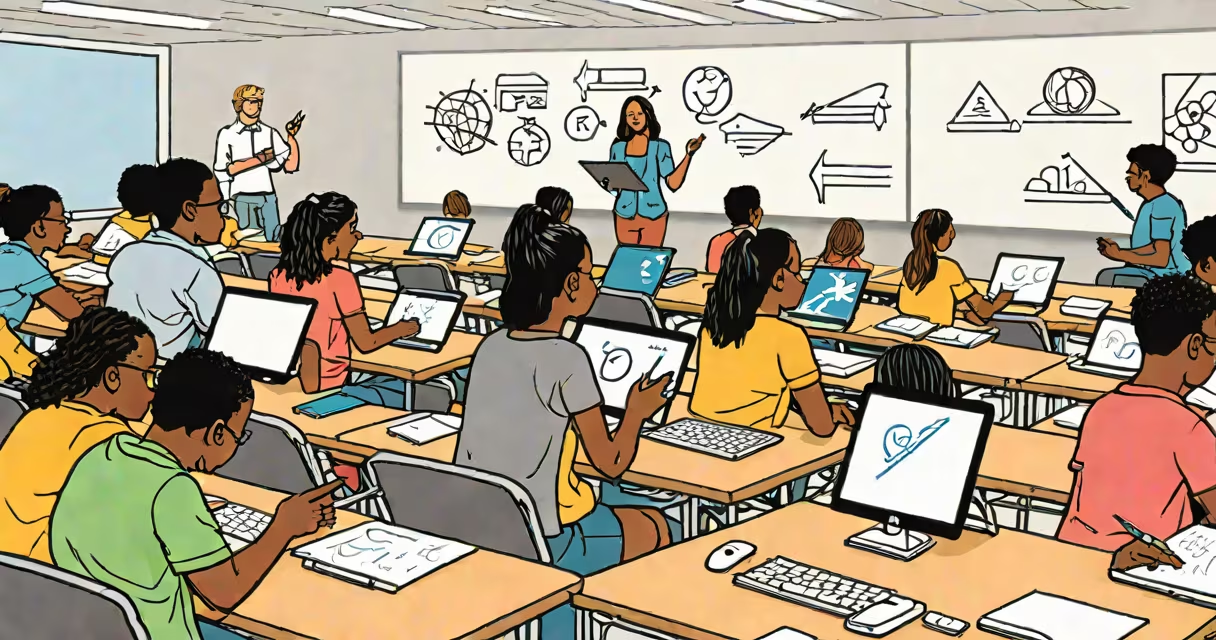
Information and communication technology in education (ICT in education) refers to the use of digital tools, software, networks, and multimedia resources to support teaching, learning, assessment, and school administration. It includes devices like computers, tablets, smartboards, learning management systems, and internet-based platforms that enable access to educational content and help interaction between students, teachers, and institutions.
ICT in education is not limited to hardware. It encompasses structured integration of technology into curricula and pedagogy. For example, a math class using online simulations to visualize algebraic functions or a history lesson where students analyze primary sources through digitized archives. These applications improve engagement, personalize learning, and allow real-time feedback.
According to UNESCO, effective ICT integration improves student outcomes by increasing motivation, supporting differentiated instruction, and enabling collaboration beyond the physical classroom. The World Bank notes that countries investing in ICT infrastructure see measurable gains in literacy and numeracy rates, especially in rural and underserved areas.
At its core, ICT in education operates through interconnected systems: devices, software, internet connectivity, and digital content. When a student logs into a school's learning management system (LMS), such as Google Classroom or Canvas, they access assignments, submit work, receive grades, and participate in discussion forums-all within a single platform. Teachers monitor progress via dashboards and adjust instruction based on analytics.
Real-time collaboration tools like shared documents or video conferencing allow synchronous learning even when students are remote. During the 2020-2021 pandemic, schools in Finland reported that 94% of secondary students continued learning through digital platforms, with minimal disruption to academic performance due to early adoption of ICT infrastructure.
Classroom workflows have evolved. Instead of paper-based grading, teachers use automated rubrics in tools like Turnitin or Microsoft Forms. Data from quizzes feed into adaptive learning platforms such as Khan Academy or DreamBox, which adjust difficulty based on individual responses. This shifts instruction from one-size-fits-all to responsive, personalized pathways.
ICT in education consists of several interdependent components. The following table outlines key categories, their functions, and real-world examples:
| Type | Function | Examples |
|---|---|---|
| Hardware | Physical devices for accessing and processing information | Laptops, tablets, interactive whiteboards, projectors |
| Software | Applications that deliver content or manage tasks | Google Workspace, Zoom, Moodle, Adobe Creative Cloud |
| Networks | Infrastructure enabling data transfer and remote access | Wi-Fi, broadband, cloud storage (e.g., iCloud, Dropbox) |
| Digital Content | Curated educational materials in electronic format | Online textbooks, videos, simulations, podcasts |
Each component plays a role in creating a functional digital learning environment. For instance, a science teacher may use a virtual lab simulation (digital content) on a tablet (hardware) while connecting to a shared document (software) during a group activity. All rely on stable internet (network).
A lesser-known distinction: not all digital tools qualify as ICT in education. A calculator app on a smartphone is a tool, but it doesn't constitute ICT unless integrated into a lesson plan with assessment goals. True ICT in education requires intentional design-tools must serve pedagogical objectives, not just replace traditional methods.
Many assume ICT in education means simply replacing chalkboards with screens. That's surface-level. Effective implementation involves restructuring how knowledge is delivered and assessed. For example, a high school in Singapore uses AI-powered chatbots to answer student queries about course schedules, freeing staff time and reducing administrative load.
Another common error is equating ICT with technology access alone. A 2022 OECD report found that 60% of schools in member nations had internet access, yet only 35% reported consistent teacher training in digital pedagogy. Without proper training, devices sit idle or are used for passive consumption-like watching videos instead of creating content.
Consider a middle school in rural Kenya that received donated tablets. Initially, students used them to play games. After introducing a curriculum-aligned app called "Kiswahili Connect," which teaches Swahili through storytelling and quizzes, reading comprehension scores rose by 28% over one academic year. The device wasn't the solution-the integration of context, language, and cultural relevance was.
I once observed a sixth-grade class in Portland using Minecraft: Education Edition to reconstruct ancient Rome. Students collaborated on building models, researched historical facts, and presented their findings via digital portfolios. The project combined spatial reasoning, research skills, and public speaking-all under a single structure. This is ICT in education: not just tech use, but purposeful, interdisciplinary application.
ICT in education supports equity, accessibility, and lifelong learning. Students with disabilities benefit from screen readers, speech-to-text software, and adjustable font sizes. Schools in low-income districts use low-bandwidth versions of platforms like Khan Academy to ensure access even with unstable connections.
Administrators use ICT for scheduling, attendance tracking, and reporting. In New York City, the Department of Education uses a centralized system to track student enrollment and resource allocation across 1,700 schools. This reduces manual errors and enables faster response to staffing or funding needs.
Higher education institutions deploy ICT for research collaboration. The University of California, Berkeley, hosts open-access repositories where faculty and students share datasets, code, and publications. These systems accelerate discovery and promote transparency in academic work.
Despite benefits, challenges remain. Cybersecurity risks, digital divides, and teacher burnout are persistent issues. A 2023 study by the National Center for Education Statistics found that 41% of U.S. teachers felt unprepared to integrate new technologies into their lessons. Training must accompany rollout.
Information and communication technology in education is not a trend-it's a structural shift in how knowledge is created, shared, and applied. Its success hinges not on gadgets, but on thoughtful integration, ongoing professional development, and a commitment to inclusive access.