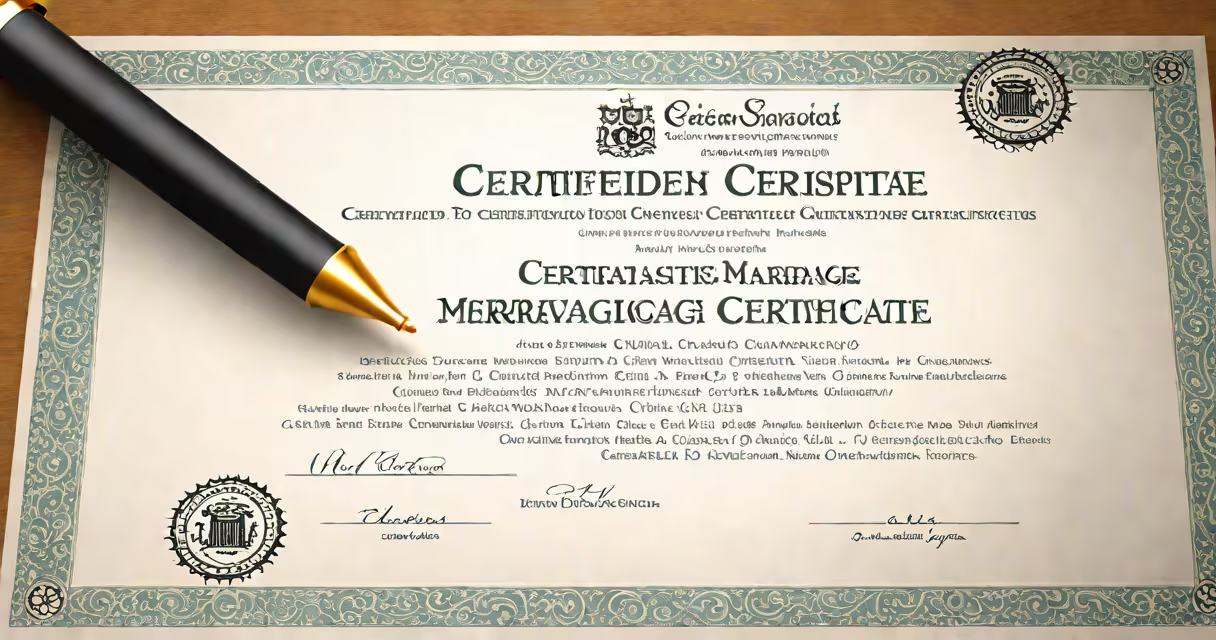
A certified Spanish to English marriage certificate translation is a legally recognized document that converts a marriage certificate issued in Spanish into accurate English text, authenticated by a sworn translator who verifies both the accuracy and the translator's qualifications.
This translation is required when submitting a marriage certificate to U.S. government agencies, immigration authorities, or courts in English-speaking jurisdictions. The process helps the original document's meaning is preserved and that the translated version holds legal weight.
For example, a U.S. citizen applying for a spouse visa must submit a marriage certificate issued in Mexico. The U.S. Citizenship and Immigration Services (USCIS) requires the document to be accompanied by a certified translation. Without it, the application is rejected outright.
The process begins with a qualified translator receiving the original Spanish marriage certificate. The translator reviews the document for clarity, consistency, and proper formatting. They then produce a word-for-word translation that maintains the original intent, including names, dates, locations, and legal terminology.
After the translation is complete, the translator signs a sworn statement affirming that the translation is accurate and complete to the best of their knowledge. This statement is typically printed on the translated document or attached as a separate affidavit.
The final step involves notarization. A notary public witnesses the translator's signature and affixes their seal and signature to the certification. This notarized document becomes the official certified translation.
A certified Spanish to English marriage certificate translation consists of three core components: the translated text, the translator's sworn statement, and the notary's authentication.
The translated text must match the original in content and structure. Names, dates, and legal terms are rendered precisely. For example, "matrimonio civil" becomes "civil marriage," and "acta de matrimonio" becomes "marriage certificate."
The sworn statement includes the translator's name, credentials, date of translation, and a declaration of accuracy. The notary adds their official seal and signature, confirming the authenticity of the entire package.
Not all translations qualify as "certified." Only those completed by a translator who is sworn or commissioned by a court, state, or federal authority meet the standard. The translator must have a formal qualification, such as being listed in the U.S. Department of State's list of approved translators or holding a certification from the American Translators Association (ATA).
| Type | Required For | Verification Method |
|---|---|---|
| Certified Translation | U.S. immigration, court filings, adoption, visas | Sworn statement + notarization |
| Non-Certified Translation | Personal reference, informal use | None |
| Legal Translation (Specialized) | Family law, immigration hearings | Additional attorney review may be needed |
Some agencies require the translator to be fluent in both languages and familiar with regional variations. For instance, a marriage certificate from Spain may use different legal phrasing than one from Colombia. A qualified translator accounts for these differences.
Many assume that any translation from a language app or online tool qualifies as certified. This is false. Machine translations lack legal standing. Even if the output appears correct, USCIS and other bodies reject them outright.
Another misconception is that the notary certifies the translation itself. Notaries do not verify content accuracy-they only confirm the identity of the signer and the authenticity of the signature. The responsibility for accuracy lies solely with the translator.
A third error is using a translator without formal credentials. According to the ATA, only translators who pass a standardized exam and maintain ongoing education are eligible for certification. Using an unqualified individual risks rejection of official documents.
In 2022, a couple from Guatemala applied for permanent residency in the U.S. Their marriage certificate was issued in Spanish by a municipal registry in Quetzaltenango. The initial submission included a machine-generated translation from Google Translate. USCIS returned the application with a rejection notice citing "insufficient documentation."
They hired a certified translator licensed by the New York State Supreme Court. The translator reviewed the original document, produced a precise translation, added a sworn statement, and had it notarized. The corrected submission was accepted within 30 days.
This case illustrates that accuracy and compliance are not optional-they are mandatory for legal recognition.
Certified Spanish to English marriage certificate translations are routinely submitted to:
Without a certified translation, applications stall. The U.S. Department of Homeland Security states that all foreign-language documents submitted to immigration authorities must be accompanied by a certified translation or be deemed invalid.
I once worked with a client whose marriage certificate from Chile was rejected because the translation omitted the registrar's signature and seal. The original document contained these elements, but the untrained translator assumed they were irrelevant. The corrected version, completed by a certified professional, passed review on the second attempt.
Most providers treat certification as a checkbox. But the difference between a compliant and non-compliant translation lies in attention to detail. A certified translation must preserve the original document's format, including line breaks, punctuation, and layout. Some agencies even compare the visual alignment of the original and translated versions.
For example, if the original certificate lists the bride's name in a specific font size and position, the translation must mirror that placement. Failure to replicate formatting can trigger suspicion of tampering-even if the content is accurate.
Always use a translator who is officially sworn and whose certification is verifiable. Double-check that the notary's seal is current and that the translator's name appears on the affidavit. These details prevent delays and denials.