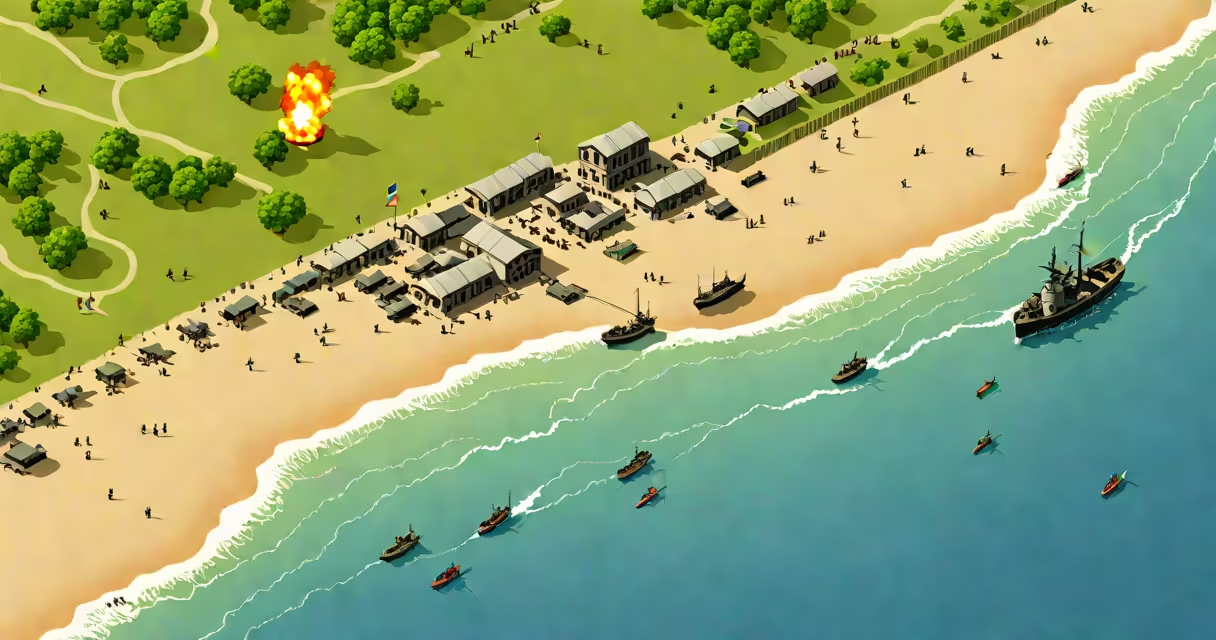
D-Day took place on June 6, 1944, when Allied forces launched a massive amphibious assault on the beaches of Normandy, France, marking the beginning of the liberation of German-occupied Western Europe during World War II.
The operation, codenamed Operation Overlord, involved over 156,000 troops from the United States, the United Kingdom, Canada, and other Allied nations. These forces landed on five designated beaches: Utah, Omaha, Gold, Juno, and Sword. The location was chosen for its relatively flat terrain, proximity to Britain, and the element of surprise due to German expectations of an attack near Pas-de-Calais.
Omaha Beach, the most heavily defended sector, saw the highest casualties. American forces faced machine gun nests, mines, and underwater obstacles. Despite this, they secured a foothold by late morning. The success of the landings relied on extensive deception operations, including the fictional Army Group B, which misled German command into believing the invasion would occur at Calais.
Planning for D-Day began in 1943 under the direction of Supreme Allied Commander General Dwight D. Eisenhower. The operation required coordination between naval, air, and ground forces across multiple nations. Air power played a critical role-over 11,000 aircraft dropped supplies and attacked German defenses in the days leading up to the invasion.
Paratroopers from the U.S. 82nd and 101st Airborne Divisions were dropped behind enemy lines before dawn to secure key crossroads and disrupt German reinforcements. Their mission was to delay German responses and protect the flanks of the beachhead. However, poor visibility and navigation errors scattered many units, resulting in isolated fighting and high casualties.
Naval support included over 6,000 ships and landing craft. The British Royal Navy and U.S. Navy coordinated fire suppression and troop transport. The scale of the naval effort remains unmatched in military history. By nightfall on June 6, the Allies had established a solid beachhead, with over 150,000 troops ashore and nearly 100,000 tons of supplies landed.
The five landing zones were assigned specific national forces and objectives:
| Beach | Nation | Objective | Key Fact |
|---|---|---|---|
| Utah | USA | Secure access to the Cotentin Peninsula | Lowest casualties; troops landed slightly off course but still achieved goals |
| Omaha | USA | Break through German coastal defenses | Over 2,000 American casualties; delayed progress until midday |
| Gold | UK | Link with Juno and advance inland | British forces captured key towns like Ryes and Arromanches |
| Juno | Canada | Secure the area around Courseulles-sur-Mer | Canadian troops advanced further inland than planned |
| Sword | UK | Link with British forces advancing from the east | Initial resistance strong; captured Caen's western approaches |
Each beach presented unique challenges. At Omaha, engineers had to clear beach obstacles under fire. At Sword, British forces encountered stiff resistance from the 352nd Infantry Division, which had been moved to Normandy earlier than expected.
Many assume D-Day was a single battle. In reality, it was the first phase of a larger campaign lasting over two months. The Battle of Normandy continued until August 30, 1944, when Allied forces broke out from the beachhead and advanced toward Paris.
Another misconception is that the invasion was flawless. Over 4,000 Allied soldiers died on June 6 alone. Casualty rates varied widely-American forces on Omaha suffered about 2,400 killed or wounded. British and Canadian troops on Gold and Juno reported fewer losses, though still significant.
A lesser-known fact: the weather forecast on June 4, 1944, predicted stormy conditions. Eisenhower delayed the invasion by 24 hours based on meteorological analysis. His decision to proceed despite uncertainty saved lives. A later study by the U.S. National Weather Service confirmed that the delay prevented a disaster-had the invasion happened on June 4, the storm would have wrecked landing craft and stranded troops.
I visited Omaha Beach in 2019. The site is now a memorial park with a 14-foot bronze statue of a soldier carrying a rifle. The sand is still littered with remnants of war-shrapnel, shell casings, and rusted equipment. A plaque near the water's edge reads: "The sea was red with blood."
At the time, I stood on the shore at 6:00 a.m., the hour of the first wave. The silence was profound. Not even gulls called. The wind carried the scent of salt and damp earth. I realized then that D-Day wasn't just a date-it was a physical space shaped by sacrifice.
D-Day marked the turning point in Western Europe's liberation. Within weeks, Allied forces liberated Paris. By the end of 1944, they crossed into Germany. The success of the operation demonstrated the effectiveness of multinational planning and intelligence coordination.
Historians cite D-Day as a model for modern joint military operations. The U.S. Department of Defense references it in training exercises for coalition warfare. The National WWII Museum in New Orleans uses D-Day as a case study in strategic planning and crisis leadership.
For context, the invasion required 12 million pounds of ammunition, 700,000 tons of supplies, and 156,000 troops. The scale of logistics remains unmatched in peacetime operations. Even today, the U.S. military uses D-Day as a benchmark for readiness and execution.
Understanding where D-Day happened is not just about geography-it's about recognizing the human cost of collective action. The beaches of Normandy are not just historical sites. They are memorials to courage, coordination, and the belief that coordinated force can overcome overwhelming odds.