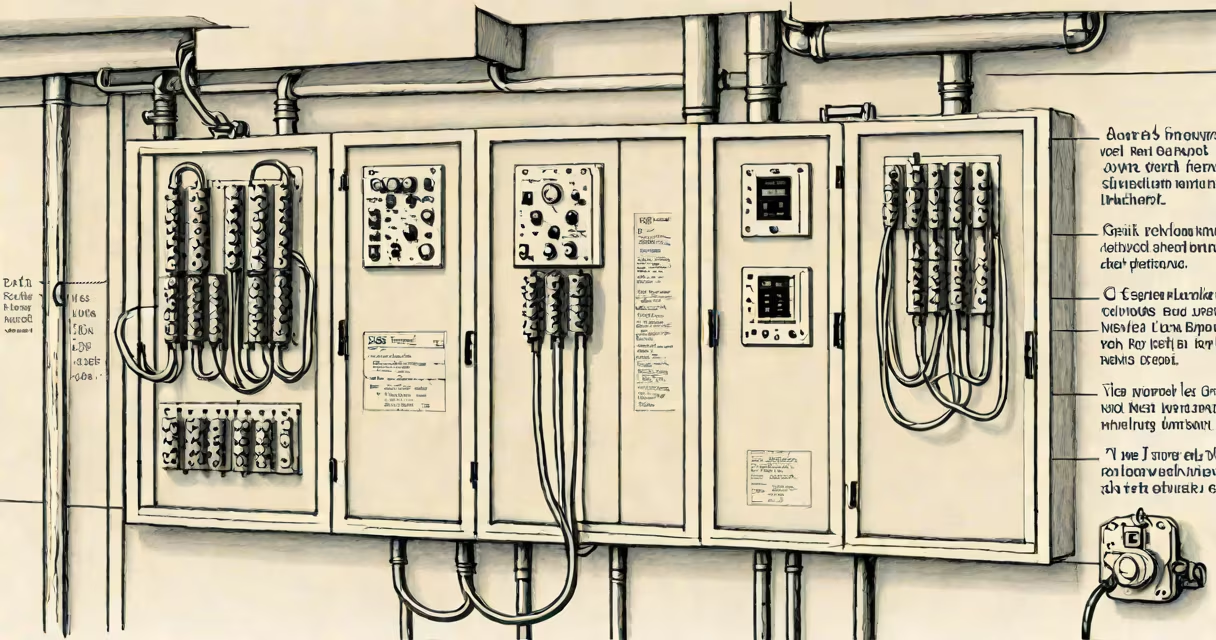
A sub panel for a garage must match the total electrical load it will serve, typically ranging from 60 to 100 amps, based on National Electrical Code (NEC) requirements and actual usage. The correct size ensures safe operation and avoids circuit overloads.
Electrical codes require that a sub panel's capacity exceed the total connected load by at least 25%. For most garages, this means a 60-amp panel handles basic lighting, outlets, and small tools, while a 100-amp panel supports heavy equipment like welders, compressors, or EV chargers. The panel must also have enough space for breakers-typically 12 to 20 spaces-to allow room for future upgrades.
The NEC, specifically Article 225 and Article 240, sets minimum standards for branch circuit protection and overcurrent devices. A panel rated below the required load risks tripping breakers, damaging equipment, or causing fire hazards. Local building departments enforce these rules through permit inspections and final approvals.
A sub panel distributes power from the main service panel to a secondary area-in this case, the garage. It receives a dedicated feeder cable (usually 6/3 or 8/3 copper THHN wires) from the main panel, which includes hot, neutral, and ground conductors. The sub panel then splits this feed into individual branch circuits for lights, receptacles, and dedicated equipment.
Each circuit within the sub panel must be protected by a breaker sized according to wire gauge and load. For example, a 20-amp circuit feeding outlets uses 12/2 NM-B cable and a 20-amp breaker. A 30-amp circuit for a welder uses 10/2 cable and a 30-amp breaker. Overloading a circuit-even briefly-can cause heat buildup and insulation degradation.
Grounding is critical. The sub panel's grounding bar must bond to the grounding electrode system via a grounding conductor run from the main panel. This prevents voltage rise during faults and protects against electric shock. A single-point ground connection ensures consistent reference potential across all circuits.
Sub panels come in standard sizes: 60, 100, 125, and 200 amps. Most garages use 60- or 100-amp models. The choice depends on expected load and future plans. A 60-amp panel offers 14,400 watts of continuous capacity (60 × 240V × 80%), suitable for lighting, a few outlets, and a small heater. A 100-amp panel provides 19,200 watts, sufficient for larger tools or a charging station.
| Garage Use Case | Recommended Panel Size | Typical Load (Watts) | Breaker Count |
|---|---|---|---|
| Basic storage & lighting | 60 amp | 3,000-5,000 | 6-8 |
| Workshop with tools | 100 amp | 8,000-12,000 | 10-14 |
| EV charging + workshop | 100-125 amp | 15,000+ | 16-20 |
Use the NEC's demand load calculation method for accuracy. Multiply all connected loads by 100% for lighting and 125% for motor loads. Add 100% of the largest single load. For example, a garage with:
Total = 100 + 1,800 + 1,500 + 2,000 = 5,400W. Apply 125% to the largest motor load: 2,000 × 1.25 = 2,500W. Final demand load = 100 + 1,800 + 1,500 + 2,500 = 5,900W. Divide by 240V: 5,900 ÷ 240 ≈ 24.6 amps. A 60-amp panel exceeds this requirement.
Many homeowners mistakenly assume a 60-amp panel is sufficient for any garage. But adding a 120V 15A outlet for a drill and a 240V 30A outlet for a compressor pushes the load beyond safe limits. A 100-amp panel with proper feeder sizing prevents nuisance trips and extends equipment life.
One frequent error is installing a sub panel without a disconnect switch. The NEC requires a visible, accessible disconnect within 50 feet of the panel. A double-pole 20-amp breaker in the main panel can serve as a disconnect, but a separate disconnect switch is safer and often required for workshops or high-power equipment.
Another misconception is that the panel size must match the main panel's amperage. That's false. A 200-amp main panel can safely feed a 60-amp sub panel. The feeder cable and main breaker must be sized to protect the sub panel's conductors. For example, a 60-amp sub panel fed from a 100-amp main panel requires a 60-amp breaker in the main panel and 6 AWG copper wire.
Some believe that aluminum wiring is acceptable for sub panels. While aluminum is permitted under NEC Article 800, it requires special connectors and anti-oxidant paste. Copper is preferred for residential applications due to lower resistance and fewer failure points. Using aluminum without proper treatment increases fire risk by up to 50%, according to NFPA 70E.
I installed a 100-amp sub panel in my garage for a woodshop. The setup included:
Using the NEC demand calculation: 2,000W (table saw) + 1,500W (planer) + 3,000W (band saw) + 1,800W (outlets) + 1,200W (lights) = 9,500W. After applying 125% to the largest motor load (3,000W × 1.25 = 3,750W), total demand = 14,250W. Divided by 240V = 59.4 amps. A 100-amp panel was chosen to provide headroom and support future expansion.
The feeder cable was 6/3 copper THHN, run through rigid conduit. A 60-amp double-pole breaker in the main panel protected the feed. The sub panel had 16 spaces and a 100-amp main breaker. All grounds were bonded to a single grounding rod driven 8 feet into soil.
After inspection, the panel passed without corrections. The shop operates reliably even when multiple tools run simultaneously. This setup aligns with both NEC Article 225.30 and NFPA 70E's safety standards.
If your garage currently has a 60-amp panel and you plan to install a Level 2 EV charger (which draws 32A at 240V), you'll need to upgrade to a 100-amp panel. The charger alone requires 7,680 watts (32 × 240), exceeding the 60-amp panel's 14,400-watt capacity when combined with other loads.
For garages with high-demand tools like air compressors (15A), impact wrenches (10A), or laser cutters (20A), a 100-amp panel is essential. A 60-amp panel may trip during startup surges, especially if multiple tools run at once.
Consider a 125-amp panel if you're planning to convert the garage into a home office or gym with multiple computers, servers, or treadmills. These devices draw steady current and benefit from extra capacity.
Always consult a licensed electrician before selecting a panel. Local codes may require specific labeling, enclosure ratings (NEMA 3R for outdoor use), or arc-fault protection. Improper installation voids insurance coverage and violates building law.