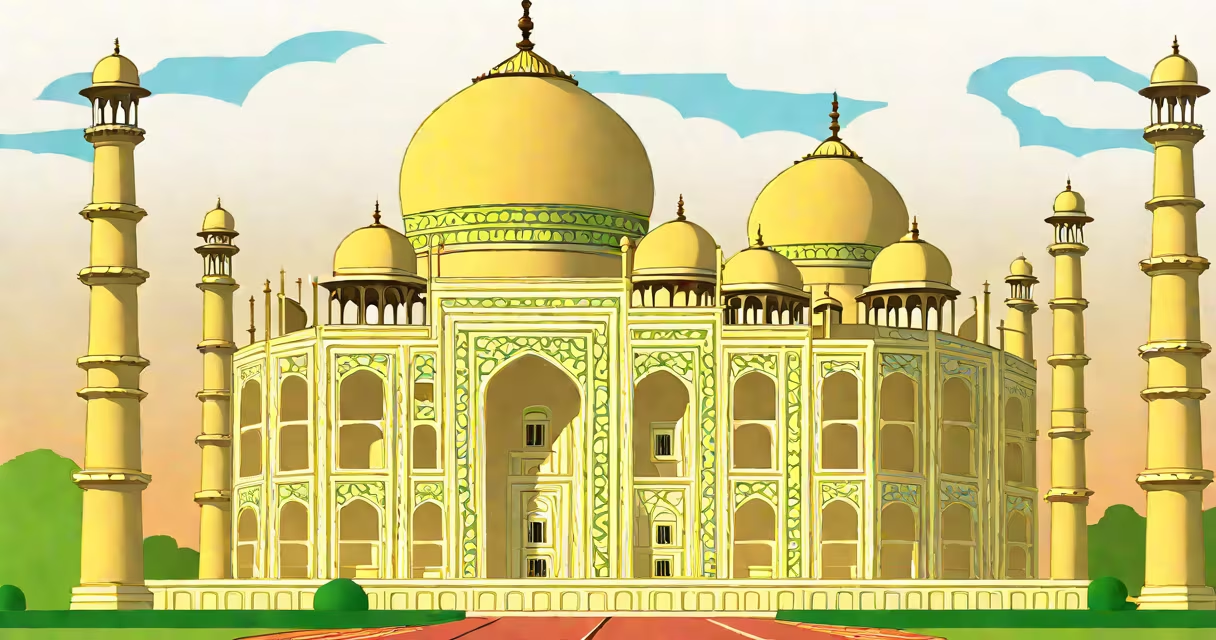
The Taj Mahal was constructed under the direction of Ustad Ahmad Lahori, a Persian-trained architect and engineer who served as chief designer during the reign of Mughal Emperor Shah Jahan. Construction began in 1632 and was completed in 1653, with Lahori overseeing the integration of Persian, Islamic, and Indian architectural traditions.
Lahori was not a lone figure. He led a team of over 20,000 artisans, laborers, and craftsmen drawn from India, Persia, the Ottoman Empire, and Central Asia. These workers included stonecutters, calligraphers, mosaic artists, and garden designers. The project required 1,000 elephants to transport materials across northern India, including marble from Makrana in Rajasthan and semi-precious stones from Afghanistan and Sri Lanka.
Shah Jahan commissioned the Taj Mahal as a mausoleum for his beloved wife Mumtaz Mahal, who died in childbirth in 1631. The structure's design reflects both personal grief and imperial ambition. Its symmetrical layout, central dome, and four minarets were intended to symbolize paradise as described in the Quran. The building's white marble surface changes color throughout the day-from pinkish at dawn to golden in afternoon, and silver under moonlight-reflecting the emotional and spiritual dimensions of the site.
Construction followed a phased approach. First, engineers laid a foundation of rubble and timber, then poured a thick layer of lime mortar mixed with sugar and egg whites to improve cohesion. This base supported massive load-bearing walls made of sandstone and marble. The foundation was designed to absorb ground movement, a feature critical in a region prone to earthquakes.
Each major component was built using precise geometric principles. The central dome, for example, is a double-shell structure: an inner shell of brick and an outer shell of white marble. The space between them allows for thermal expansion and contraction. The dome's height is 73 meters, and its weight is distributed evenly through 16 buttresses embedded in the walls.
Interior decoration relied heavily on pietra dura, a technique involving inlaid stones. Over 28 types of gemstones-including lapis lazuli, jade, carnelian, and turquoise-were set into marble panels. The floral motifs and Arabic inscriptions from the Quran were carved with a precision that required tools capable of cutting to within 0.1 millimeters.
While Ustad Ahmad Lahori is credited as the lead architect, several other individuals contributed:
A common misconception is that the Taj Mahal was built entirely by slaves. Historical records from the Mughal court show that most workers were paid laborers. Wages varied: skilled stonemasons earned about 12 rupees per month, while unskilled laborers received 6. These rates were competitive with local standards at the time.
Many assume the Taj Mahal was built solely by Persian architects. While Lahori was born in Persia (modern-day Iran), he had spent decades working in Delhi and Agra. His design blended Persian symmetry with Indian craftsmanship. For example, the chhatris (domed pavilions) atop the corners reflect Rajput architectural styles.
Another myth is that Shah Jahan planned to build a black marble version of the Taj Mahal across the river. This idea, often cited in travel guides, lacks documentary evidence. The earliest mention of such a plan appears in 18th-century British colonial records, long after Shah Jahan's death. The Mughal chronicles do not reference a "Black Taj."
A lesser-known fact: the Taj Mahal's reflection in the Yamuna River is intentionally imperfect. The water level fluctuates seasonally, creating a shifting mirror effect. This was not an accident-it was a deliberate design choice to represent the impermanence of beauty, a concept central to Sufi philosophy.
Construction cost approximately 32 million rupees in 17th-century currency. Adjusted for inflation, this equates to roughly $1.5 billion USD in 2023 values. The project consumed 1,000 elephants, 1,000 oxen, and 20,000 workers over 21 years.
For comparison, the Great Pyramid of Giza took around 20 years to build with a workforce estimated at 10,000 people. The Taj Mahal's scale is comparable, but its complexity-especially in ornamentation and engineering-exceeds that of ancient Egyptian structures.
Today, the Taj Mahal draws over 7 million visitors annually. Entry fees are ₹1,100 ($13) for foreign tourists, with guided tours available through licensed agencies. The monument is maintained by the Archaeological Survey of India, which conducts regular structural assessments.
The Taj Mahal remains a global symbol of love and architectural excellence. UNESCO designated it a World Heritage Site in 1983, citing its "universal value" and "strong creative achievement." The site has faced challenges from pollution and groundwater depletion, prompting conservation efforts since the 1990s.
Ustad Ahmad Lahori's legacy extends beyond the Taj Mahal. He also designed parts of the Red Fort in Delhi and the Shalimar Gardens in Lahore. His work established a blueprint for Mughal architecture that influenced buildings across South Asia for centuries.