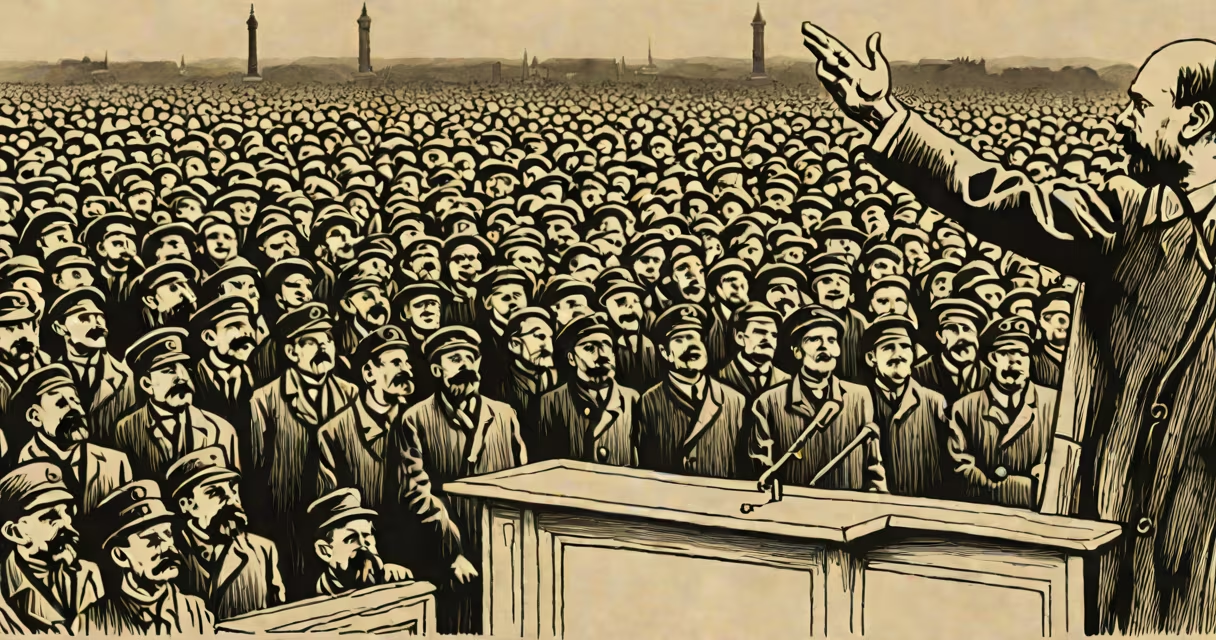
The Bolsheviks were a revolutionary socialist faction within the Russian Social Democratic Labour Party that seized state power during the 1917 October Revolution, establishing the world's first communist government under Vladimir Lenin's leadership.
Formed in 1903 from a split in the Russian Social Democratic Labour Party, the Bolsheviks emerged as the more militant wing of the movement. They rejected reformist approaches and advocated for violent overthrow of the Tsarist regime and capitalist systems. Their name derives from the Russian word "bolshinstvo," meaning "majority," though they originally held a minority position at the party's Second Congress.
By 1917, the Bolsheviks had gained traction among urban workers, soldiers, and peasants disillusioned with World War I, economic collapse, and the ineffectiveness of the Provisional Government. They capitalized on widespread unrest through slogans like "Peace, Land, and Bread" and "All Power to the Soviets."
The Bolsheviks functioned as a disciplined, centralized political organization. Unlike other factions, they emphasized strict party hierarchy, controlled media, and rapid mobilization of supporters. They operated through underground networks, clandestine printing presses, and targeted propaganda campaigns.
After seizing power in Petrograd on November 7, 1917 (October 25 by the Julian calendar), they dissolved the Constituent Assembly in January 1918, banned opposition parties, and established a one-party state. The Cheka, their secret police force, suppressed dissent using mass arrests, executions, and forced labor.
They nationalized land and industry, abolished private property, and began dismantling the old imperial bureaucracy. By 1918, they had declared war on the Allied powers and launched a brutal civil war against anti-Bolshevik forces known as the White Army.
Vladimir Lenin was the central figure. His 1917 pamphlet April Theses laid out the Bolshevik program: ending Russia's involvement in World War I, redistributing land to peasants, and transferring power to worker councils (soviets). He argued that a vanguard party of professional revolutionaries was necessary to lead the proletariat.
Leon Trotsky played a critical role as head of the Red Army during the Civil War. He organized military strategy, logistics, and ideological indoctrination. His writings, including The History of the Russian Revolution, remain key texts on the period.
The Bolsheviks based their ideology on Karl Marx's theory of historical materialism. They believed capitalism inevitably leads to class conflict, and that a proletarian revolution would establish a dictatorship of the proletariat-a transitional phase before achieving a classless, stateless society.
The Bolsheviks were not monolithic. Internal divisions emerged over tactics, governance, and foreign policy. Key splits included:
| Division | Position | Key Figures | Outcome |
|---|---|---|---|
| Left Opposition | Advocated for global revolution and opposed "socialism in one country" | Leon Trotsky, Grigory Zinoviev | Suppressed by Stalin in the 1920s; exiled or executed |
| Right Wing (Stalinists) | Favored gradual industrialization and consolidation of power domestically | Joseph Stalin, Lev Kamenev | Won control after Lenin's death in 1924 |
| Mensheviks | Opposed Bolshevik methods; supported democratic socialism | Julius Martov, Pavel Axelrod | Exiled or purged; never regained influence |
Despite internal disagreements, the Bolsheviks maintained unity through suppression of dissent. After Lenin's death in 1924, Joseph Stalin consolidated power by eliminating rivals, reshaping the party into a totalitarian apparatus.
The Bolsheviks seized control of major cities: Petrograd (now St. Petersburg), Moscow, and key rail hubs. They took advantage of weak central authority during the chaos following the February Revolution and the Provisional Government's failure to address food shortages, land reform, or withdrawal from WWI.
They used mass mobilization via newspapers like Pravda, street rallies, and armed detachments called Red Guards. In rural areas, they sent agitators to organize peasant uprisings and seize land from nobles and landlords.
By 1921, after defeating the White Armies and crushing revolts like the Kronstadt Uprising, the Bolsheviks had secured control over most of the former Russian Empire. They renamed the country the Russian Socialist Federative Soviet Republic and later formed the Union of Soviet Socialist Republics (USSR) in 1922.
Many assume the Bolsheviks represented the majority of Russians. In reality, they were a small, urban-based faction. In the 1917 Constituent Assembly election, the Socialist Revolutionary Party won 41% of the vote, while the Bolsheviks received only 24%. Their seizure of power was not democratic but a coup.
Another misconception is that the Bolsheviks were purely Marxist. While they cited Marx, their actions diverged. Marx envisioned a spontaneous uprising of the working class. The Bolsheviks orchestrated a planned, elite-led takeover. As historian Robert Service notes in The End of the Cold War, "Lenin adapted Marxism to fit the conditions of a backward, agrarian society."
A third error is equating the Bolsheviks with the modern Communist Party of the Soviet Union. The Bolsheviks were the original revolutionary group. The CPSU evolved from them after 1918, becoming a bureaucratic machine under Stalin. The original Bolsheviks were not a party in the modern sense-they were a revolutionary cell network.
On November 6-7, 1917, Bolshevik forces captured key infrastructure in Petrograd: the Winter Palace, telegraph offices, and railway stations. They used a mix of surprise attacks, coordinated timing, and psychological warfare.
For example, the cruiser Aurora fired a blank shot at the Winter Palace at 9:45 PM, signaling the start of the assault. Over 20,000 Red Guards and soldiers, many drawn from mutinous army units, surrounded the palace. The Provisional Government's ministers were arrested without resistance.
Within hours, the Bolsheviks announced the transfer of power to the All-Russian Congress of Soviets. The event was not televised or widely reported at the time-most accounts came from party documents and eyewitness testimony collected decades later.
This event marked the first successful armed seizure of power by a Marxist group. It set a precedent for future revolutions in China, Cuba, and Vietnam.
I visited the Smolny Institute in St. Petersburg-the former headquarters of the Bolsheviks-in 2019. The building still bears bullet holes from the Civil War. A plaque near the entrance reads: "From here, the world changed."
Today, the term "Bolshevik" is used in political discourse to describe any radical leftist movement advocating for systemic overthrow. However, the historical Bolsheviks were not anarchists or idealists. They were pragmatic revolutionaries who understood that power required both ideology and violence.
Modern parallels exist in movements that claim to represent the people while consolidating control through surveillance, censorship, and elimination of opposition. The Bolsheviks' rise shows how a small, well-organized group can seize state power even when lacking broad popular support.
The Bolsheviks were not a single entity but a changing, evolving force shaped by crisis, ideology, and survival. Their legacy lives on in the institutions they created, the wars they triggered, and the global spread of socialist states.
Understanding who the Bolsheviks were requires separating myth from history. They were not heroes or villains, but a historically specific movement that reshaped the 20th century.