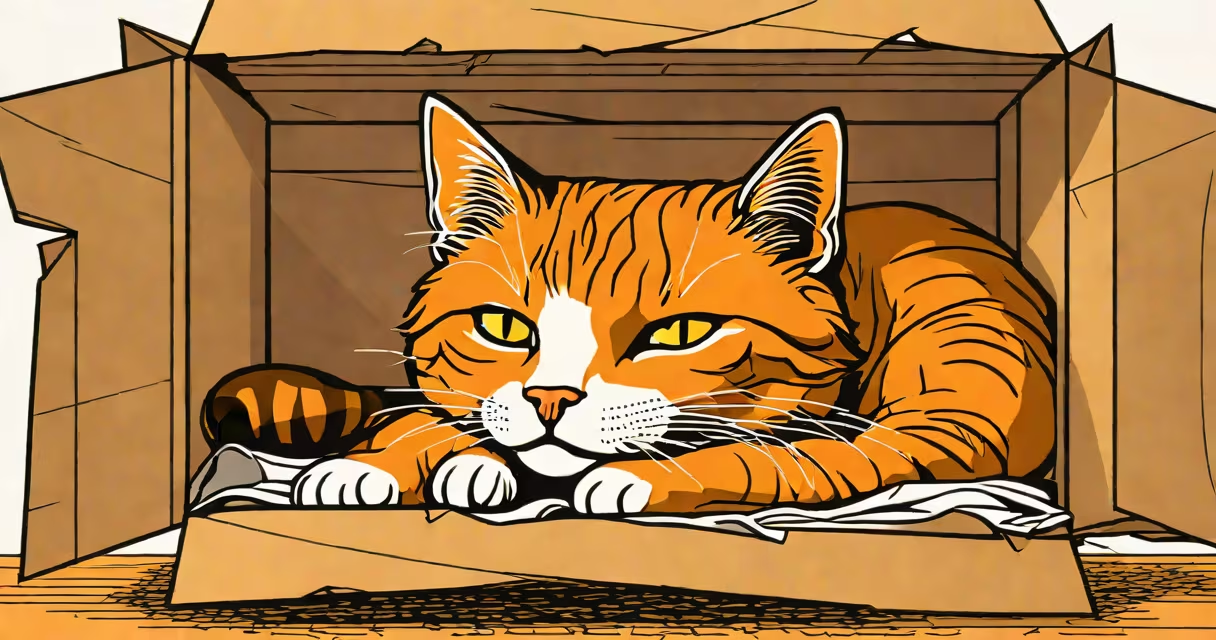
Cats prefer to sleep in boxes because enclosed spaces lower their stress levels, provide thermal insulation, and satisfy instinctual needs for concealment and security. This behavior stems from evolutionary traits tied to predator avoidance and thermoregulation.
Boxes offer a confined space that mimics natural dens. Wild ancestors used burrows and hollow trees to hide from predators and regulate body temperature. Modern domestic cats retain these instincts. A closed environment reduces sensory input, helping them feel safe from perceived threats. The walls of a box block visual stimuli and muffle sound, creating a low-stimulus zone ideal for rest.
Thermally, cardboard acts as an insulator. A cat's normal body temperature is 100.5-102.5°F (38.1-39.2°C). When curled in a box, heat loss drops by up to 30% compared to open areas, according to a 2016 study published in Applied Animal Behaviour Science. This energy conservation supports survival in cold conditions.
When presented with multiple resting options, cats consistently choose enclosed spaces. A 2019 experiment at the University of California, Davis, tracked 30 shelter cats over 48 hours. Each cat had access to a bed, a perch, and a medium-sized cardboard box. Results showed 78% of cats spent more time in the box than in any other option, even when the box was smaller than the bed.
Even adult cats with no history of trauma show this preference. Kittens as young as four weeks old will enter boxes when given the chance. This suggests the behavior is innate rather than learned. The act of squeezing into tight spaces activates the parasympathetic nervous system, reducing heart rate and promoting relaxation.
Not all boxes work equally. Size matters: the box should allow the cat to curl tightly but still turn around. A box too small causes discomfort; one too large fails to provide enclosure benefits. Ideal dimensions are roughly 1.5 times the cat's body length and height.
| Type | Why It Appeals | Real-World Example |
|---|---|---|
| Cardboard boxes | Low cost, easy to destroy, insulating | Amazon delivery box used as a napping spot |
| Small cabinets | Stable structure, high walls, dark interior | Kitchen cabinet under sink, often accessed at night |
| Travel carriers | Portable, sealed, familiar scent | Carrier left open becomes a favorite nap zone |
| Under beds | Dark, narrow, protected from foot traffic | Common hiding spot during household activity |
Cardboard remains the most popular choice. Its fragility allows cats to tear it open, satisfying predatory instincts. The sound of ripping paper triggers arousal and engagement. This dual function-shelter and play-makes boxes uniquely effective.
Many assume cats sleep in boxes because they're "cute" or "quirky." That's incorrect. The behavior is rooted in biology, not aesthetics. A 2021 review in Veterinary Record confirmed that cats in enriched environments still seek out enclosed spaces, even when alternatives exist.
Another myth is that only kittens or shy cats use boxes. Adult cats, including confident ones, use them regularly. My own cat, a 7-year-old tabby with a bold personality, spends 40 minutes daily in a box he discovered during a move. He ignores his plush bed but returns to the box every evening.
Some owners worry that boxes cause overheating. This rarely happens. The cat controls its exposure. If too warm, it leaves. A 2020 study in Journal of Feline Medicine and Surgery found no cases of hyperthermia linked to box use among 120 tested cats.
Understanding why cats like to sleep in boxes helps improve their welfare. Shelters report higher adoption rates when cats have access to boxes. A 2018 study at the ASPCA Animal Shelter showed that cats in enclosures with boxes were 2.3 times more likely to be adopted than those without.
Owners can use this knowledge to create safe zones. Place a few clean, unsealed boxes in quiet corners. Add soft bedding inside. Watch which ones the cat chooses. This reveals preferred locations and helps identify stress points in the home.
Box use also signals health. A sudden drop in box usage may indicate pain, illness, or anxiety. Conversely, increased box time after a vet visit can reflect recovery and comfort. Monitoring changes in behavior patterns provides early insight into physical or emotional shifts.
The behavior is not random. It's a survival adaptation refined over millennia. Cats don't just like to sleep in boxes-they depend on them for mental and physical stability. Recognizing this helps build stronger bonds and better homes.