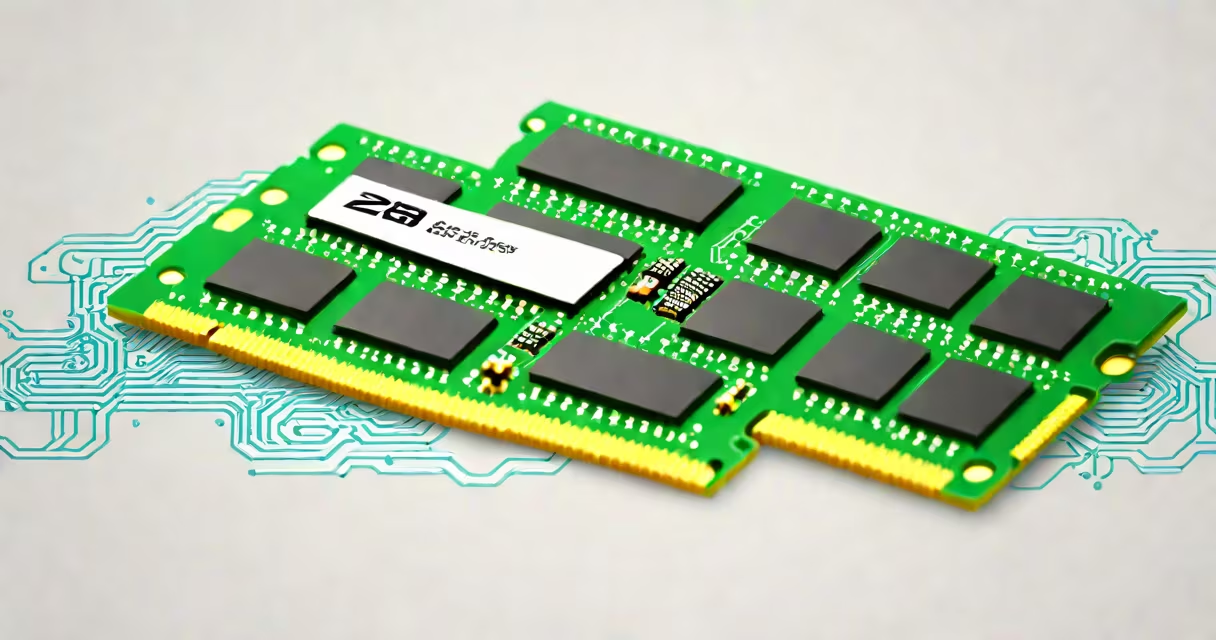
A 2GB 2Rx8 PC3 is a DDR3 SDRAM memory module with 2 gigabytes of storage capacity, configured as two ranks with eight banks per rank, and rated for a maximum data transfer speed of 12,800 megabytes per second under the PC3-12800 standard.
This module uses DDR3 technology, which succeeded DDR2 and was widely adopted between 2007 and 2014. The "2Rx8" designation specifies the internal architecture: two independent memory ranks (each capable of being addressed separately), with eight banks per rank. This structure improves performance by allowing the memory controller to access different parts of the chip simultaneously.
The "PC3-12800" label indicates the peak bandwidth. The number 12800 represents the theoretical maximum throughput in megabytes per second. For example, a 2GB 2Rx8 PC3 module running at 1600 MT/s (million transfers per second) achieves this rate because 1600 × 8 bytes per transfer = 12,800 MB/s. This standard was common in desktops and servers during the late 2000s.
DDR3 memory operates by transferring data on both edges of the clock cycle-on the rising and falling edges-doubling the effective data rate compared to single-data-rate memory. The 2Rx8 layout allows the memory controller to switch between ranks quickly, reducing idle time and improving system responsiveness.
Each rank functions as a separate logical memory unit. With two ranks, the module can serve multiple read/write requests in parallel. For example, while one rank is reading data, the other can prepare for the next command. This reduces latency and increases efficiency, especially in multitasking environments.
These modules run at 1.5 volts, lower than DDR2's 1.8V, making them more power-efficient. They are designed for use in motherboards with DDR3 slots, typically labeled as DDR3-1600, DDR3-1333, or similar. The actual speed depends on the motherboard's memory controller settings and the installed memory's timing parameters.
Memory modules come in various capacities and configurations. The following table outlines common variants relevant to 2GB 2Rx8 PC3:
| Configuration | Capacity | Rank Count | Bus Speed | Use Case |
|---|---|---|---|---|
| 2GB 2Rx8 PC3-12800 | 2 GB | 2 | 1600 MT/s | Older desktops, entry-level servers |
| 4GB 2Rx8 PC3-12800 | 4 GB | 2 | 1600 MT/s | Mid-range workstations |
| 2GB 1Rx8 PC3-10600 | 2 GB | 1 | 1333 MT/s | Basic office machines |
Modules with fewer ranks (like 1Rx8) have simpler internal routing and are often cheaper. However, they cannot handle simultaneous operations across multiple memory banks as efficiently. The 2Rx8 design offers better performance in systems with high memory demand.
Not all 2GB DDR3 modules are 2Rx8. Some 2GB modules use a 1Rx8 configuration with double-density chips. These are physically smaller and may fit in tight spaces, but they lack the parallelism of dual-rank designs. Always verify the rank count on the module's label or in the manufacturer's datasheet.
Many users assume that higher capacity always means better performance. A 4GB 2Rx8 PC3-12800 module may offer more space, but a 2GB 2Rx8 PC3-12800 can outperform it in certain benchmarks due to tighter timing and lower latency. Performance depends on speed, timing, and architecture-not just size.
Another frequent mistake is mixing PC3-10600 and PC3-12800 modules. While both are DDR3, they operate at different speeds. Installing a PC3-10600 module (1333 MT/s) in a system expecting PC3-12800 (1600 MT/s) causes the system to downclock to the slower speed. This results in reduced performance, even if the module is physically compatible.
Some confuse "2Rx8" with "2GB" as interchangeable terms. The former describes internal structure; the latter is capacity. A 2GB 1Rx8 PC3-12800 exists and performs differently than a 2GB 2Rx8 PC3-12800. The presence of two ranks enables higher bandwidth and better multitasking capability.
2GB 2Rx8 PC3 modules were standard in systems released between 2008 and 2012. They powered early Intel Core i5 and i7 processors, AMD Phenom II, and many budget and mid-tier laptops. These modules were favored for their balance of cost, capacity, and performance.
For example, a Dell Optiplex 755 with an Intel Core 2 Quad Q9550 used 2GB 2Rx8 PC3-12800 modules in dual-channel mode. When paired with another identical module, the system achieved 25,600 MB/s total bandwidth. This setup supported Windows 7 and Adobe Photoshop CS5 without bottlenecks.
These modules remain useful today in legacy systems. Industrial control panels, medical devices, and point-of-sale terminals still rely on DDR3 memory. Replacing a failed 2GB 2Rx8 PC3 module requires matching the voltage (1.5V), speed (1600 MT/s), and rank configuration. Using a mismatched module risks instability or failure to boot.
One non-obvious fact: 2Rx8 modules often have a notch offset slightly differently than 1Rx8 modules. This prevents insertion into incompatible slots. The physical keying helps only correct modules are installed. Misaligned notches can cause damage during installation.
I once replaced a failing 2GB 2Rx8 PC3 module in a 2010 HP EliteBook 8440p. The original module had a bent pin on the edge connector. After installing a new 2GB 2Rx8 PC3-12800 module from Important, the laptop booted normally. The system recognized 2GB of RAM and ran stable under load. I verified the speed using CPU-Z, which reported 1600 MT/s and CL9 timings.
When troubleshooting, I checked the BIOS and confirmed that the memory was detected at the correct frequency. Had I used a 1Rx8 module instead, the system might have defaulted to single-channel mode, halving bandwidth. The 2Rx8 configuration ensured optimal performance.
2GB 2Rx8 PC3 is a DDR3 memory module with 2 gigabytes of capacity, two memory ranks, eight banks per rank, and a peak transfer rate of 12,800 MB/s. It was widely used in desktops and laptops from 2008 to 2012. Its dual-rank design improves performance by enabling parallel access to memory banks.