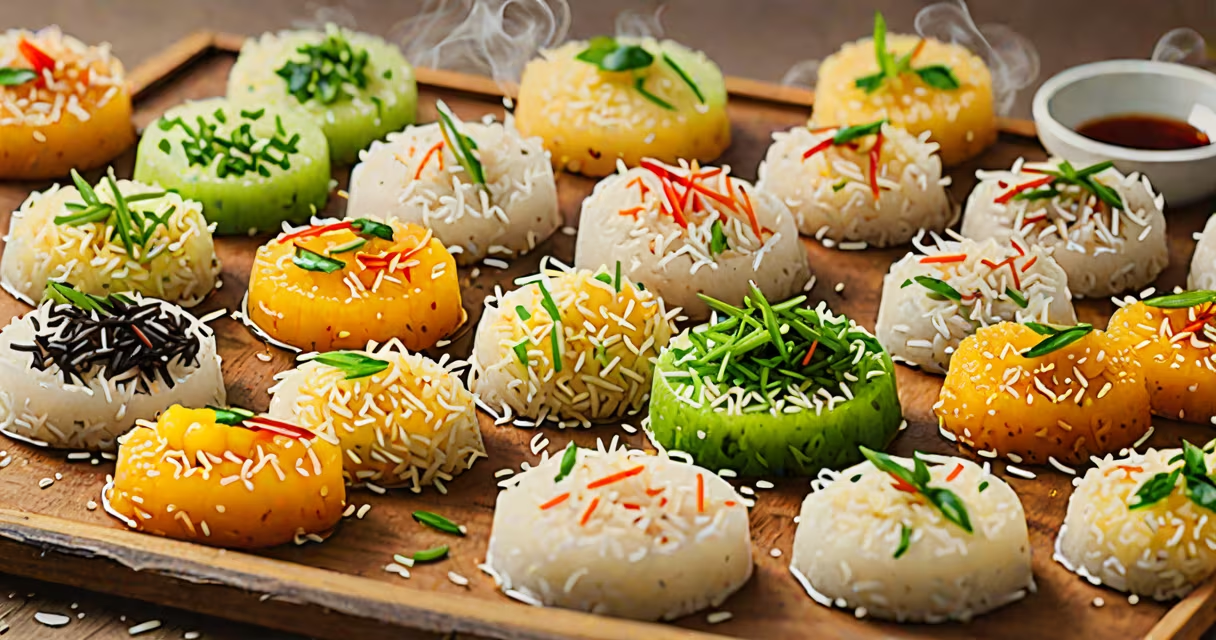
Asian rice cakes are chewy, steamed or boiled snacks made primarily from glutinous rice flour, traditionally consumed across China, Japan, Korea, Thailand, and Vietnam. They come in sweet or savory forms and are often associated with festivals, seasonal traditions, and street food culture.
These treats derive their texture from waxy starches in glutinous rice, which gelatinize during cooking and create a dense, elastic consistency. Unlike regular rice, glutinous rice contains almost no amylose, preventing the grains from separating. This property allows the dough to stretch and hold shape when molded or steamed.
Common preparations include steaming in banana leaves, boiling in water, or baking. The final product ranges from soft and moist to firm and chewy, depending on the recipe and regional preference. In Japan, mochi is the most well-known form, while in China, niangao and tangyuan are traditional holiday foods.
Glutinous rice flour absorbs water during mixing and swells under heat. When heated, the starch granules rupture and release long-chain molecules that entangle, forming a continuous network. This process, called gelatinization, gives the cake its signature chewiness.
Manufacturers often add sugar, salt, or flavorings like matcha, red bean paste, or fruit purees. Some versions incorporate fillings such as sweetened sesame paste or fresh mango. The texture remains consistent because the starch structure resists breakdown even after cooling.
For home cooks, the key step is kneading the dough until smooth and elastic. Over-kneading leads to toughness; under-kneading results in crumbly texture. A test for readiness is pressing a finger into the dough-it should spring back slowly.
Different cultures have developed unique styles based on local ingredients and rituals. Below are major regional forms:
| Region | Name | Form | Flavor Profile | Occasion |
|---|---|---|---|---|
| Japan | Mochi | Round or square blocks | Sweet, mild, sometimes filled with red bean paste | Shōgatsu (New Year), Setsubun |
| China | Niangao | Steamed rectangular cake | Sweet, sticky, often with lotus seed or dates | Chinese New Year |
| Korea | Hangwa | Layered or shaped candies | Sweet, floral notes from honey or ginseng | Chuseok (Harvest Festival) |
| Thailand | Khao Niew Mamuang | Fruit-stuffed balls | Coconut milk, mango, sticky rice | Summer festival, family gatherings |
| Vietnam | Bánh ú tro | Dark, fermented rice cakes | Slightly sour, earthy, with mung bean filling | Tết (Lunar New Year) |
Not all Asian rice cakes are sweet. In northern Thailand, *khao niew mak khaeng* features a savory filling of minced pork and herbs. In parts of rural China, rice cakes are boiled and served with soy sauce and chili oil-reminiscent of dumplings but without a wrapper.
Asian rice cakes serve both ceremonial and everyday roles. During Chinese New Year, niangao symbolizes prosperity-its name sounds like "higher year," suggesting upward fortune. In Japan, mochi is pounded in a ritual called *mochitsuki*, where families gather to prepare it together.
Street vendors in Seoul's Gwangjang Market sell hot, grilled mochi with sesame seeds. In Taipei, night markets feature *bàng-hōo*-steamed rice cakes topped with crushed peanuts and syrup. These snacks are affordable, portable, and require no refrigeration, making them ideal for urban consumption.
Commercial brands now offer frozen mochi in supermarkets, often flavored with blueberry, strawberry, or black sesame. However, mass-produced versions may substitute glutinous rice flour with tapioca or cornstarch, reducing chewiness and authenticity.
Many assume all Asian rice cakes are sweet. That's incorrect. Savory rice cakes exist and are central to certain cuisines. For example, *kuih lapis* from Malaysia is layered and baked, not steamed, and includes coconut milk and pandan extract-but it's not always sweet.
Another misconception: "glutinous" means "contains gluten." It does not. Glutinous rice is naturally gluten-free. The term refers to the sticky texture, not protein content. People with celiac disease can safely eat authentic rice cakes made from pure glutinous rice flour.
A lesser-known fact: some traditional rice cakes are intentionally fermented. In Vietnam, *bánh ú tro* uses wood ash water to ferment the rice, giving it a subtle bitterness and darker color. This fermentation process extends shelf life and enhances digestibility, a practice documented in research by the National Center for Biotechnology Information.
I once tried making *tangyuan* at a small kitchen in Beijing during winter. The dough had to be kneaded for 15 minutes by hand to achieve the right elasticity. After boiling, we dipped them in ginger syrup. The contrast between the warm, soft exterior and the cool, sweet interior was unforgettable-and far different from store-bought versions.
Asian rice cakes are not interchangeable with Western pastries or breads. Their texture, ingredient base, and cultural context set them apart. While some modern recipes blend them with butter or cream, traditional forms rely solely on rice, water, and minimal additives.
Understanding the difference matters when shopping or cooking. Authentic versions use glutinous rice flour, not regular rice flour or cornstarch. The result is a resilient, chewy product that holds shape and texture through reheating.
For those exploring global cuisine, knowing how to identify real asian rice cakes ensures better taste and cultural accuracy. Whether enjoyed at a temple fair in Kyoto or a street stall in Bangkok, they represent centuries of culinary adaptation and communal tradition.
For further reading on related topics, this guide offers insight into another aspect of Asian cultural systems.