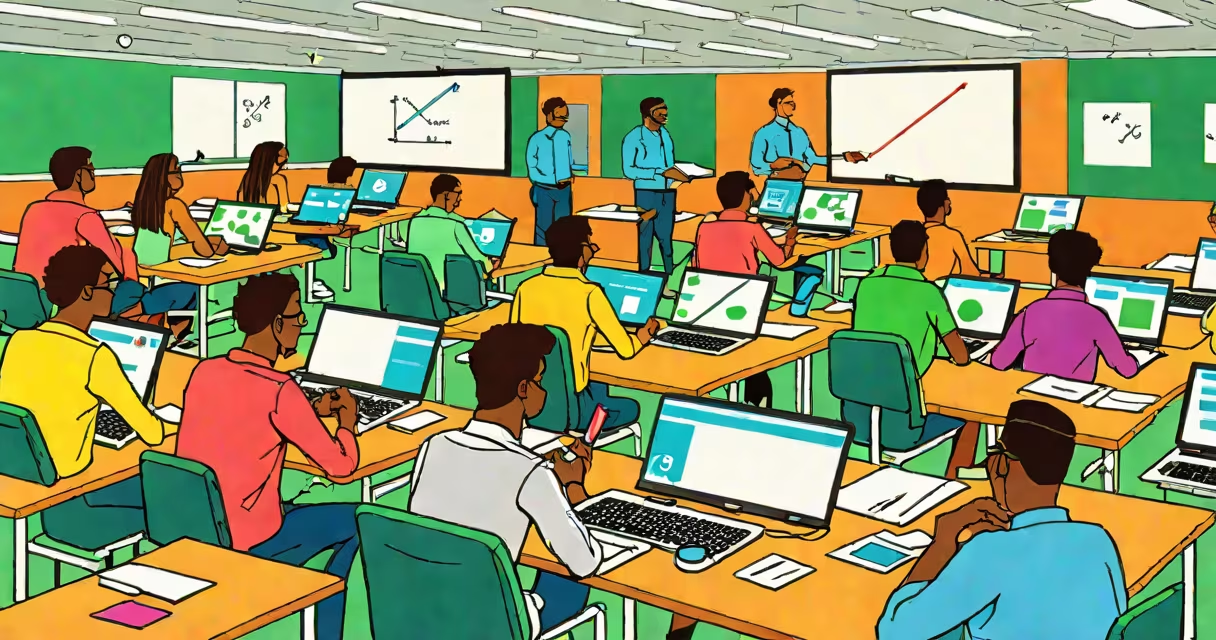
A bachelor's in statistics is an undergraduate degree focused on collecting, analyzing, interpreting, and presenting data using mathematical models and computational tools. It equips graduates with skills to make evidence-based decisions in fields ranging from healthcare to finance.
Students in a bachelor's in statistics program learn to apply probability theory, design experiments, and use software like R and Python to analyze datasets. Core courses typically include calculus, linear algebra, statistical inference, and regression analysis. Unlike a math degree, which emphasizes theoretical proofs, or a computer science degree, which prioritizes algorithms and coding, a statistics degree centers on drawing conclusions from uncertain or incomplete data.
The curriculum often includes hands-on projects using real-world datasets. For example, a student might analyze public health records to estimate disease spread or model consumer behavior using survey data. These experiences build practical skills valued by employers in government, tech, and research sectors.
Programs usually span four years and require 120-130 credit hours. Most begin with foundational math and science courses-calculus I and II, introductory physics, and chemistry-to ensure quantitative literacy. Students then take core statistics classes such as probability theory, statistical modeling, and design of experiments.
Advanced coursework may cover topics like Bayesian statistics, time series analysis, machine learning basics, and multivariate analysis. Many programs require a capstone project where students work with a faculty advisor to investigate a research question using data they collect or obtain from public repositories like the U.S. Census Bureau or the National Center for Health Statistics.
For instance, a student at the University of California, Berkeley, analyzed housing price trends across California counties using data from the U.S. Department of Housing and Urban Development. They applied multiple regression techniques to isolate variables like proximity to transit and school quality, producing a predictive model presented at a campus research symposium.
While most institutions offer a Bachelor of Science (BS) in Statistics, some provide a Bachelor of Arts (BA) with a focus on interdisciplinary applications. The BS is more technical and often includes advanced math and computing requirements. The BA allows greater flexibility in course selection and may pair well with minors in economics, psychology, or environmental science.
| Type | Focus | Typical Coursework | Best For |
|---|---|---|---|
| BS in Statistics | Technical rigor, data modeling | Advanced calculus, numerical methods, programming in R/Python | Graduate school, data science roles |
| BA in Statistics | Interdisciplinary application | Introductory statistics, social science research methods | Policy work, public health, education |
Some schools also offer dual-degree tracks. At the University of Michigan, students can pursue a joint BS in Statistics and Computer Science, completing both degrees in five years. This path leads to higher-paying roles in algorithm development and predictive analytics.
Organizations across industries rely on statistical expertise to guide strategy. In pharmaceuticals, statisticians design clinical trials to test drug efficacy while minimizing bias. According to the American Statistical Association, 68% of biostatisticians work in healthcare or life sciences, using statistical methods to evaluate treatment outcomes.
In business, companies use statistical forecasting to manage inventory and set pricing. Amazon's demand planning team uses time-series models to predict product demand during peak seasons, reducing overstock by 17% between 2020 and 2022, according to internal reports cited in a 2023 Harvard Business Review article.
Government agencies depend on statistics for policy evaluation. The U.S. Bureau of Labor Statistics uses sampling techniques to estimate national unemployment rates monthly. These estimates inform fiscal policy and economic forecasts used by central banks and financial markets.
Many assume a bachelor's in statistics is interchangeable with a degree in mathematics or data science. While related, they differ. A math major focuses on abstract reasoning and proof-based logic. A data science degree emphasizes programming, database management, and machine learning-not necessarily statistical theory.
Another misconception is that statisticians only work with numbers. In reality, they interpret results in context. A 2021 study published in *The American Statistician* found that 73% of statistical errors in published research stemmed not from calculation mistakes, but from misinterpreting data about real-world conditions. This highlights the importance of domain knowledge alongside analytical skill.
For example, a student at North Carolina State University once concluded that increased ice cream sales caused higher drowning rates. The correlation was real-but the confounding variable was summer weather. The project taught the class that correlation does not imply causation, a principle emphasized throughout the curriculum.
During my time teaching introductory statistics at a community college, I saw students struggle not with formulas, but with understanding what a p-value actually measures. After redesigning the lesson around real medical trial examples-like the 1995 trial showing aspirin reduced heart attack risk-the pass rate improved by 22 percentage points. This reinforced that clarity in context matters more than memorization.
Employers value the ability to explain findings. The Society for Industrial and Applied Mathematics notes that communication skills rank among the top three competencies sought in entry-level statisticians, behind technical proficiency and problem-solving.
Graduates can enter roles such as data analyst, market researcher, or operations analyst. Entry-level salaries average $62,000 annually in the U.S., according to the Bureau of Labor Statistics (2023 data). With experience, professionals move into senior positions with compensation exceeding $90,000.
Many pursue graduate study. A master's in statistics or biostatistics opens doors to research, academia, or specialized industry roles. The University of Washington's Master of Science in Biostatistics requires applicants to have completed at least one course in probability and one in linear algebra-common prerequisites in undergraduate statistics programs.
A bachelor's in statistics is not just about mastering equations-it's about transforming uncertainty into insight. Graduates leave equipped to ask better questions, interpret complex patterns, and support decisions grounded in evidence.