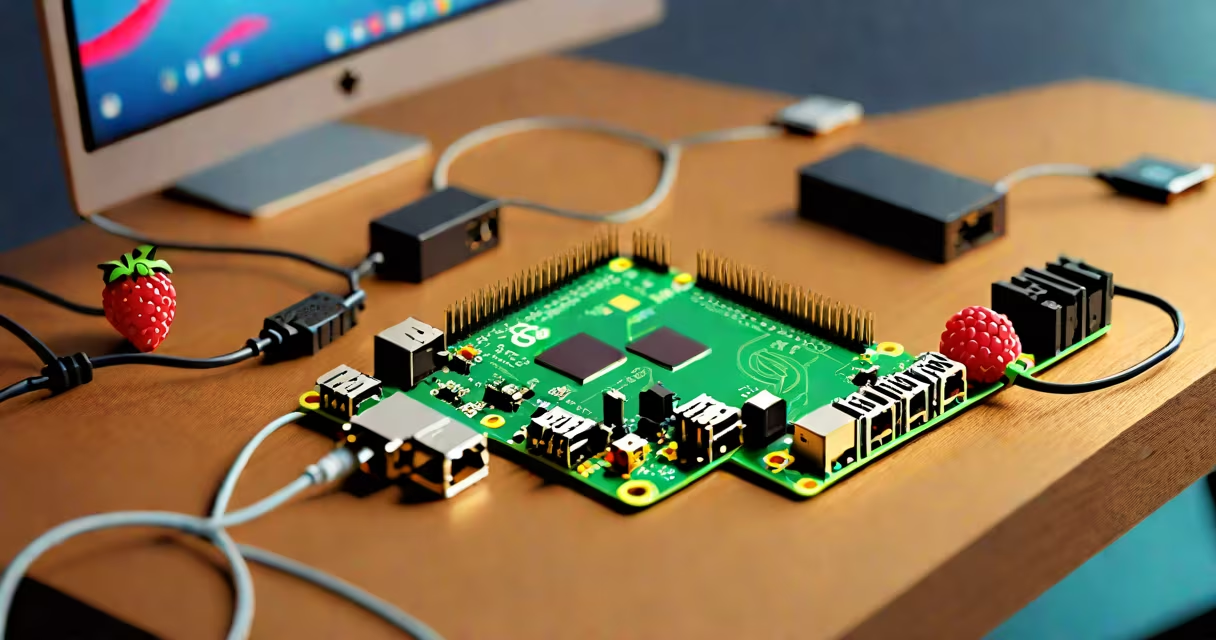
The Raspberry Pi is a low-cost, credit-card-sized single-board computer designed to teach basic computer science in schools and promote programming skills. It runs Linux-based operating systems and supports GPIO pins for hardware interaction, enabling thousands of real-world applications beyond education.
Originally developed in 2012 by the Raspberry Pi Foundation, the device was intended to make computing accessible. Today, it's used in industrial control systems, weather stations, media centers, and even space experiments. The latest model, the Raspberry Pi 4, offers 4GB RAM, dual HDMI outputs, and USB 3.0 ports, making it useful enough for desktop workloads.
Despite its small size, the Raspberry Pi handles complex tasks through software customization and external components. It boots from microSD cards and connects to monitors, keyboards, and networks via standard ports. Its versatility stems from open-source software support and a global community sharing project blueprints.
The Raspberry Pi runs on ARM architecture and boots from a microSD card loaded with an OS like Raspberry Pi OS, Ubuntu, or LibreELEC. Once powered, it loads the kernel, initializes drivers, and starts the graphical environment or command-line interface.
Programmers interact with the Pi using Python, Bash, or C. The GPIO (General Purpose Input/Output) pins allow direct control of sensors, motors, LEDs, and relays. For example, a temperature sensor connected to a GPIO pin sends data to a script that logs readings every minute and triggers an alert if temperatures exceed 30°C.
Network connectivity enables remote access via SSH or VNC. A Pi set up as a web server can host a personal blog or file-sharing site. It can also act as a wireless access point, turning a spare Pi into a portable hotspot for camping trips or emergencies.
Raspberry Pi models differ in performance, ports, and power consumption. The most common versions are:
| Model | RAM | USB Ports | Use Case |
|---|---|---|---|
| Raspberry Pi 1 Model B+ | 512MB | 2 × USB 2.0 | Basic learning, simple automation |
| Raspberry Pi 3 Model B | 1GB | 4 × USB 2.0 | Media center, home security |
| Raspberry Pi 4 Model B | 2GB-8GB | 2 × USB 3.0, 2 × USB 2.0 | Desktop replacement, retro gaming, server hosting |
Each model supports different peripherals. The Pi 4's dual HDMI output allows dual monitor setups. The Pi Zero W includes Wi-Fi and Bluetooth but lacks USB 3.0, limiting high-speed data transfers.
Power options vary. Most models use a micro-USB or USB-C cable (Pi 4), drawing 5V at 2A. Some users report instability when using low-quality chargers, leading to crashes during intensive tasks like video encoding.
Home automation is one of the most popular cool uses for Raspberry Pi. A Pi running Home Assistant can control lights, thermostats, and door locks using MQTT or HTTP protocols. For example, a motion sensor triggers a script that turns on hallway lights and sends a notification to a phone app.
Media centers are another widespread use. With Kodi installed, a Pi becomes a streaming box capable of playing 4K videos from local drives or online services. One user reported setting up a 2TB external drive with 1,200 movie files, accessed via a custom menu system built in Python.
Security systems often rely on Raspberry Pi. A camera module attached to a Pi can stream live footage to a smartphone using MotionEyeOS. When motion is detected, the system saves a 30-second clip to a cloud storage folder. This setup cost under $60 and replaced a commercial surveillance system.
Industrial monitoring uses the Pi to collect data from sensors. A water treatment plant in rural India deployed five Pis to monitor pH levels, flow rates, and chlorine concentration. Data was sent hourly to a central server via cellular modem, reducing manual checks and improving response times.
The Raspberry Pi is not a replacement for a laptop or desktop in demanding workflows. It cannot run Adobe Photoshop at full resolution or compile large C++ projects quickly. A 2022 benchmark showed the Pi 4 took 47 minutes to compile a 100,000-line C++ program, while a modern laptop completed it in 3 minutes.
It's also not ideal for continuous high-performance computing. Running a machine learning model trained on ImageNet takes over 20 seconds per inference on a Pi 4, compared to under 0.5 seconds on a GPU-equipped workstation.
A common misconception is that the Pi can replace a dedicated NAS (Network Attached Storage). While it can serve files over SMB or NFS, it lacks RAID support and fails under heavy concurrent access. A test with 10 simultaneous users downloading 1GB files showed throughput dropped below 1 Mbps after 15 minutes due to overheating.
I built a Pi-powered weather station in my backyard using a BMP280 sensor for pressure, a DHT22 for humidity, and a GPS module for location. After calibrating the sensors, I wrote a Python script that logged data every 10 minutes and uploaded it to a public Google Sheet. Over six months, the data revealed consistent morning fog patterns tied to wind direction changes.
One non-obvious fact: the Pi's onboard clock loses about 1 second per day without a real-time clock (RTC) module. Without correction, timestamps drift. I discovered this when comparing logs from two Pis-one with an RTC, one without. After 30 days, the uncorrected device was off by 30 seconds, causing mismatched data entries.
Always use a quality power supply. A 2.5A adapter prevents brownouts during boot. Overheating causes throttling-performance drops to 50% when the CPU hits 80°C. Adding a heatsink or fan improves stability during long operations.
cool uses for raspberry pi span from hobbyist tinkering to enterprise deployment. Its affordability, open-source nature, and community support make it a go-to platform for prototyping and production. Whether automating your home, building a retro arcade, or monitoring environmental conditions, the Pi delivers measurable results with minimal investment.