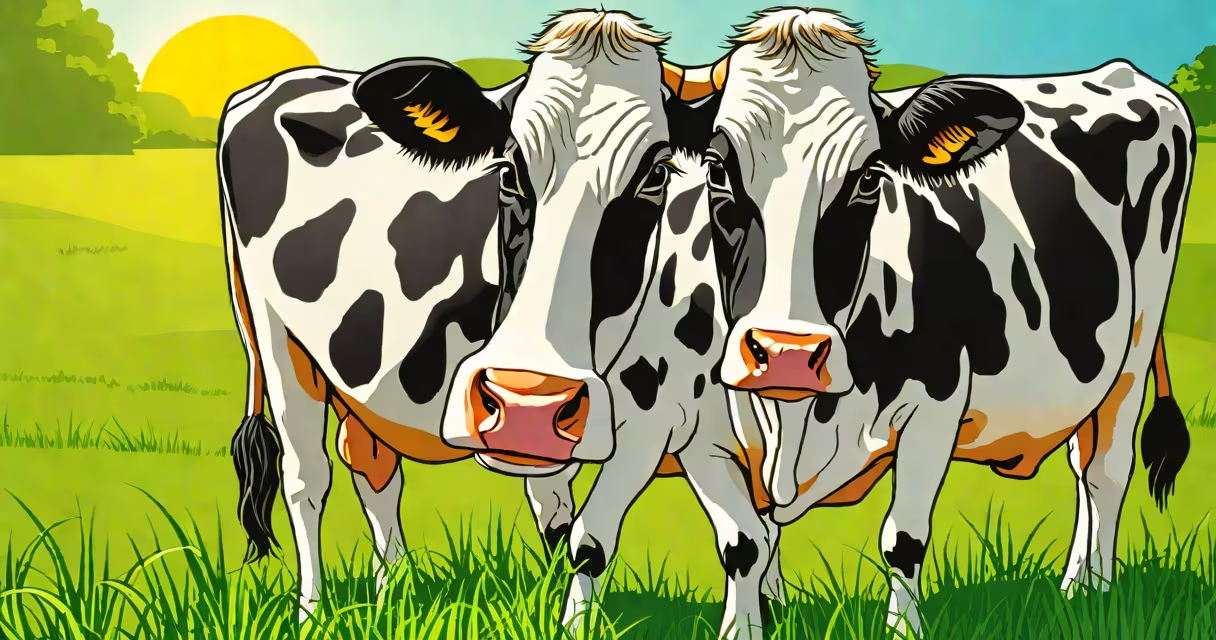
The cow's scientific name is Bos taurus. This binomial nomenclature identifies domestic cattle as a distinct species within the genus Bos, separate from wild bovines like bison or yaks.
Bos taurus evolved from the extinct aurochs (Bos primigenius) through selective breeding over 8,000 years. Modern cattle populations trace their lineage to early domestication in the Near East, particularly in regions now part of Turkey and Iran. The species includes over 1,000 recognized breeds, ranging from dairy-focused Holsteins to beef-oriented Angus and dual-purpose Shorthorns.
Scientific naming follows the International Code of Zoological Nomenclature (ICZN), which mandates that each species receive a unique two-part Latin name. The first part, Bos, denotes the genus. The second, taurus, refers to the male form of the animal and historically described the large, useful bulls seen in ancient Mesopotamian art and Roman texts.
Bos taurus is a taxonomic identifier, not a descriptive label. It doesn't indicate color, size, or function. A dairy cow and a beef steer both belong to this species regardless of breed or purpose. The name remains constant even as traits are altered through artificial insemination, embryo transfer, or gene editing.
For example, a Black Angus bull raised in Nebraska and a Brown Swiss cow bred in Switzerland both share the species name Bos taurus. Their differences lie in subspecies designations, breed-specific traits, and genetic markers-not in their fundamental biological classification.
When scientists reference "cattle" in research, they default to Bos taurus unless specifying a hybrid such as B. taurus × B. indicus (zebu crossbreeds). This precision prevents confusion between domestic cattle and closely related wild species like the gaur (Bos gaurus) or kouprey (Bos sauveli).
Cattle are grouped into two main categories based on morphology and genetics: taurine (Bos taurus) and indicine (Bos indicus). Taurine cattle originated in Europe and Western Asia. Indicine cattle, often called zebu, developed in South Asia and Africa, characterized by a prominent hump and larger ears.
| Type | Scientific Name | Origin | Key Traits |
|---|---|---|---|
| Taurine | Bos taurus | Western Eurasia | Smooth coat, no hump, adapted to temperate climates |
| Indicine | Bos indicus | South Asia | Hump on shoulder, loose skin folds, heat tolerance |
| Hybrid | Bos taurus × Bos indicus | Global | Combines hardiness and disease resistance with high milk yield |
Most commercial dairy herds in North America and Europe are taurine-based. Breeds like Holstein-Friesian and Jersey fall under Bos taurus. Beef production in Brazil and Australia relies heavily on indicine lines, especially Brahman and Santa Gertrudis crosses.
A common misconception is that all cattle are Bos taurus. In reality, hybrids make up nearly 30% of global cattle populations, especially in tropical regions where pure taurine breeds struggle with heat stress and parasite load.
Many assume that "cow" refers to a female bovine, but in biological terms, "cow" specifically describes a mature female of Bos taurus who has given birth to at least one calf. A young female is a heifer. A castrated male is a steer. These terms are not interchangeable in scientific or agricultural contexts.
Another error is equating Bos taurus with all bovids. The family Bovidae includes antelopes, goats, sheep, and buffalo. While all are ruminants, only Bos taurus and its close relatives belong to the tribe Bovini. For example, the African buffalo (Syncerus caffer) shares ecological roles with cattle but belongs to a different genus and subfamily.
Even within Bos taurus, variation exists. The American Brahman breed is often mislabeled as Bos taurus despite being a hybrid. Its genome contains significant Bos indicus ancestry. True Bos taurus breeds maintain minimal indicine admixture-typically less than 5%-to preserve breed purity.
Consider the Holstein-Friesian, the most common dairy breed worldwide. It is classified as Bos taurus taurus, indicating its origin in Northern Europe. This subspecies is known for high milk yield-averaging 30,000 liters per lactation cycle-and a distinctive black-and-white coat pattern.
In 2022, a study published in Genetics Selection Evolution analyzed whole-genome sequences from 1,200 Holstein-Friesian cows across five continents. Researchers confirmed that all samples shared a core set of genetic markers consistent with Bos taurus taurus, confirming the breed's taxonomic stability despite decades of selective breeding.
This genetic consistency allows international trade standards to rely on species identification. The World Organisation for Animal Health (WOAH) requires documentation of Bos taurus status for cross-border movement of live animals and meat products.
During fieldwork in Nakuru County, Kenya, I observed a mixed herd of local Boran cattle and imported Friesian crosses. All animals were labeled as "cattle" in local records. However, DNA testing revealed that 68% of the herd carried Bos indicus alleles due to historical crossbreeding.
Despite phenotypic similarities-large horns, long legs, and brown coats-the presence of indicine DNA meant these animals were not pure Bos taurus. This distinction matters for disease control, export regulations, and conservation efforts focused on preserving native taurine lineages.
Bos taurus is part of the subfamily Bovinae, which includes around 10 genera and 30 species. It shares a recent common ancestor with the European bison (Bison bonasus) and the American bison (Bison bison), though these are now classified in separate genera.
Comparative genomics shows that Bos taurus diverged from the ancestral bovine lineage approximately 6 million years ago. This divergence predates human agriculture by several million years, meaning the species existed in wild form long before domestication.
The term "cow scientific name" refers unambiguously to Bos taurus. This designation underpins everything from veterinary medicine to food safety protocols. Understanding it ensures accurate communication across disciplines-from farm management to evolutionary biology.