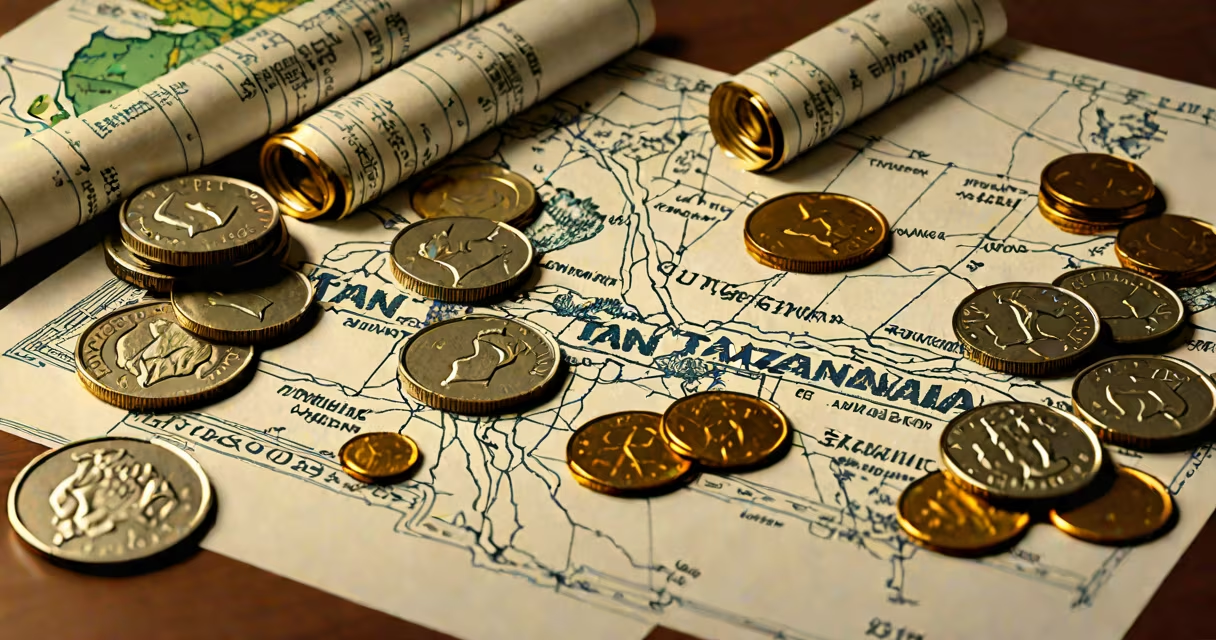
The official currency of Tanzania is the Tanzanian shilling (TZS), introduced in 1966 to replace the East African shilling after Tanzania's independence. It is issued and regulated by the Bank of Tanzania, the country's central bank, and circulates throughout mainland Tanzania and Zanzibar.
TZS operates as a floating exchange rate system, meaning its value fluctuates daily based on market demand, inflation, and foreign trade balances. As of June 2024, one U.S. dollar traded at approximately 2,750 TZS, though rates vary between banks and exchange offices.
Local businesses, markets, and government services accept only TZS. Foreign visitors must exchange dollars, euros, or British pounds at authorized bureaux de change or banks to access local spending power. ATMs in urban centers like Dar es Salaam and Arusha dispense TZS, but cash withdrawal limits apply.
The Tanzanian shilling is divided into 100 cents, though cents are rarely used in everyday transactions due to low purchasing power. Prices are quoted in whole shillings, and rounding is common in retail settings.
Physical currency includes polymer banknotes in denominations of 100, 200, 500, 1,000, 2,000, and 5,000 TZS. Coins exist in 1, 5, 10, 20, and 50 cents, and 1, 5, 10, and 20 shillings. The 5,000 TZS note features Julius Nyerere, Tanzania's first president, on the front and a scene of traditional farming on the reverse.
Electronic payments are growing. Mobile money platforms like M-Pesa allow users to send and receive TZS via smartphone. Over 80% of adults in Tanzania have access to mobile financial services, according to the World Bank's Global Findex Database (2021).
Denominations are designed with national symbols, cultural motifs, and prominent historical figures. Security features include watermarks, microprinting, and color-shifting ink.
| Denomination | Front Design | Reverse Design | Material |
|---|---|---|---|
| 100 TZS | Julius Nyerere | Mount Kilimanjaro | Polymer |
| 500 TZS | Julius Nyerere | Traditional dance group | Polymer |
| 1,000 TZS | Julius Nyerere | Coastal fishing village | Polymer |
| 5,000 TZS | Julius Nyerere | Farming in rural Tanzania | Polymer |
Older notes featuring Tanganyika's first president, Julius Nyerere, remain legal tender. Counterfeit shillings are rare but reported in tourist-heavy areas like Zanzibar and Serengeti National Park. Always check for security features when handling cash.
TZS is used in all commercial transactions within Tanzania. Street vendors in Dar es Salaam charge 5,000 TZS for a grilled chicken skewer. A taxi ride from Arusha city center to the airport costs around 12,000 TZS. Public transport fares range from 200 to 500 TZS depending on distance.
Foreign exchange controls limit how much TZS individuals can take out of the country. Travelers may carry up to 10 million TZS in cash when leaving, but must declare amounts exceeding 5 million TZS at customs. This rule aims to prevent capital flight during economic instability.
Businesses often quote prices in both TZS and USD for international clients. A hotel room in Zanzibar might list at 150,000 TZS or $55. This dual pricing helps tourists compare values across currencies.
Many assume that Kenyan shillings (KES) are accepted in border towns like Musoma or Tabora. While KES appears in informal markets near the Kenyan border, it is not legal tender in Tanzania. Acceptance is limited to barter or unofficial exchanges, and rates differ from official ones.
Another misconception is that all Tanzanian banknotes feature Julius Nyerere. While he appears on most higher-denomination notes, the 100 TZS note shows a woman harvesting cassava-a nod to agricultural labor and gender equity in national identity.
A less known fact: the Bank of Tanzania issues commemorative coins for special events. In 2023, a 20 TZS coin honored the 60th anniversary of Tanzania's independence. These coins are not widely circulated but are collected by numismatists.
In July 2023, I traveled to Ngorongoro Crater for a safari. I exchanged $100 at a licensed bureau in Moshi. The rate was 2,720 TZS per USD. After buying a 5,000 TZS meal at a lodge, I paid 1,000 TZS for a guided walk through the crater rim. The guide accepted only cash-no card terminals were available.
I used M-Pesa to send 20,000 TZS to my sister in Dar es Salaam. The transaction took 12 seconds and cost 500 TZS in fees. She received the funds instantly and withdrew them at a local agent.
When returning to Nairobi, I converted 300,000 TZS back to KES at a border exchange office. The rate was 1.15 KES per 100 TZS-slightly worse than the official rate. I lost 15,000 TZS in fees and exchange loss. This illustrates how currency conversion costs accumulate during travel.
Tanzania does not belong to the East African Community's proposed common currency, the Eco. While Kenya, Uganda, and Rwanda plan to adopt the Eco by 2025, Tanzania has delayed implementation due to concerns over monetary sovereignty and inflation control.
Unlike Nigeria's naira or South Africa's rand, the Tanzanian shilling is not freely convertible. The Bank of Tanzania restricts foreign exchange trading to authorized dealers. This reduces volatility but limits access for international investors.
For comparison, the U.S. dollar is accepted in luxury hotels and tour operators, but not in small shops or public transport. In contrast, in countries like the UAE, the U.S. dollar is interchangeable with the local dirham. In Tanzania, USD is a secondary currency, not a substitute.
Understanding the role of currency in Tanzania is essential for travelers, expatriates, and investors. The Tanzanian shilling remains the foundation of domestic economic activity and a key indicator of national fiscal health.
Exchange rate movements are tracked through platforms like XE.com and the Bank of Tanzania's monthly reports. These documents show that TZS depreciated by 12% against the USD in 2023 due to rising import costs and lower export revenues.
currency in Tanzania is not just a medium of exchange-it reflects national history, economic policy, and social priorities. Its design, circulation, and regulation reveal deeper truths about governance and development in East Africa.