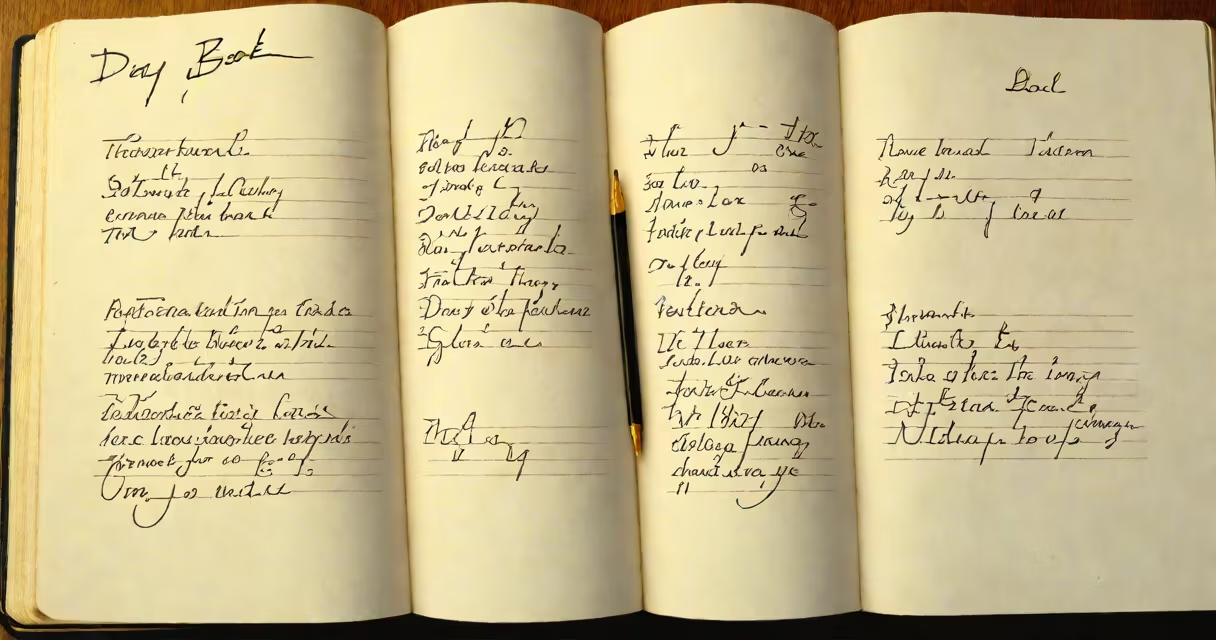
A day book, in accounting, is a chronological record of daily financial transactions before they are transferred to formal ledgers. It captures details like date, description, amount, and account codes, serving as the first step in maintaining accurate financial records.
Day books are foundational in double-entry bookkeeping systems. They ensure that every transaction is logged in sequence, reducing errors during later posting. Without a day book, businesses risk missing entries or duplicating them, which can distort financial statements.
For small businesses and sole proprietors, a day book may be a simple notebook or spreadsheet. Larger organizations often use digital accounting software that automatically generates day book entries in real time. The key function remains unchanged: capture raw transaction data early and consistently.
Each entry in a day book follows a standard format: date, transaction type (e.g., sale, payment, purchase), description, debit and credit amounts, and reference numbers. These entries are recorded as they happen-daily, not monthly or quarterly.
Once the day book is complete, accountants transfer selected entries to corresponding general ledger accounts. This process, called posting, maintains the integrity of the double-entry system. For example, a $500 cash sale appears as a $500 credit in the sales account and a $500 debit in the cash account-both entries originate from the day book.
Modern accounting platforms like QuickBooks or Xero generate day book records automatically. When a user enters a customer invoice, the system logs it in the day book under "sales" and updates the relevant ledger accounts instantly. This reduces manual effort and minimizes human error.
Businesses use different types of day books based on transaction type. Common categories include:
| Type | Purpose | Example Entry |
|---|---|---|
| Sales Day Book | Records all credit sales | March 5: Sold $1,200 of goods to ABC Corp on 30-day terms |
| Purchases Day Book | Tracks credit purchases | March 6: Bought $800 in office supplies from XYZ Supplier |
| Cash Receipts Day Book | Logs incoming cash | March 7: Received $300 from client D for services rendered |
| Cash Payments Day Book | Documents outgoing cash | March 8: Paid $450 rent via bank transfer |
Some firms combine multiple entries into a single day book, especially if volume is low. Others maintain separate books for better control and audit trails. The choice depends on scale, regulatory requirements, and internal controls.
Day books are essential in any business that tracks income and expenses systematically. They're required by tax authorities in many countries, including the U.S. and UK, as part of proper bookkeeping standards.
The IRS mandates that businesses keep records of all financial activity. A day book provides a clear audit trail. If auditors question a $10,000 expense, the business can trace it back to the original entry in the day book, including the vendor name, date, and supporting document reference.
For instance, a retail store owner using a day book to log daily sales reported $12,400 in revenue over a week. When reconciling with the bank statement, discrepancies were found. Rechecking the day book revealed two duplicate entries totaling $1,800. Correcting them restored accuracy. This example shows how day books prevent financial misstatements.
Many people confuse a day book with a general ledger. The day book is the initial recording point; the general ledger is the consolidated view. Think of the day book as a draft, the ledger as the final copy.
Another misconception is that day books are obsolete due to digital tools. This is false. Even automated systems rely on day book logic. Software doesn't eliminate the need-it automates it. Without a structured day book layer, digital systems can still produce errors if input is inconsistent.
A lesser-known fact: in some jurisdictions, such as India, the Companies Act requires companies to maintain day books for audit purposes. Failure to do so can result in penalties. The law doesn't specify format-paper or digital-but demands chronological order and retention for seven years.
I once helped a local bakery set up its accounting system. The owner used a notebook to track daily sales and payments. Entries were handwritten, sometimes messy, and occasionally missed. After switching to a digital day book in Excel with auto-calculations, reconciliation time dropped from four hours weekly to under 30 minutes. The clarity improved dramatically-especially during tax season.
This experience confirmed that the day book's value lies not in the medium but in the discipline of consistent, timely logging. Whether handwritten or digital, the principle remains: record first, analyze later.
Day book meaning differs from "daybook" as a personal planner. While both contain daily entries, a financial day book tracks monetary transactions, not appointments or goals. Confusing the two leads to misplaced expectations.
Also, avoid mixing up "day book" with "journal." In accounting, a journal is a broader term for any record of transactions. A day book is a specific kind of journal focused on daily entries. Not all journals are day books, but all day books are journals.
Understanding day book meaning is critical for anyone managing finances. It's not just a historical tool-it's a practical, ongoing requirement for transparency, compliance, and sound decision-making.