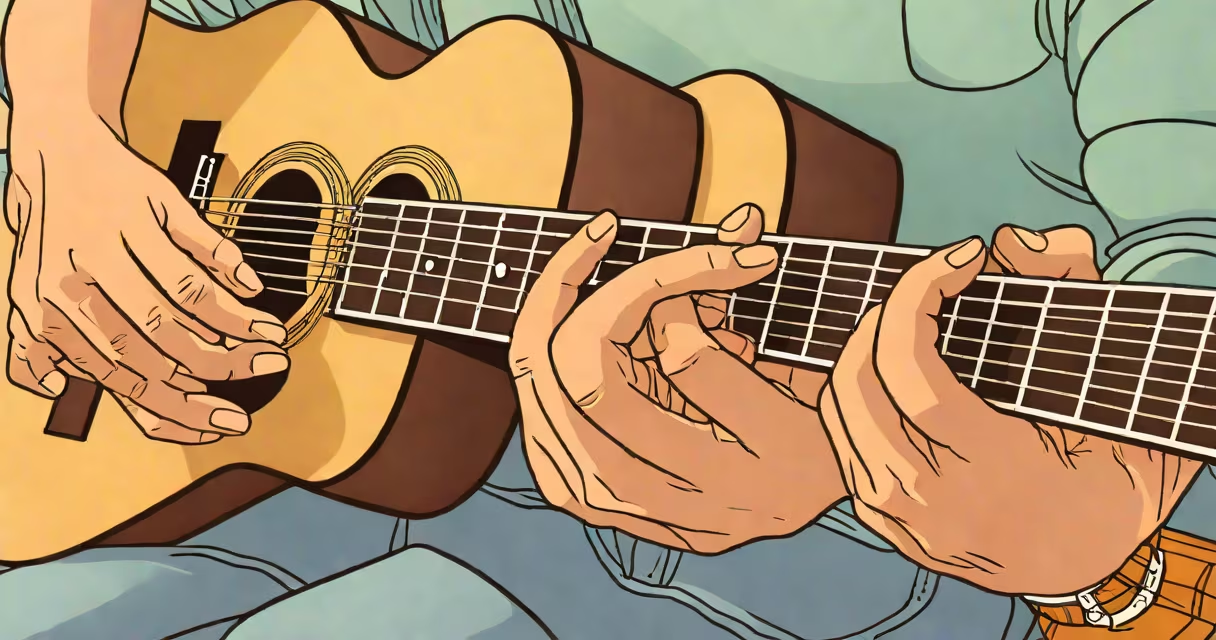
gratitude guitar chords are simple, emotionally resonant chord progressions often built from open-position major and minor chords, designed to express warmth, reflection, and appreciation. They typically use common fingerings found in beginner-friendly songs and emphasize smooth voice leading and steady rhythm.
These chords work because they align with natural vocal ranges and intuitive hand positions. Most progressions use I-IV-V or I-vi-IV patterns, which sound balanced and familiar. For example, G-C-D (I-IV-V in G major) appears in hundreds of folk and pop songs expressing thankfulness. The ease of switching between these chords makes them ideal for players who want to connect through music without complex techniques.
Many gratitude guitar chords appear in songs about peace, family, and personal growth. They're not limited to any single genre-acoustic rock, country, gospel, and indie folk all use them. Their power lies in simplicity: you don't need advanced skills to convey deep feeling. A few well-placed chords can create space for introspection, shared singing, or quiet moments of connection.
They rely on harmonic stability and predictable movement. Chord changes that follow the circle of fifths or use stepwise bass motion feel natural to the ear. This reduces cognitive load, allowing focus on tone, dynamics, and expression rather than mechanics.
For instance, the progression C-G-Am-F (I-V-vi-IV in C major) is widely used in songs expressing gratitude. It moves through stable tonal centers and resolves smoothly. The Am chord introduces a touch of melancholy, which contrasts gently with the brighter C and G chords-this emotional contrast enhances sincerity.
Players often use alternate tunings or capos to make these progressions easier to sing along with. A capo on the 2nd fret shifts C-G-Am-F to D-A-Bm-G, raising the key while keeping the same fingering. This helps match the singer's range without changing the chord shapes.
Three core progressions dominate gratitude guitar chords:
| Progression | Key Example | Emotional Effect | Use Case |
|---|---|---|---|
| I-IV-V (e.g., G-C-D) | "Here Comes the Sun" (George Harrison) | Uplifting, warm | Weddings, celebrations, morning routines |
| I-vi-IV-V (e.g., C-Am-F-G) | "Let It Be" (The Beatles) | Reflective, comforting | Funerals, quiet evenings, personal meditation |
| ii-V-I (e.g., Dm-G-C) | "Hallelujah" (Leonard Cohen) | Intimate, spiritual | Prayer settings, small gatherings, solo performances |
Each progression uses chords that share common tones. In C-Am-F-G, the notes C, E, and G appear in multiple chords, creating continuity. This overlapping harmony supports a sense of cohesion, making the music feel grounded and sincere.
Some players avoid barre chords to maintain accessibility. Open chords like G, C, D, Em, and Am require minimal finger strength and are easy to learn. These are the building blocks of most gratitude-based songs.
gratitude guitar chords are central to community music events. Churches, support groups, and wellness retreats often feature them in group singing. Their simplicity allows people of all skill levels to participate without anxiety over mistakes.
At a mindfulness workshop I attended last year, participants sat in a circle and played C-G-Am-F together. No one had formal training. We started slowly, then added soft strumming and humming. After ten minutes, the room felt lighter. One woman said she hadn't cried in months-until that moment. The chords didn't fix anything. But they created space for emotion to surface.
They're also used in therapy and grief counseling. Research from the American Music Therapy Association shows that structured chord progressions reduce cortisol levels during sessions. Simple, repeating patterns help regulate breathing and calm nervous systems. The act of playing becomes a form of nonverbal communication.
People often mistake gratitude guitar chords for "easy" music. But ease doesn't mean shallow. A simple progression can carry deep meaning. The difference lies in intention and delivery-not complexity.
Another misconception is that these chords only suit acoustic instruments. While they're most common in fingerstyle or strummed acoustic settings, they work on electric guitars too-especially with reverb and delay effects. The emotional weight comes from phrasing, not gear.
A lesser-known fact: many gratitude chords are derived from modal scales, not just major/minor. The Dorian mode, for example, uses a minor 6th scale degree. Songs like "Blackbird" (Beatles) use Dm-G-C-F progressions that lean into Dorian tonality. This gives them a bittersweet quality-thankful, but aware of loss. That duality adds authenticity.
"Let It Be" uses the I-vi-IV-V progression in C major: C-Am-F-G. Here's how to play it step-by-step:
Play each chord for four beats. Use a slow, even strum. Add a light palm mute on the G chord to create a breath-like effect. Sing softly or hum. The goal isn't perfection-it's presence.
This progression appears in let it be guitar chords with full tablature and audio reference. It's one of the most-requested progressions for beginners learning to express emotion through music.
When choosing chords for gratitude, prioritize consistency over variety. Stick to a few trusted progressions. Master them in multiple keys. Practice transitioning slowly until muscle memory forms. Then, let the mood guide your tempo and volume.
gratitude guitar chords aren't about technical brilliance. They're about showing up-with your hands, your voice, and your attention. The music isn't meant to impress. It's meant to invite others in.