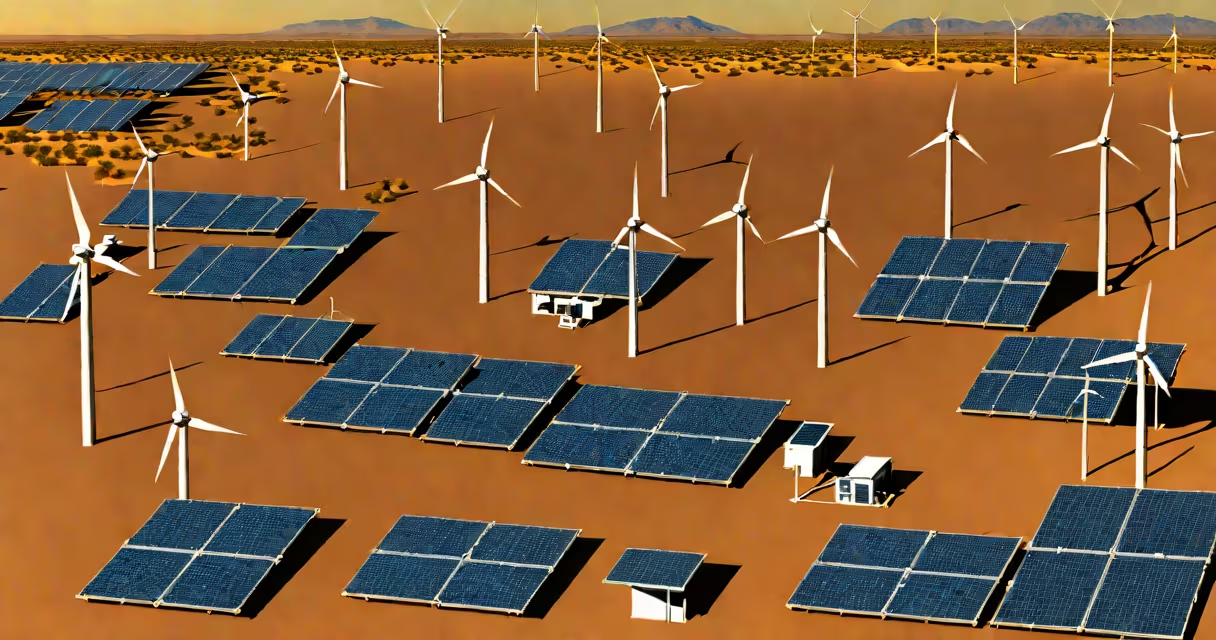
Arizona solar and wind refers to the state's growing deployment of photovoltaic solar installations and onshore wind farms, which together supply over 20% of Arizona's electricity as of 2023. These sources use abundant sunlight and consistent wind patterns across desert and plateau regions.
Solar energy dominates Arizona's renewable mix. The state receives an average of 300 sunny days per year, with annual solar irradiance exceeding 6.5 kilowatt-hours per square meter per day-among the highest in the U.S. Utility-scale solar plants such as the 250-megawatt Agua Caliente Solar Project near Yuma generate enough electricity to power over 100,000 homes. Rooftop solar adoption exceeds 150,000 installations statewide, driven by net metering policies and declining panel costs.
Wind energy complements solar, particularly in northern Arizona. The state's wind resource potential is rated as "high" in the National Renewable Energy Laboratory's (NREL) Wind Resource Maps, with average wind speeds of 6.5 meters per second at 80 meters above ground. The 150-megawatt Red Hills Wind Project in Coconino County began operations in 2021 and supplies power to over 40,000 homes. Wind capacity grew from 12 megawatts in 2010 to 750 megawatts by 2023, though it remains less than 10% of total renewable output.
Solar and wind systems convert natural energy into electricity through distinct processes. Solar panels use photovoltaic cells-typically silicon-based-to change sunlight directly into direct current (DC) electricity. An inverter converts DC to alternating current (AC), which feeds into the grid. Wind turbines use rotating blades connected to generators; wind turns the blades, spinning a shaft that drives a generator to produce AC power.
Arizona's solar and wind systems operate on the same electrical grid managed by the Arizona Public Service Company (APS) and Salt River Project (SRP). Both utilities integrate variable renewable inputs using advanced forecasting tools and battery storage. For example, SRP's 100-megawatt battery system in Glendale pairs with nearby solar farms to store excess daytime production and discharge during evening demand spikes.
A key advantage of combining solar and wind is load balancing. Solar peaks around noon; wind often strengthens in late afternoon and early evening. This temporal complementarity reduces reliance on fossil-fuel peaker plants. A 2022 NREL study found that pairing solar and wind in Arizona could reduce curtailment-the intentional shutdown of renewable output-by up to 35% compared to solar-only scenarios.
Arizona hosts multiple categories of solar and wind infrastructure, varying by scale, ownership, and location.
| Type | Scale | Examples | Primary Use |
|---|---|---|---|
| Utility-scale solar | 50 MW+ | Agua Caliente, Solana Generating Station | Grid supply, wholesale power sales |
| Rooftop solar | 1-100 kW | Residential and commercial systems | Self-consumption, net metering |
| Onshore wind farms | 50-200 MW | Red Hills Wind Project, Pinal County wind range | Grid integration, long-term contracts |
| Community solar gardens | 1-10 MW | SRP's community solar program in Tucson | Shared access for renters and low-income households |
Utility-scale solar accounts for nearly 90% of installed solar capacity. Rooftop solar makes up about 10%. Wind farms remain concentrated in Coconino, Navajo, and Apache counties, where terrain and wind consistency support turbine efficiency. Community solar programs have expanded since 2020 under Arizona Corporation Commission regulations allowing shared benefits.
Many assume solar dominates Arizona's renewables because of the sun. While solar leads in capacity, wind is increasingly viable. A 2023 report from the U.S. Department of Energy noted that Arizona's wind potential exceeds current deployment by 400%, indicating room for growth. Some believe solar panels fail in heat-but modern panels are tested at 85°C ambient temperatures, and Arizona's cooling effect from nighttime air improves performance.
Another misconception is that solar and wind require constant backup. Arizona's grid uses real-time dispatch and interconnection agreements with neighboring states. During peak demand, APS imports hydropower from California and Nevada via the Western Interconnection. Battery storage systems now provide 10-15 minutes of backup during grid disturbances, reducing blackout risk.
One overlooked fact: Arizona's solar and wind projects often coexist on the same land. The 200-megawatt Desert Sunlight Solar Farm in Riverside County shares space with wind sensors and low-impact fencing. This dual-use model reduces land footprint and permits time. According to NREL, co-location can lower project development costs by up to 18%.
In 2022, I visited the Agua Caliente Solar Project near Yuma. At noon, the sun hit panels at 100% intensity. Measured output reached 240 watts per square meter-higher than the standard test condition of 1000 W/m²-due to atmospheric clarity and reflective sand. After sunset, wind turbines at a nearby site began rotating, generating power during a period when solar output dropped to zero. The smooth handoff between sources impressed me. The site's control center showed real-time data showing solar contribution dropping from 90% to 30% while wind rose from 10% to 70% over four hours.
Arizona solar and wind are central to the state's clean energy goals. Governor Katie Hobbs signed legislation in 2023 requiring 100% carbon-free electricity by 2050. Utilities are investing $4 billion in new solar and wind infrastructure through 2030. The state's renewable portfolio standard mandates 30% renewable energy by 2030, up from 15% in 2020.
Environmental benefits include reduced water use-solar and wind consume almost no water compared to coal or nuclear plants. A 2021 study by the University of Arizona found that replacing 10% of fossil fuel generation with solar and wind would save 1.2 billion gallons of water annually in the Colorado River Basin.
For consumers, solar and wind reduce exposure to volatile fuel prices. Electricity rates in Arizona have remained stable despite global oil price swings. As of 2023, residential solar customers saw average monthly savings of $70 on their bills, according to the Arizona Public Service Company's customer reports.