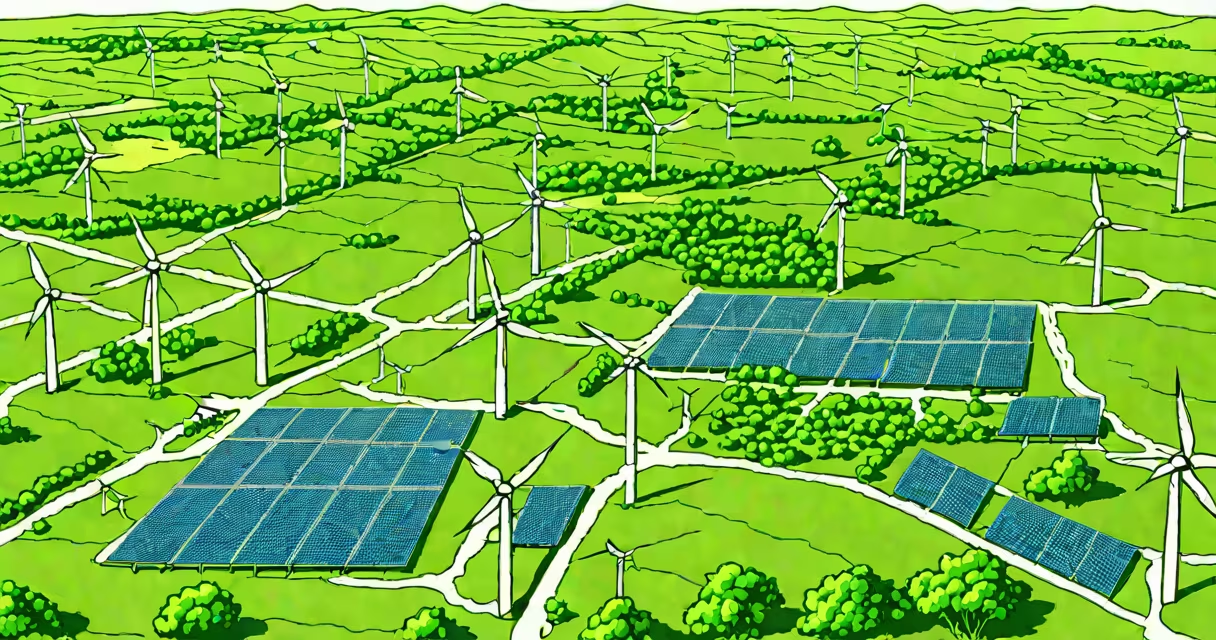
Green energy is power derived from natural, replenishable sources such as sunlight, wind, rain, tides, and geothermal heat. It produces little to no greenhouse gas emissions during operation and plays a key role in reducing dependence on fossil fuels.
Unlike coal or oil, which release carbon dioxide when burned, green energy sources emit minimal pollutants. This makes them essential for combating climate change and improving air quality. The International Energy Agency (IEA) reports that renewable energy accounted for nearly 30% of global electricity generation in 2023, with solar and wind leading growth.
Green energy is not a single technology. It includes solar photovoltaic panels, wind turbines, hydropower plants, biomass systems, and geothermal installations. These technologies convert natural flows into usable electricity without depleting finite resources.
Green energy systems capture natural phenomena and convert them into electrical current. Solar panels use semiconductors to turn sunlight into direct current (DC), which inverters then convert into alternating current (AC) for home and grid use. Wind turbines spin blades with moving air, driving generators that produce electricity.
Hydropower relies on flowing water-often from dams or rivers-to turn turbines. Geothermal systems tap underground heat reservoirs to generate steam that powers turbines. Biomass energy burns organic material like wood chips or agricultural waste, though it requires careful management to avoid deforestation and high emissions.
A 2022 study by the National Renewable Energy Laboratory (NREL) found that utility-scale solar farms in the U.S. achieve average efficiency rates of 18-22%, while offshore wind projects reach 40% capacity factors-meaning they run near full output more than 40% of the time.
The following table outlines major forms of green energy, their typical outputs, and common deployment settings.
| Type | Energy Source | Typical Output (per unit) | Common Use Cases |
|---|---|---|---|
| Solar PV | Direct sunlight | 250-400 watts per panel | Residential rooftops, commercial buildings, utility-scale farms |
| Onshore Wind | Wind speed ≥ 6 m/s | 2-5 MW per turbine | Rural areas, offshore zones, large grids |
| Offshore Wind | Consistent coastal winds | 10-15 MW per turbine | Coastal regions with high wind potential (e.g., UK, Denmark) |
| Hydropower | Flowing water in rivers or dams | 100 MW-2 GW per plant | Nationwide grids, especially in mountainous or rainy climates |
| Geothermal | Subsurface heat (300-400°C) | 50-200 MW per facility | Regions with volcanic activity (e.g., Iceland, California) |
Each system has distinct site requirements. For example, solar panels perform best in sunny climates like Arizona or southern Spain. Offshore wind farms require consistent wind patterns and access to deep coastal waters, limiting deployment to specific geographic zones.
Green energy powers homes, businesses, and entire cities. In 2023, Denmark generated 55% of its electricity from wind alone, while Uruguay runs over 95% of its grid on renewables. California mandates that 60% of its electricity come from renewables by 2030, with solar and wind as primary drivers.
Grid integration remains a challenge. Solar and wind are intermittent-sun doesn't shine at night, and wind doesn't blow constantly. Energy storage solutions like lithium-ion batteries or pumped hydro storage help balance supply and demand. A 2021 report from the U.S. Department of Energy found that battery storage capacity grew 300% between 2018 and 2022, supporting higher renewable penetration.
One non-obvious fact: green energy is not automatically low-carbon throughout its lifecycle. Manufacturing solar panels involves mining silicon and rare earth metals, which can have environmental costs. A 2020 study published in *Nature Energy* showed that the carbon footprint of producing a standard solar panel is about 40 grams of CO₂ per kilowatt-hour over its lifetime-far lower than coal's 820 g/kWh, but still measurable.
Green energy is often confused with "clean energy," but the two aren't interchangeable. Clean energy refers broadly to any source that produces low emissions. Nuclear power is sometimes labeled clean due to low operational emissions, but it's not green because uranium is mined and generates long-lived radioactive waste.
Another misconception: green energy is always expensive. In 2023, the levelized cost of electricity (LCOE) for utility-scale solar fell to $24 per megawatt-hour in the U.S., below both new coal ($60/MWh) and gas ($40/MWh). Onshore wind averaged $26/MWh-making it one of the cheapest sources of new power.
I once visited a community solar project in rural Colorado where residents collectively owned 120 panels on a shared field. The system fed excess power into the local grid and reduced household bills by 15-25%. The cooperative model proved effective for underserved areas lacking rooftop space or credit for individual installations.
Green energy is most effective when paired with supportive infrastructure and regulations. Countries like Germany and Sweden have invested heavily in smart grids and feed-in tariffs, which guarantee payments for renewable producers. These policies accelerated adoption and stabilized markets.
Consumers can choose green energy through utility programs or third-party providers. In the U.S., over 10 million households now subscribe to green power plans, often at no extra cost compared to standard electricity. These plans typically match customer usage with renewable generation from certified sources.
Green energy is a foundational element of a low-emission future. Its expansion hinges on technological innovation, equitable access, and sustained public investment. As global demand grows, green energy will continue to reshape how societies produce and consume power.