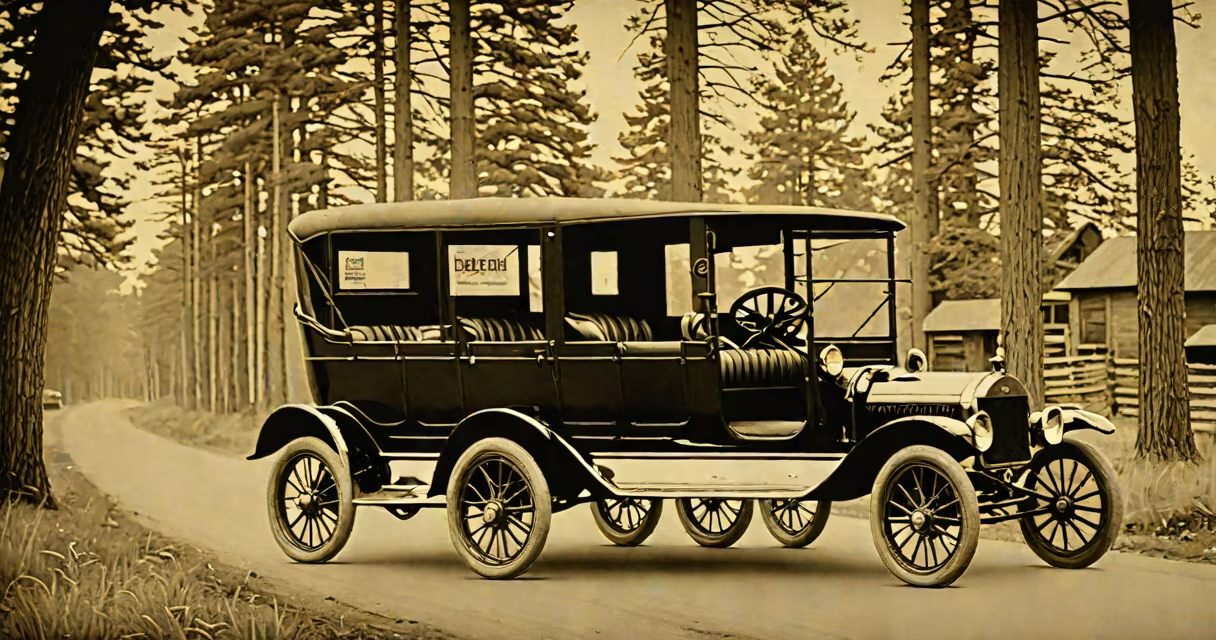
The history of car spans over 130 years, beginning with steam-powered prototypes in the 1860s and evolving into mass-produced gasoline-powered vehicles by the early 20th century, culminating in today's electric and autonomous models.
Automobiles emerged from experimental designs in the late 1800s. The first practical cars used internal combustion engines fueled by gasoline. These machines replaced horse-drawn carriages in urban areas and reshaped city planning, transportation networks, and daily life. By 1910, the United States had over 1 million registered vehicles, a figure that grew to 26 million by 1950.
Early cars were hand-built and expensive. The Ford Model T, introduced in 1908, changed that. It was the first vehicle designed for mass production using assembly-line techniques. Over 15 million units were sold between 1908 and 1927. This model made car ownership accessible to average Americans and set the foundation for modern manufacturing.
Internal combustion engines convert fuel into motion through controlled explosions. A piston moves inside a cylinder, turning a crankshaft. That rotation powers the wheels via a transmission. Early systems lacked electronic controls, relying on mechanical linkages and carburetors.
By the 1970s, emissions regulations forced changes. Catalytic converters reduced pollutants. Electronic fuel injection improved efficiency. The 1980s saw the rise of computerized engine management, allowing precise control over air-fuel mixtures and ignition timing.
Modern cars integrate hundreds of sensors and microprocessors. They monitor tire pressure, brake wear, engine temperature, and driver behavior. These systems enable features like adaptive cruise control and lane-keeping assist. The shift from mechanical to digital control began in earnest during the 1990s.
Automobiles fall into categories based on function, size, and power source. The table below outlines major types and their defining traits.
| Type | Power Source | Typical Use | Examples |
|---|---|---|---|
| Passenger Sedan | Gasoline or hybrid | Personal commuting, family transport | Ford Taurus, Toyota Camry |
| SUV | Gasoline, diesel, or electric | Off-road capability, cargo space | Honda CR-V, Tesla Model Y |
| Electric Vehicle (EV) | Electric motor, battery pack | Urban driving, low emissions | Tesla Model 3, Nissan Leaf |
| Hybrid | Gasoline engine + electric motor | Improved fuel economy | Toyota Prius, Honda Insight |
Each type reflects changing priorities. Gasoline cars dominated until the 2000s due to infrastructure and range limitations. EVs gained traction after 2010, supported by government incentives and improvements in battery density. The average range of EVs increased from under 100 miles in 2010 to over 300 miles in 2023, according to the U.S. Department of Energy.
Cars remain central to personal mobility in countries with low population density. In the United States, 90% of trips under 10 miles are made by car, according to the Federal Highway Administration. In contrast, cities like Tokyo and Amsterdam have higher public transit usage, limiting car ownership per capita.
Urban planning evolved around car use. Suburbs expanded with highways. Shopping centers developed parking lots. This pattern led to traffic congestion and environmental strain. Cities now implement congestion pricing and low-emission zones to reduce impact.
Car sharing and ride-hailing services have altered ownership models. In 2022, 18% of U.S. adults reported using a rideshare service monthly, up from 8% in 2015, per Pew Research Center. These platforms reduce individual car ownership while increasing vehicle utilization rates.
Many assume the automobile was invented in the United States. The first gasoline-powered car was built in Germany by Karl Benz in 1886. His Patent-Motorwagen used a single-cylinder engine and ran at 10 km/h. It predates the Ford Model T by over two decades.
Another misconception is that electric cars are a new invention. The first electric vehicle appeared in 1830, built by Scottish inventor Robert Anderson. He used a non-rechargeable battery. Electric cars saw brief popularity in the early 1900s, especially in the U.S., where they outperformed gasoline models in quietness and ease of operation. But limited range and lack of charging infrastructure led to their decline.
A lesser-known fact: the first traffic light was installed in London in 1868. It used gas lamps and was operated manually. When it exploded, police banned automated signals for decades. The modern electric traffic light didn't appear until 1920, after advances in electrical engineering.
I once restored a 1957 Chevrolet Bel Air. The original engine required manual carburetor tuning. Adjusting the idle speed took 20 minutes of trial and error. After replacing the distributor cap and rotor, the car ran smoothly. That experience showed me how much mechanical knowledge was required before electronic systems took over.
Consider the 1969 Dodge Charger. It had a 426 cubic inch V8 engine producing 425 horsepower. Its 0-60 mph time was 5.2 seconds. Today, a 2023 Tesla Model S Plaid achieves 0-60 mph in 1.99 seconds. Performance has advanced dramatically, but the core purpose remains unchanged: moving people quickly and efficiently.
Despite technological leaps, the history of car reveals consistent patterns. Innovation responds to demand. Infrastructure shapes adoption. Safety regulations drive design. Environmental concerns influence power sources. The path from steam to silicon shows that progress is iterative, not linear.
Understanding the history of car clarifies current debates about autonomy, electrification, and urban mobility. It shows that today's challenges-range anxiety, charging access, traffic safety-are echoes of past struggles. Solutions evolve, but the goal remains the same: safe, efficient, and accessible movement.