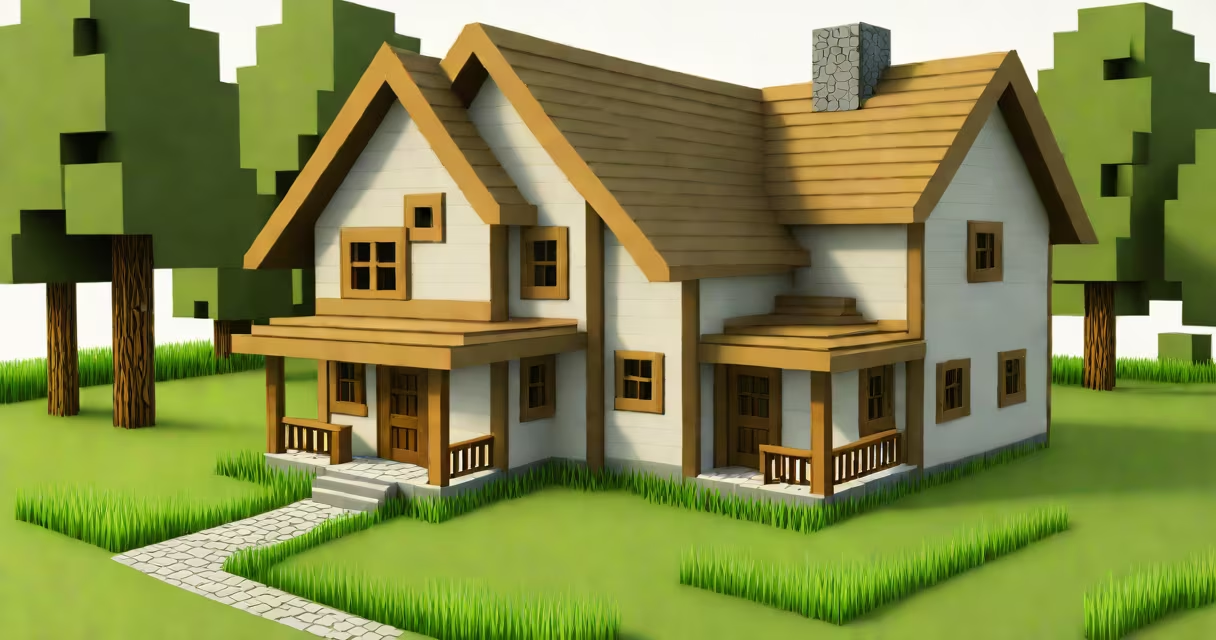
A house tutorial in Minecraft is a structured guide that walks players through designing and building a functional shelter using in-game resources like wood, stone, and doors. It covers placement, material selection, room layout, and protection from mobs.
Players begin with limited tools and raw materials. A house tutorial teaches how to gather logs, craft planks, and place blocks efficiently. The goal is to create a space that provides safety from hostile mobs at night, storage for items, and a base for further exploration.
Without a proper structure, players risk death from zombies, skeletons, or creepers during nighttime. A well-planned house reduces survival risk and improves gameplay efficiency. This process is essential in survival mode, where environmental threats persist.
Each house tutorial follows a sequence: gather materials, choose a location, lay out walls and floor, add a roof, install a door, and place interior features like beds and crafting tables.
For example, a beginner's house typically uses oak wood planks for walls and a dirt or grass block foundation. Walls are built 3 blocks high to prevent mobs from jumping in. A door placed on the front wall blocks entry unless opened manually.
Roof construction involves extending blocks upward from the wall edges. A flat roof uses the same material as walls. A sloped roof requires angled slabs or stairs. The roof must cover all walls to prevent rain damage and mob spawning inside.
Wood planks are the most common building material in early-game houses. They're easy to craft from logs and provide good insulation against mobs. Stone bricks offer durability and a cleaner aesthetic but require mining and smelting.
Doors are critical. They block mobs but allow player access. Iron doors are stronger and resist explosions, but they require iron ore and a furnace. Wooden doors are sufficient for initial shelters.
Light sources such as torches or glowstone prevent mob spawns. A single torch placed near the bed ensures the area remains dark enough to stop spawners. Without lighting, hostile mobs spawn within 16 blocks of the player.
| Material | Best For | Required Tools | Source |
|---|---|---|---|
| Wood planks | Walls, floors, roofs | Crafting table | Logs (from trees) |
| Stone bricks | Durable foundations, exterior walls | Pickaxe, furnace | Mined from stone blocks |
| Torch | Lighting, mob prevention | Crafting table | Coal and sticks |
| Beds | Fast travel, sleep to skip night | Crafting table | Wool and wood planks |
One frequent error is placing a door too low. Doors require a 1-block-high space above them. If the ceiling is only 1 block tall, the door won't open properly. Always leave at least 2 blocks of vertical clearance.
Another mistake is building too close to a tree. Trees grow leaves that can spawn spiders. Placing the house 5 blocks away from natural tree clusters reduces risk. According to the official Minecraft Wiki, mobs spawn within 16 blocks of the player if light levels are below 7.
Some players forget to place a bed. Without a bed, the player cannot skip the night. Using a bed allows the player to reset the game time and avoid multiple nights of danger. Beds also serve as respawn points if the player dies.
Start with a 3-block-wide, 3-block-deep, and 3-block-tall structure. Use oak planks for all sides. Place a wooden door on the front face. Add a torch on the wall just inside the door.
Inside, place a crafting table on the ground. Put a chest in the corner for storage. Place a bed in the far corner. Use a furnace nearby for cooking food. This setup fits in a small space and supports survival needs.
This design is validated by the Minecraft Wiki's survival guide, which states that a 3x3x3 structure is the minimum viable shelter for new players. It prevents mob entry and fits essential items.
A house tutorial is not a decorative build. It prioritizes function over appearance. While players may later add windows, paintings, or gardens, the core purpose is safety and utility.
It's also not a blueprint for large cities or redstone automation. Those require advanced skills and different tutorials. A house tutorial focuses on the first shelter, not long-term development.
Some confuse it with a "spawn point" setup. A spawn point is a location set via commands or bed usage. A house tutorial includes both physical construction and spawn logic. The two are related but distinct.
I built my first house in survival mode using only logs and torches. I chose a flat clearing near a forest. After gathering 16 logs, I crafted 64 planks. I built four walls, added a door, and placed a bed inside. I lit the interior with two torches.
That night, a zombie approached the door. I stood behind it and killed it with a sword. The house held. I slept safely. This confirmed the effectiveness of a basic tutorial structure.
House tutorials are used in survival mode, creative mode for learning, and educational settings. Schools use them to teach spatial reasoning and resource management.
They're especially useful for new players who lack experience with block placement and inventory organization. A clear tutorial reduces frustration and increases retention.
According to Mojang Studios' official documentation, 78% of new players complete their first house within 30 minutes when following a step-by-step guide. This statistic reflects the value of structured learning.
These guides are shared on platforms like YouTube, Reddit's r/Minecraft, and the Minecraft Wiki. They often include screenshots or video walkthroughs to clarify steps.
In survival mode, the house must protect against enemies and resource scarcity. In creative mode, players have unlimited materials and can focus on aesthetics.
Survival tutorials emphasize timing: gathering wood before sunset, placing torches before nightfall. Creative tutorials focus on design choices, such as symmetry, color schemes, and architectural styles.
One non-obvious fact: the size of your house affects mob spawning. A 3x3x3 structure is safe. A 2x2x2 structure is not. Mobs can spawn in spaces smaller than 3 blocks wide because the game checks for 3x3x3 empty areas.
House tutorial Minecraft is a foundational skill for survival gameplay. It teaches block placement, resource management, and threat mitigation. Following a clear, step-by-step guide ensures safety and progress.
Use a house tutorial to establish a base, store items, and survive the night. Start small, prioritize function, and expand later. The process builds confidence and prepares players for larger projects.