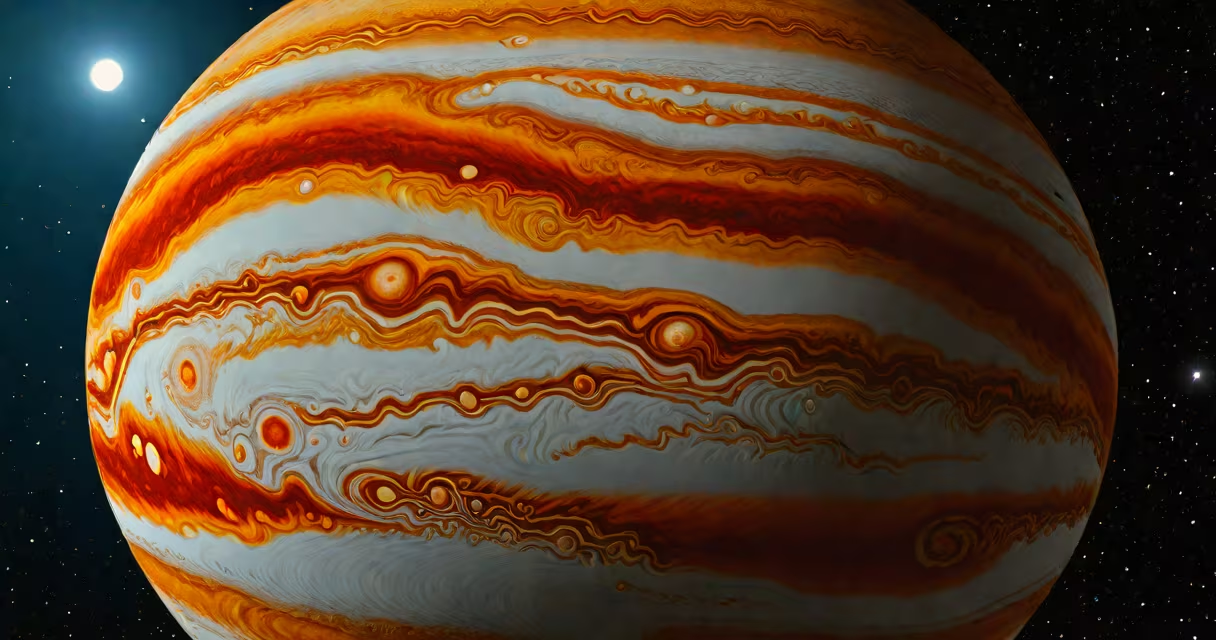
Jupiter is the largest planet in our solar system, a gas giant with a massive storm called the Great Red Spot that has raged for at least 350 years. It orbits the Sun at an average distance of 778 million kilometers and takes 12 Earth years to complete one orbit.
Jupiter is a gas giant, meaning it lacks a solid surface. Its visible cloud layers are made of ammonia, water ice, and methane, forming swirling patterns driven by useful winds. The planet rotates faster than any other in the solar system-once every 10 hours-causing extreme weather and a noticeable equatorial bulge.
Scientists have confirmed 95 moons orbit Jupiter, including four large ones discovered by Galileo in 1610: Io, Europa, Ganymede, and Callisto. Ganymede is the largest moon in the solar system, even bigger than the planet Mercury. Europa's icy crust may hide a salty ocean beneath, making it a prime target in the search for extraterrestrial life.
Jupiter generates more heat than it receives from the Sun. This internal heat drives intense atmospheric activity, including storms and lightning. Lightning bolts on Jupiter are 1,000 times stronger than those on Earth and occur deep within the cloud layers.
The planet's magnetic field is 20,000 times stronger than Earth's. This field traps charged particles, creating radiation belts so intense they can damage spacecraft. NASA's Juno probe, which entered orbit in 2016, uses a radiation-shielded vault to protect its instruments while studying Jupiter's atmosphere and interior.
When Juno arrived, it captured images of Jupiter's poles showing cyclones arranged in geometric patterns. These storms are stable and have lasted for years, defying earlier models of atmospheric behavior.
Not all features on Jupiter are visible from Earth. Here's a breakdown of key structures:
| Feature | Description | Size/Scale |
|---|---|---|
| Great Red Spot | A persistent high-pressure storm larger than Earth | 16,000 km wide (1.5x Earth's diameter) |
| Equatorial Bands | Dark and light stripes caused by wind shear | Span entire planet, extend thousands of km |
| Polar Cyclones | Multiple storms at poles, arranged in hexagonal patterns | Each ~1,000 km wide |
| Ring System | Faint dust ring from moon impacts | Only 10,000 km wide, invisible from Earth |
These features form due to Jupiter's rapid rotation and lack of a solid surface. Unlike Earth, where weather systems last days or weeks, Jupiter's storms persist for centuries because there's no land to disrupt them.
Many think Jupiter is a star because of its size. It's not-it lacks the mass needed to trigger nuclear fusion. To become a star, Jupiter would need 80 times more mass. Instead, it's a failed star, a term scientists use to describe brown dwarfs, which Jupiter nearly qualifies as.
Another myth is that Jupiter's surface is rocky. The planet has no surface at all. Any attempt to "land" would result in falling through clouds until pressure crushes the craft. The Juno probe flew through the upper atmosphere at 200,000 km/h and never touched solid ground.
Some believe Jupiter's rings are bright like Saturn's. They're actually dark and thin-only 10,000 km wide-and made of dust from micrometeorite impacts on its moons. They were only detected by Voyager 1 in 1979.
Jupiter acts as a cosmic vacuum cleaner. Its gravity pulls comets and asteroids away from the inner solar system. Scientists estimate it prevents about 300,000 impacts per year on Earth by deflecting objects.
In 1994, Comet Shoemaker-Levy 9 collided with Jupiter, leaving scars visible for months. The impact released energy equivalent to 6 million megatons of TNT-over 100 times more than all nuclear weapons ever tested combined.
I once watched a live feed from the Hubble Space Telescope during a Jupiter storm event. The video showed a new storm forming in minutes, growing from a small swirl to a feature larger than Earth in under 24 hours. The speed and scale reminded me why planets aren't static-they're changing worlds shaped by forces we're still learning to measure.
Jupiter is often compared to Saturn, another gas giant. While both are composed mostly of hydrogen and helium, Saturn has a lower density and a more prominent ring system. Jupiter is 318 times more massive than Earth, while Saturn is 95 times more massive.
Mercury, the smallest planet, is only 4,880 km wide-about 1/10 the width of Jupiter. If you placed Mercury inside Jupiter's Great Red Spot, it would fit with room to spare. Jupiter's volume is so vast that 1,300 Earths could fit inside it.
Jupiter facts for kids cover more than size and color. They include planetary science, space exploration, and the role of gravity in shaping our solar system. Understanding Jupiter helps explain why Earth is stable and how other planets form.
With ongoing missions like Juno and planned future probes, Jupiter remains a frontier of discovery. Its storms, moons, and magnetic fields offer clues about how planets evolve-and whether life could exist beyond Earth.
Learning about Jupiter isn't just about memorizing numbers. It's about seeing how nature operates on a grand scale, where time and motion work differently than on Earth. That's what makes jupiter facts for kids both educational and inspiring.