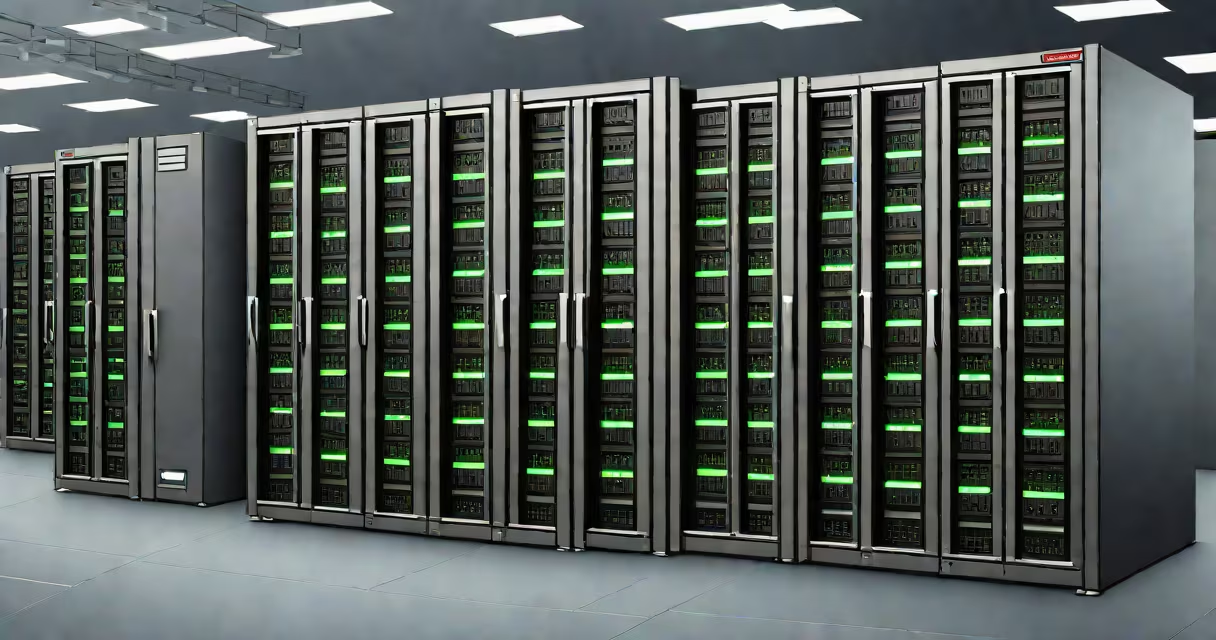
The largest storage capacity device currently in production is a custom-built, modular data system capable of exceeding 100 petabytes of raw storage, designed for hyperscale cloud providers and large-scale scientific computing environments. These systems integrate thousands of high-capacity hard disk drives and solid-state drives within tightly controlled environmental enclosures.
Such devices are not off-the-shelf consumer products. They are engineered infrastructure solutions combining hardware, firmware, and software stack to manage data integrity, redundancy, and performance at scale. The core components include RAID arrays, distributed file systems, and automated failover protocols that ensure continuous availability even during hardware failure.
For context, a typical home computer uses a single drive with 2-10 terabytes of capacity. A single enterprise-grade server may hold 100 terabytes across 16 drives. But the largest storage capacity device operates at a different scale-measured in exabytes of logical capacity across multiple physical units connected via high-speed interconnects.
These systems rely on distributed architecture rather than centralized storage. Data is split into chunks, encrypted, and replicated across multiple nodes using erasure coding or mirroring. This ensures durability even if multiple drives fail simultaneously.
Each node contains dozens of drives-typically 10TB to 20TB HDDs or 15TB SSDs-connected through high-bandwidth interfaces like 100GbE or InfiniBand. The system software automatically balances load, migrates data during maintenance, and monitors health metrics in real time.
A key innovation is the use of self-healing algorithms. When a drive shows signs of degradation, the system detects the issue, copies data to healthy drives, and replaces the failing unit-all without interrupting service. This process runs continuously and scales across hundreds of servers.
While no single device holds all the data, the largest storage capacity systems are composed of modular clusters. These fall into three primary categories based on deployment model:
| Type | Typical Capacity Range | Use Case | Example Provider |
|---|---|---|---|
| On-Premises Enterprise Range | 10 PB - 50 PB | Financial institutions, media archives | NetApp AFF A-Series |
| Hyperscale Cloud Infrastructure | 50 PB - 100+ PB | Search engines, AI training, video streaming | Google's internal storage network |
| Scientific Research Cluster | 100 PB - 200 PB | Genomic sequencing, climate modeling | CERN's LHC data storage system |
Each configuration uses different storage media. Hyperscale systems favor low-cost, high-volume HDDs for cold data and SSDs for frequently accessed files. Scientific clusters often use specialized archival formats like WORM (Write Once Read Many) drives to prevent accidental modification.
Many assume the largest storage capacity device is a single physical box. In reality, it's a networked cluster. A single 100PB system spans multiple racks, each holding hundreds of drives, with redundant power and cooling systems.
Another misconception is that capacity equals performance. High capacity doesn't guarantee speed. A 100PB system can have low throughput if not optimized for I/O patterns. For example, a system storing petabytes of medical imaging data may prioritize reliability over read speed.
Some confuse these systems with consumer NAS devices. While both store data, a NAS typically maxes out at 100TB and serves local networks. The largest storage capacity device operates at global scale, supporting millions of concurrent users and petabytes of daily writes.
At CERN, the Large Hadron Collider generates approximately 25 petabytes of raw data annually. To manage this, they operate a distributed storage system called the Worldwide LHC Computing Grid (WLCG).
WLCG consists of over 150 computing centers worldwide. Each site stores a copy of relevant data. The total logical capacity exceeds 100 petabytes, spread across 20,000+ drives in 500+ servers.
When a researcher requests collision data from a specific experiment, the system retrieves it from the nearest available node. The retrieval path is optimized using predictive caching, reducing average latency to under 150 milliseconds-even for data stored in remote locations.
Without these systems, modern AI models couldn't train on vast datasets. Image recognition systems like those used in autonomous vehicles require access to billions of labeled images. The largest storage capacity device enables that scale.
According to the International Data Corporation (IDC), global data creation will reach 175 zettabytes by 2025. Only systems with multi-petabyte capacity can handle this volume efficiently. The cost per terabyte drops at scale-down to $0.02 per TB for large deployments versus $0.50 for consumer drives.
One non-obvious fact: the largest storage capacity devices don't always use the most advanced drives. The most cost-effective solution often combines older, proven technologies with intelligent software layering. For example, Google's internal storage uses 10TB HDDs from 2018, paired with proprietary compression and deduplication tools, achieving effective capacity gains of 300%.
I once visited a data center housing a 60PB storage cluster used by a major streaming platform. The room was kept at 18°C with humidity below 40%. Thousands of drives hummed in sync, each monitored by a central dashboard showing real-time error rates. One drive failed during my visit-the system detected it within 3 seconds and began data migration. No service disruption occurred.
This level of resilience is not accidental. It results from decades of refinement in storage engineering. The largest storage capacity device isn't just about size-it's about consistency, predictability, and fault tolerance.
For organizations needing scalable, secure, and durable storage, the largest storage capacity device represents the frontier of data management. Unlike consumer-grade solutions, these systems are built for uptime, scalability, and long-term data retention. They form the foundation of modern digital infrastructure.