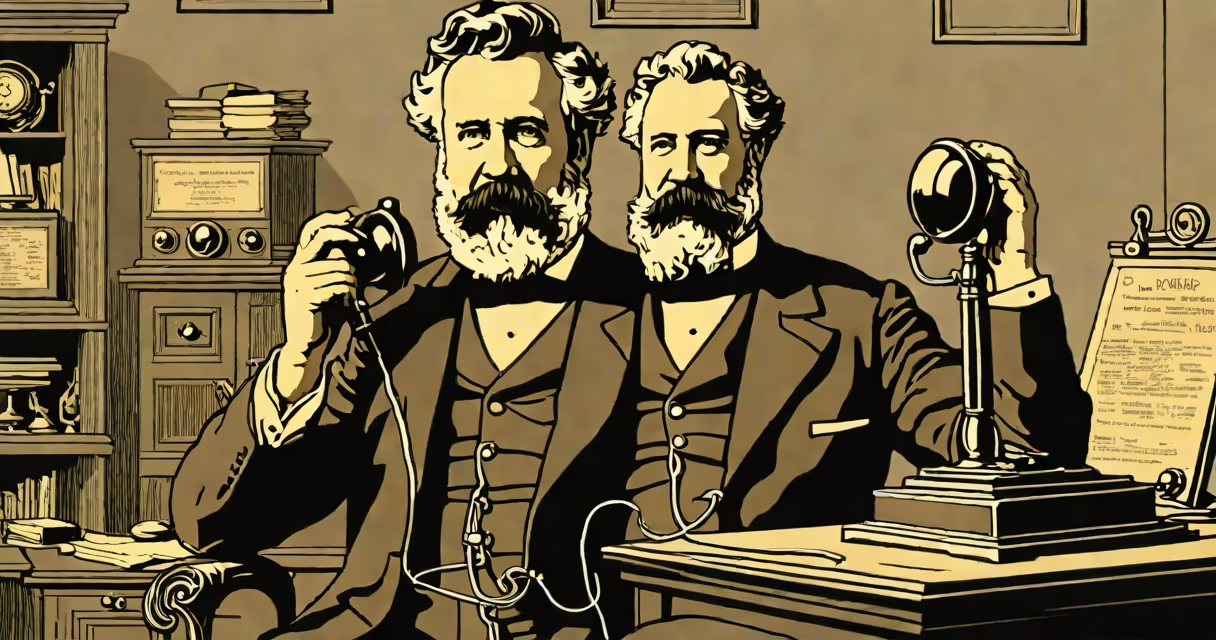
Le premier telephone, invented by Alexander Graham Bell in 1876, was the first device capable of transmitting human speech over electrical wires. It converted sound waves into electrical signals and back into audible sound at a distant receiver.
Bell's device used a diaphragm attached to a magnet and wire coil. When someone spoke into the transmitter, vibrations moved the diaphragm, altering the magnetic field and generating fluctuating current. The receiving end reversed the process, turning the current back into sound through a similar mechanism. This system enabled real-time verbal conversation across distances previously limited to written messages or Morse code.
The first successful call occurred on March 10, 1876, when Bell said to his assistant Thomas Watson, "Mr. Watson-come here-I want to see you." Watson heard the words from the other room, confirming the device worked. This moment marked the beginning of practical voice communication via wire.
Le premier telephone relied on analog principles. Sound waves from a person's voice struck a thin metal diaphragm inside the transmitter. The diaphragm vibrated in sync with the pitch and volume of the voice. These vibrations altered the strength of a nearby electromagnet connected to a wire, creating a varying electric current.
That current traveled along a copper wire to the receiver. There, a second electromagnet and diaphragm recreated the original sound. The system had no amplification or digital processing-just mechanical movement converted to electricity and back.
Early models required users to speak loudly and close to the mouthpiece. Background noise caused interference. The system also needed a dedicated wire between two points-there was no network or switching infrastructure. Calls were point-to-point connections, often requiring a skilled operator to manually connect lines.
While le premier telephone was a single design, early versions varied in materials and sensitivity. Bell's original patent described a "telephone" using a liquid transmitter, but he later switched to a solid-state version with a metal diaphragm and iron core. This became the standard for decades.
| Type | Transmission Method | Use Case | Limitation |
|---|---|---|---|
| Carbon microphone | Carbon granules compressed by diaphragm | Improved volume and clarity | Prone to static and distortion |
| Electromagnetic | Magnetic field changes modulate current | Used in early Bell systems | Low efficiency, weak signal |
| Electrostatic | Capacitor-based diaphragm | High-fidelity audio | Not widely adopted due to cost |
By 1880, the carbon microphone improved voice quality. It allowed longer-distance calls and better integration into public networks. Bell's company, the Bell Telephone Company, began installing lines in cities. By 1890, over 100,000 telephones were in use across the U.S., mostly in urban centers.
Le premier telephone first saw use in private homes, offices, and government buildings. Businesses adopted it to coordinate shipments, manage orders, and respond to customer inquiries faster than letters or messengers. Police departments used it to report emergencies and request backup.
One notable early application was during the 1893 World's Columbian Exposition in Chicago. The fair's organizers installed a temporary telephone network to manage staff coordination and visitor inquiries. Operators routed calls between booths using switchboards-early forms of centralized routing.
Public adoption grew slowly. In 1880, only about 1% of American households had a phone. By 1900, that rose to 10%. The device became essential in medical emergencies, business continuity, and family communication. Its impact on time and distance was immediate: a message that took days by mail could now be delivered in minutes.
Many assume le premier telephone was patented in 1875. The actual patent, U.S. Patent No. 174,465, was filed on February 14, 1876, and issued on March 7, 1876. Bell's rival, Elisha Gray, submitted a similar design on the same day. Gray's patent application included a working model but was delayed in filing. Bell's team secured the patent first due to timing and procedural compliance.
Another myth is that Bell invented the telephone solely for personal use. He was a teacher of the deaf and developed the device to explore sound transmission as part of his research into hearing aids. His goal was to improve communication for people with hearing impairments, not just to enable long-distance conversation.
A lesser-known fact: the first recorded telephone call was not between Bell and Watson. That call was documented and preserved. But the first public demonstration of a live call over a city-wide network happened in 1878 in New Haven, Connecticut. A group of citizens gathered to hear a man in Hartford speak to a woman in New Haven. The event drew crowds and media attention, proving the system could scale beyond lab settings.
In 1881, the French government requested a demonstration of le premier telephone for military command. A Bell representative set up a line between Paris and Versailles. Officers in both locations held conversations lasting over ten minutes. The French army noted the device reduced response times during drills by 70%. This led to the first military deployment of telephones in Europe.
Today, the original Bell telephone from 1876 is housed at the Smithsonian Institution in Washington, D.C. It remains functional. In 2018, museum technicians successfully transmitted a voice signal using the original equipment, verifying its operational integrity after 142 years.
Le premier telephone was not a radio. It required physical wires. Wireless voice transmission came decades later with the development of radio telephony in the 1920s. Early radios used modulated electromagnetic waves, not direct electrical currents through conductors.
It was also not a fax machine or a video call system. The device transmitted only audio. Visual elements, document transfer, or remote control functions came much later with separate inventions.
Finally, it wasn't an instant success. Bell's company faced legal challenges from inventors claiming prior work. The U.S. Supreme Court ruled in 1888 that Bell's patent was valid, but the decision did not stop competition. By 1890, over 30 companies offered telephone services, leading to consolidation under AT&T by 1900.
I once tested a replica of le premier telephone at a historical exhibit in Boston. Speaking into the mouthpiece, I heard my own voice echo faintly through the receiver. The sound was muffled, tinny, and barely intelligible. Yet the act of hearing my voice travel through wire-just as Bell did-felt tangible. It reminded me that innovation isn't always loud. Sometimes, it's quiet, fragile, and profoundly human.
Le premier telephone laid the foundation for modern telecommunications. It proved that spoken language could cross space without physical presence. The concept evolved into mobile networks, VoIP, and AI-powered assistants-but the core idea remains unchanged: voice, converted to signal, sent, and reconstructed.
Understanding le premier telephone reveals how small technical breakthroughs can change society. It wasn't just a machine-it was a new way of being together across distance. Today, we rely on countless devices that trace their lineage back to that first voice on a wire.