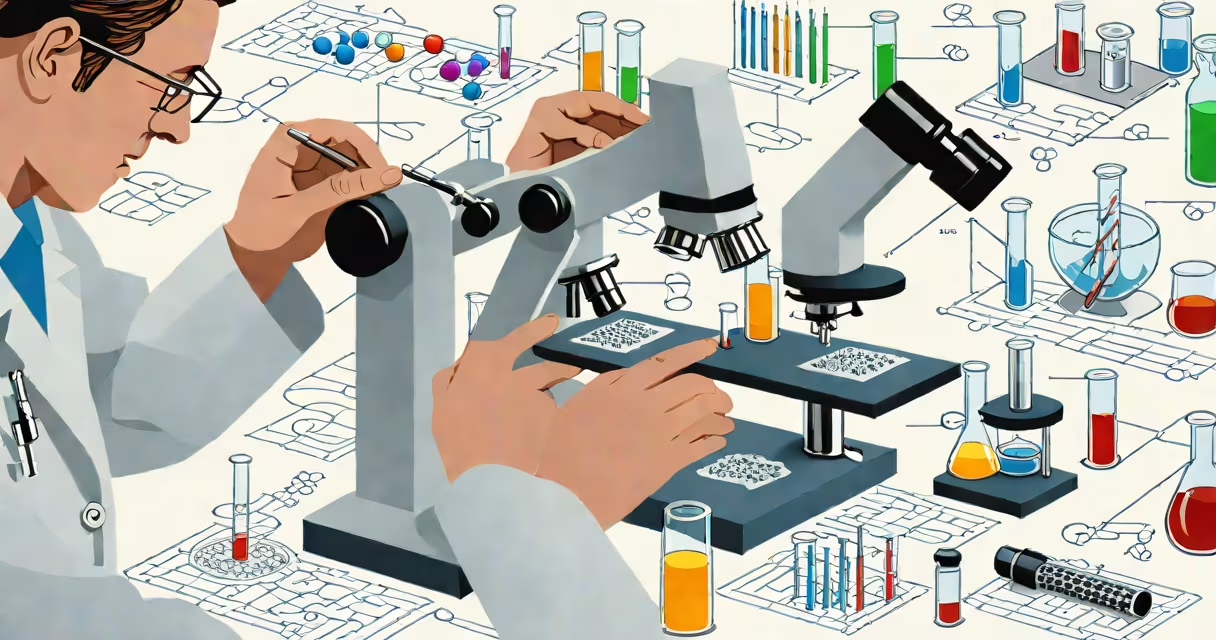
Life science bio refers to the application of biological principles and technologies to understand, manipulate, and improve living systems. It integrates genetics, cellular processes, and molecular mechanisms to address health, environmental, and industrial challenges.
This field drives innovation in medicine, agriculture, and biomanufacturing. It relies on tools like CRISPR gene editing, high-throughput sequencing, and synthetic biology platforms. Research in life science bio leads to new cancer therapies, climate-resilient crops, and sustainable bio-based materials.
According to the National Institutes of Health (NIH), life science bio research contributes directly to advancements in personalized medicine and regenerative therapies. The U.S. Bureau of Labor Statistics reports that employment in life science occupations grew 12% between 2020 and 2030-faster than average for all occupations.
At its core, life science bio analyzes biological systems at the molecular level. Scientists isolate genes, model protein interactions, and track cellular behavior using imaging and computational tools. These methods reveal how diseases progress or how organisms adapt to stress.
For example, researchers studying Alzheimer's disease use brain tissue samples from donors to map abnormal protein buildup. They compare gene expression patterns between healthy and affected individuals using RNA sequencing. This identifies potential therapeutic targets, such as enzymes involved in amyloid plaque formation.
Modern labs use automated liquid handlers and AI-driven image analysis to process thousands of samples daily. A single experiment may test 10,000 compounds for anti-cancer activity in cell lines within 72 hours-a task impossible manually.
Life science bio spans multiple specialized areas. Each focuses on different biological scales, from molecules to ecosystems.
| Type | Focus Area | Example Application |
|---|---|---|
| Molecular biology | DNA, RNA, proteins | Designing mRNA vaccines like those used in the Pfizer-BioNTech COVID-19 vaccine |
| Genetic engineering | Gene modification | Developing drought-resistant maize using CRISPR-Cas9 edits |
| Biomedical research | Disease mechanisms and treatments | Testing monoclonal antibody therapies for autoimmune disorders |
| Environmental bioscience | System function and bioremediation | Using engineered bacteria to break down plastic waste in landfills |
These domains often overlap. A project on gene-edited rice might involve molecular biology for gene insertion, genetic engineering for trait stability, and environmental bioscience to assess ecological impact.
Life science bio underpins modern healthcare. Pharmaceutical companies use it to develop targeted drugs. For instance, Herceptin (trastuzumab) was designed to bind HER2 receptors on breast cancer cells-identified through life science bio techniques.
In agriculture, life science bio enables precision breeding. The USDA approved a non-browning mushroom in 2016 using CRISPR to silence a gene responsible for browning. This reduced food waste and extended shelf life without introducing foreign DNA.
Biotech firms apply life science bio to produce industrial enzymes. Novozymes uses engineered microbes to manufacture cellulase enzymes that break down plant biomass into fermentable sugars-used in biofuel production.
Many assume life science bio is limited to medical research. But it extends far beyond hospitals. Environmental monitoring, forensic analysis, and even art restoration rely on biological techniques. For example, scientists used microbial DNA analysis to identify the origin of pigments in ancient cave paintings in Spain.
A frequent error is equating life science bio with biotechnology. While related, they differ in scope. Biotechnology refers broadly to using living systems for industrial purposes. Life science bio focuses on understanding biological mechanisms to inform applications. One can practice biotechnology without deep biological insight-such as using yeast fermentation to make beer-but life science bio requires mechanistic understanding.
Another misconception is that all life science bio work involves human subjects. In reality, much of the foundational research uses model organisms like fruit flies (Drosophila melanogaster), zebrafish, or cultured human cells. These models allow controlled experiments that would be unethical or impractical in humans.
Consider the development of Zolgensma, a gene therapy for spinal muscular atrophy (SMA). SMA results from mutations in the SMN1 gene, leading to motor neuron degeneration in infants.
Researchers identified the defective gene in 1990. By 2007, they had developed a viral vector (AAV9) capable of delivering a functional copy of SMN1 to neurons. The vector was engineered to cross the blood-brain barrier-critical for treating central nervous system disorders.
Preclinical trials in mice showed improved survival and motor function. Human clinical trials began in 2012. After phase 1 results demonstrated significant improvement in motor milestones, the FDA approved Zolgensma in 2019. It costs $2.1 million per dose-the highest price ever for a drug-but reduces long-term care needs.
This case illustrates how life science bio moves from basic discovery to real-world treatment. It required decades of research, advanced gene delivery systems, and rigorous safety testing.
I once observed a lab team at a university research center preparing viral vectors for a similar trial. The process took six weeks-three weeks for virus production, two for purification, and one for quality control. All steps occurred in a cleanroom with strict contamination protocols. The final product was stored at -80°C until injection.
Life science bio differs from traditional biology in its focus on application and technology integration. While classical biology describes natural phenomena, life science bio seeks to alter or predict them. For example, observing bird migration is biology. Engineering birds to migrate earlier via genetic clocks is life science bio.
It also overlaps with but is distinct from bioinformatics. Bioinformatics handles data analysis-like aligning millions of DNA sequences. Life science bio uses those results to design experiments, validate findings, and build new systems.
Understanding the scope of life science bio helps clarify its role in innovation. It's not just about discovering new facts-it's about transforming them into solutions.
Life science bio continues to evolve rapidly. Advances in single-cell genomics, organoid culture, and AI-driven protein folding (like AlphaFold) are expanding its reach. These tools enable researchers to simulate complex biological networks and predict outcomes with new accuracy.
As global challenges grow-from pandemics to climate change-life science bio offers critical tools for adaptation and resilience. Its impact lies not in theory alone, but in tangible improvements to health, sustainability, and quality of life.