The term "samaritan" in the Bible refers to someone from Samaria, a region north of Judea, and most famously appears in the parable of the good Samaritan-a story illustrating that compassion transcends ethnic and religious divides.
Samaria was the capital of the northern kingdom of Israel after the division following Solomon's death. The people of Samaria were descendants of the tribes of Ephraim and Manasseh, but intermarriage with foreign settlers during the Assyrian exile led to a mixed population. By the time of Jesus, Jews in Judea viewed Samaritans as outsiders, culturally and religiously distinct, and often hostile toward them.
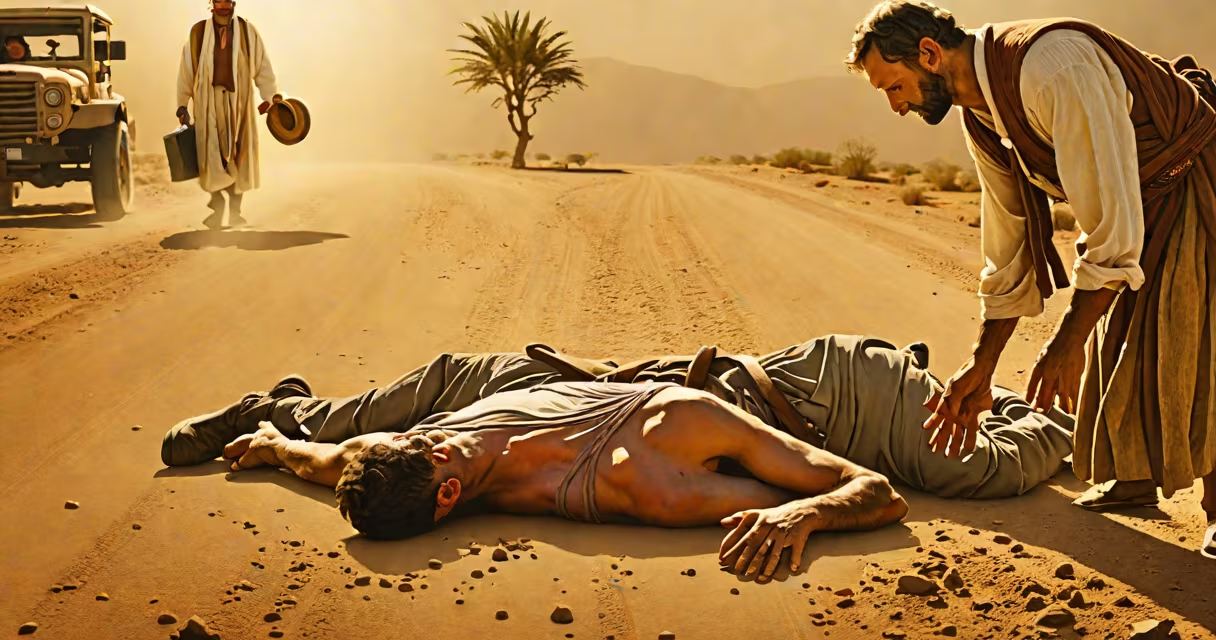
The term "good Samaritan" originates in Luke 10:25-37. A Jewish man traveling from Jerusalem to Jericho is attacked by robbers, stripped, beaten, and left half-dead. A priest and then a Levite pass by but avoid helping. A Samaritan arrives, sees the man, and stops. He tends to his wounds with oil and wine, places him on his donkey, takes him to an inn, and pays for his care.
This act shocked listeners. Samaritans were seen as enemies by Jews. The story subverts expectations: the person society would least expect to show mercy becomes the model of it. Jesus uses the parable to define "neighbor" not by blood or religion, but by action.
In the New Proof, "Samaritan" is not always positive. In John 4:9, Jesus speaks to a Samaritan woman at Jacob's well. His disciples are surprised because Jews typically avoided Samaritans. But Jesus engages her in conversation about worship and salvation, challenging the cultural divide.
Jesus calls the Samaritan "good" not because he is morally perfect, but because he acts with deliberate kindness. The Greek word used-καλός (kalos)-means "noble," "excellent," or "virtuous." It's not a moral judgment on the entire group, but a recognition of individual virtue.
Later, in Acts 8:26-40, Philip evangelizes an Ethiopian eunuch, but the Samaritans themselves are later baptized by Peter and John, showing early Christian inclusion. This marks a shift: Samaritans are no longer outsiders but part of the emerging church.
The Bible uses "Samaritan" in three main ways:
| Biblical Context | Meaning | Example |
|---|---|---|
| Geographic/ethnic reference | Person from Samaria | 2 Kings 17:24 - Assyrians settle in Samaria after deporting Israelites. |
| Religious outsider | Someone excluded from Jewish religious practice | John 4:9 - Disciples are amazed Jesus speaks to a Samaritan woman. |
| Moral exemplar | One who shows mercy regardless of prejudice | Luke 10:33-35 - The Samaritan treats the injured man with care. |
Modern usage often reduces "good Samaritan" to a generic term for anyone who helps strangers. But in the original context, the term carried political and theological weight. The Samaritan wasn't just kind-he broke social taboos.
A non-obvious fact: The wound described in the parable is consistent with ancient road violence. Robbers often targeted travelers on the 17-mile stretch between Jerusalem and Jericho, known for steep terrain and frequent ambushes. The man's injuries-likely deep lacerations and exposure-would have required immediate treatment. Oil and wine were standard antiseptics in the ancient world.
Many assume the Samaritan in the parable was a high-status figure. He was not. He was likely a common traveler, possibly a merchant or minor official. His actions cost him time and money-his donkey, his supplies, and his schedule. He didn't stop because he had spare resources; he stopped because he chose to act.
Another misconception: The priest and Levite ignored the man out of fear. The text doesn't say why they passed by. They may have feared ritual defilement from touching a corpse or dying man. According to Jewish law, touching a dead body rendered one unclean for seven days. But the man was still alive-this nuance is lost in many retellings.
Some interpret the parable as a call to charity only. But Jesus ends the story with a command: "Go and do likewise." The focus isn't on giving money-it's on doing something tangible. Compassion requires movement, not just feeling.
I once witnessed a similar moment during a storm in rural Pennsylvania. A trucker pulled over to help a stranded motorist whose car had stalled on a flooded road. The man was soaked, shivering, and unable to move. The trucker didn't ask for permission. He opened his cab, offered dry clothes, and drove the man to the nearest service station. When asked why, he said, "He looked like he needed help. I couldn't just drive past."
That moment mirrored the Samaritan's choice-not based on shared identity, but on seeing suffering and responding. The Samaritan didn't ask, "Are you my neighbor?" He acted first.
Today, the phrase "good Samaritan" is used in legal contexts. Many U.S. states have Good Samaritan laws protecting people who assist others in emergencies. These laws reflect the biblical idea that helping strangers is not optional-it's a moral duty.
The meaning of samaritan in the bible is not about geography or lineage. It's about choosing to see another human being in pain-and deciding to act.