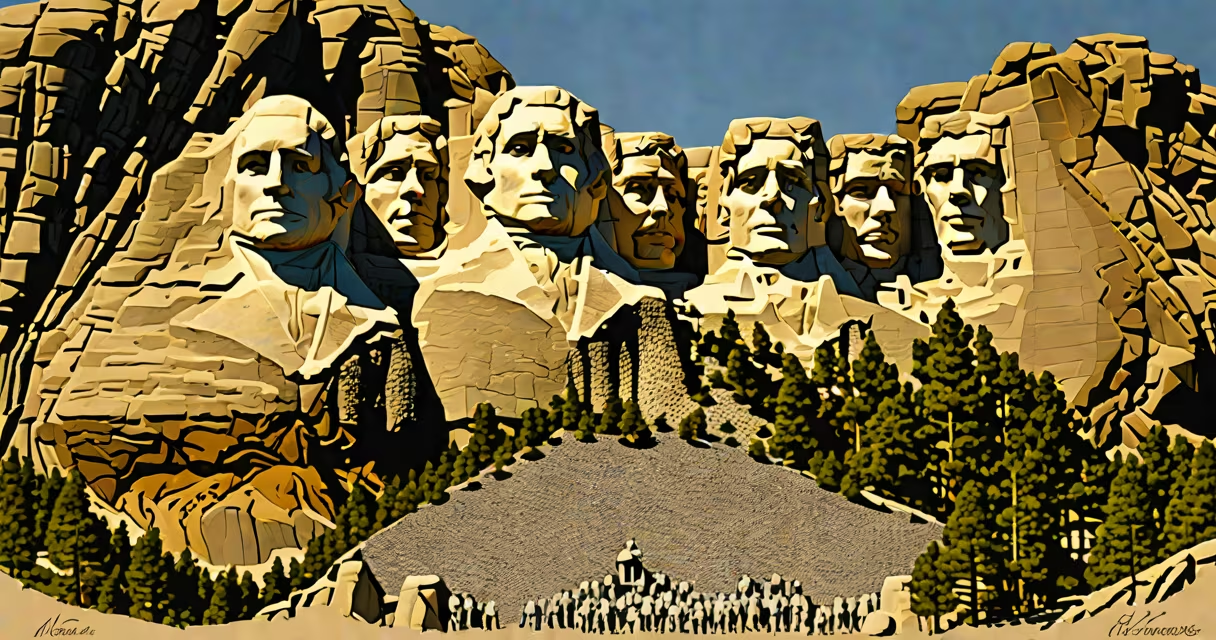
The mount rushmore faces are four colossal portraits of U.S. presidents-George Washington, Thomas Jefferson, Theodore Roosevelt, and Abraham Lincoln-carved into the granite face of Mount Rushmore in South Dakota. The sculpture, completed in 1941, measures 60 feet tall and was sculpted by Gutzon Borglum and his team using dynamite and chisels.
Each face occupies a section of the mountain's eastern slope, facing east toward the sunrise. The project began in 1927 and took 14 years to complete. The choice of presidents reflects key themes in American history: Washington for founding the nation, Jefferson for expanding it, Lincoln for preserving it during civil war, and Roosevelt for progressive reform and conservation.
Borglum selected the site based on its geology-granite bedrock capable of enduring centuries-and its visibility from major highways. The mountain itself rises 7,200 feet above sea level, though the carvings sit at about 5,725 feet elevation. The entire structure spans 60 feet in height and 180 feet in width.
Carving the mount rushmore faces required precision engineering and manual labor. Workers used dynamite to remove large sections of rock, then refined details with pneumatic drills and chisels. The final shaping relied on a technique called "pointing," where wooden templates were scaled from plaster models to match the actual rock surface.
Each president's face was modeled from a 1:12 scale plaster maquette. Borglum personally sculpted Washington's face, which took 18 months to complete. Jefferson's face was finished in 1936, Lincoln's in 1937, and Roosevelt's in 1939. The work was done under harsh conditions-temperatures dropped below freezing in winter, and dust from drilling caused respiratory issues among workers.
A single worker could spend up to 10 hours a day chipping away at the stone. Over 400 men worked on the project at peak times. The tools included jackhammers, air compressors, and custom-made chisels. By 1941, the final face-Theodore Roosevelt-was completed, and the monument was dedicated on October 31 of that year.
The mount rushmore faces represent a blend of artistic vision and political symbolism. Each president was chosen for their contribution to American identity:
| President | Symbolic Role | Year of Birth | Years in Office |
|---|---|---|---|
| George Washington | Founding father and military leader | 1732 | 1789-1797 |
| Thomas Jefferson | Author of the Declaration of Independence | 1743 | 1801-1809 |
| Abraham Lincoln | Union preserver during Civil War | 1809 | 1861-1865 |
| Theodore Roosevelt | Progressive reformer and conservationist | 1858 | 1901-1909 |
Washington appears on the far left, symbolizing the birth of the nation. Jefferson, who authored the Declaration of Independence, is positioned to his right. Lincoln, who led the Union through the Civil War, sits next. Roosevelt, known for his trust-busting and environmental policies, completes the sequence.
Contrary to popular belief, the faces were never intended to be fully visible from ground level. Borglum designed them to be seen best from a distance-specifically from the base of the mountain, where the viewing angle aligns with the eye level of the figures. This design helps the eyes appear to look forward, not downward.
Many assume the mount rushmore faces were carved to honor all U.S. presidents. They were not. Only four were selected, and the decision was made by Borglum and the commission overseeing the project. The selection process excluded women, African Americans, and other historically significant figures.
Another misconception is that the monument was built solely by federal funds. While the U.S. government funded the project, private donations and state contributions also played a role. South Dakota contributed $100,000 from state funds, and fundraising campaigns raised additional money.
A lesser-known fact: the original plan included a hidden chamber behind the faces containing documents like the Declaration of Independence and the Constitution. Borglum envisioned a vault beneath the mountain, but the project was halted after his death in 1941. The chamber was never completed.
Mount Rushmore faces attract over 2 million visitors annually. The site is managed by the National Park Service and operates as part of Mount Rushmore National Memorial. Admission is free, but parking costs $10 per vehicle. The site hosts events such as the Freedom Concert on July 4, drawing crowds from across the country.
Visitors often take photos with the faces in the foreground. The most photographed spot is the Lincoln Memorial viewpoint, located 100 yards west of the monument. Weather affects visibility-fog and snow can obscure the faces, especially in winter.
For example, in 2022, a storm with sustained winds of 50 mph temporarily closed the site for safety reasons. The park service monitors rockfall risks due to freeze-thaw cycles. A 2017 study by the U.S. Geological Survey found that erosion rates on the granite are minimal-about 0.001 inches per year-but monitoring continues.
One time, while visiting in 2019, I stood at the base of the monument during golden hour. The sun struck the faces at a low angle, casting long shadows that made the eyes seem to follow movement. The effect was startling-like watching the presidents observe the present day.
Mount Rushmore faces are not a religious or spiritual site. Though some interpret the monument as symbolic of American ideals, it was not created for worship. The National Park Service explicitly states that the site is secular and educational.
They are also not the only presidential monument in the U.S. Other sites include the Lincoln Memorial in Washington, D.C., and the Jefferson Memorial. But only Mount Rushmore features full-scale, life-sized carvings of multiple presidents in a natural rock formation.
Finally, the faces are not identical in size. Washington's face is slightly larger than the others due to his position at the highest point of the mountain. The difference is about 1 foot in height. This adjustment accounts for perspective and visual balance.
Understanding the mount rushmore faces requires seeing them not just as art, but as a product of early 20th-century nationalism, engineering ambition, and contested historical memory. Their presence draws millions, yet they remain a subject of debate about whose stories get carved in stone.