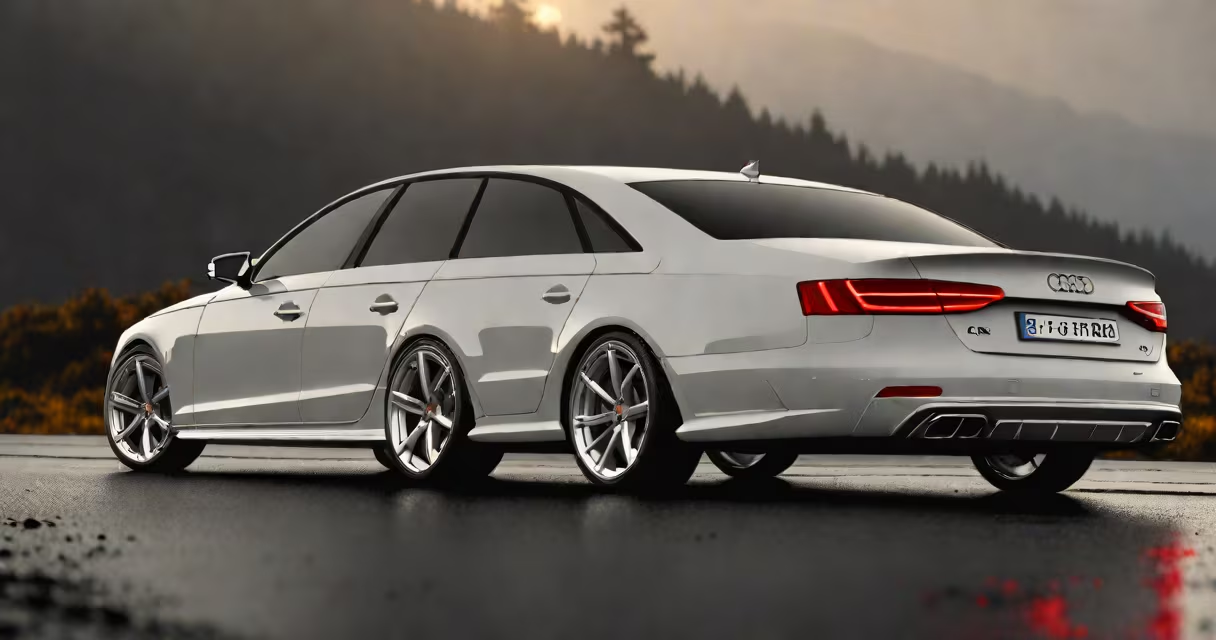
Audi Quattro is Audi's proprietary all-wheel-drive system designed to deliver balanced traction, improved handling, and enhanced stability across diverse driving conditions. Introduced in 1980, it remains a core differentiator in Audi's performance lineup.
The term "Quattro" derives from Latin, meaning "four," referencing the four-wheel drive configuration. It is not a generic descriptor but a registered trademark tied to specific engineering standards. The system uses a central differential to distribute torque between front and rear axles, with most models sending 40% to the front and 60% to the rear under normal conditions.
Quattro systems vary by model year and vehicle class. Early versions used a mechanical center differential, while modern iterations integrate electronic controls and torque vectoring. These updates allow real-time adjustments based on wheel slip, steering input, and throttle position.
At its core, Quattro uses a Torsen (torsional-sensing) differential in the center. This mechanical device automatically detects speed differences between axles and redistributes torque accordingly. When one axle begins to lose grip, the Torsen locks partially, sending more power to the axle with better traction.
Modern Quattro variants, such as the ultra and sport versions, add electronic control units (ECUs) that monitor wheel speed, yaw rate, and lateral acceleration. These ECUs can apply brakes to individual wheels and redistribute torque via a multi-plate clutch pack. This enables torque vectoring-sending more power to the outer rear wheel during cornering to reduce understeer.
For example, in an Audi RS6 Avant, the Quattro system can send up to 85% of torque to the rear axle during aggressive driving. During low-traction conditions, it shifts to a 50/50 split to maintain balance. This adaptability allows the car to remain stable even at high speeds on winding roads.
Audi offers several Quattro configurations, each tailored to performance, efficiency, or luxury. The table below outlines key variants:
| System Type | Drive Distribution | Use Case | Model Examples |
|---|---|---|---|
| Standard Quattro | 40% front / 60% rear (default) | Everyday driving, urban use | Audi A4, A6 |
| Quattro with Sport Differential | Variable, up to 85% rear | Performance handling, track use | Audi S4, RS5 |
| Quattro Ultra | Front-wheel bias until needed | Fuel efficiency, mild off-road | Audi Q5, A3 |
| Quattro with Torque Vectoring | Changing rear torque split | Cornering precision, agility | Audi RS7, R8 |
Quattro Ultra, introduced in 2015, improves fuel economy by disengaging the rear axle when not needed. It re-engages within 0.2 seconds when traction loss is detected. This feature reduces drivetrain drag and lowers CO₂ emissions by up to 15% compared to older systems, according to Audi's official technical documentation.
Many assume Quattro means "all-wheel drive" in general. That's incorrect. While all Quattro vehicles are all-wheel drive, not all all-wheel-drive cars use Quattro. The term is legally protected and reserved for Audi's system.
Another misconception is that Quattro makes a car immune to skidding. It doesn't. Quattro improves traction and stability but cannot overcome excessive speed, poor road conditions, or driver error. On icy surfaces, even Quattro-equipped cars require reduced speed and careful inputs.
A less obvious point: Quattro was originally developed for rally racing. The 1980 Audi Sport Quattro won multiple World Rally Championship events. Its success proved that four-wheel drive could outperform rear-wheel drive on gravel and snow. This legacy still influences modern Quattro tuning.
In 1994, the Audi RS4 B5 debuted with a 2.2-liter turbocharged engine producing 315 horsepower. With Quattro, it achieved 0-60 mph in 4.6 seconds and maintained grip through tight corners at speeds exceeding 120 mph.
During a test at the Nürburgring Nordschleife, the RS4 completed a lap in 7 minutes 52 seconds-faster than many rear-wheel-drive sports cars. The Quattro system's ability to manage torque distribution minimized wheel spin and kept the car planted during braking zones.
This performance wasn't accidental. Engineers tuned the Torsen differential to respond instantly to changes in grip. The result was a car that felt stable and predictable, even at the limit.
Quattro remains a defining feature in Audi's identity. It's not just about traction-it's about confidence. Drivers report feeling more secure in rain, snow, or uneven terrain because the system continuously adapts.
According to a 2022 study by the German Automobile Association (ADAC), Quattro-equipped vehicles had a 23% lower accident rate in winter conditions compared to similar rear-wheel-drive models. The study analyzed over 12,000 incidents across Germany from 2018 to 2021.
When choosing a performance car, Quattro offers a tangible advantage. It's not marketing-it's engineering. The system's integration with electronic stability control and adaptive suspension enhances vehicle dynamics.
Understanding what Audi Quattro means involves recognizing it as more than a feature-it's a philosophy of balanced performance. It's not just about moving forward faster. It's about moving forward smarter, safer, and with greater control.