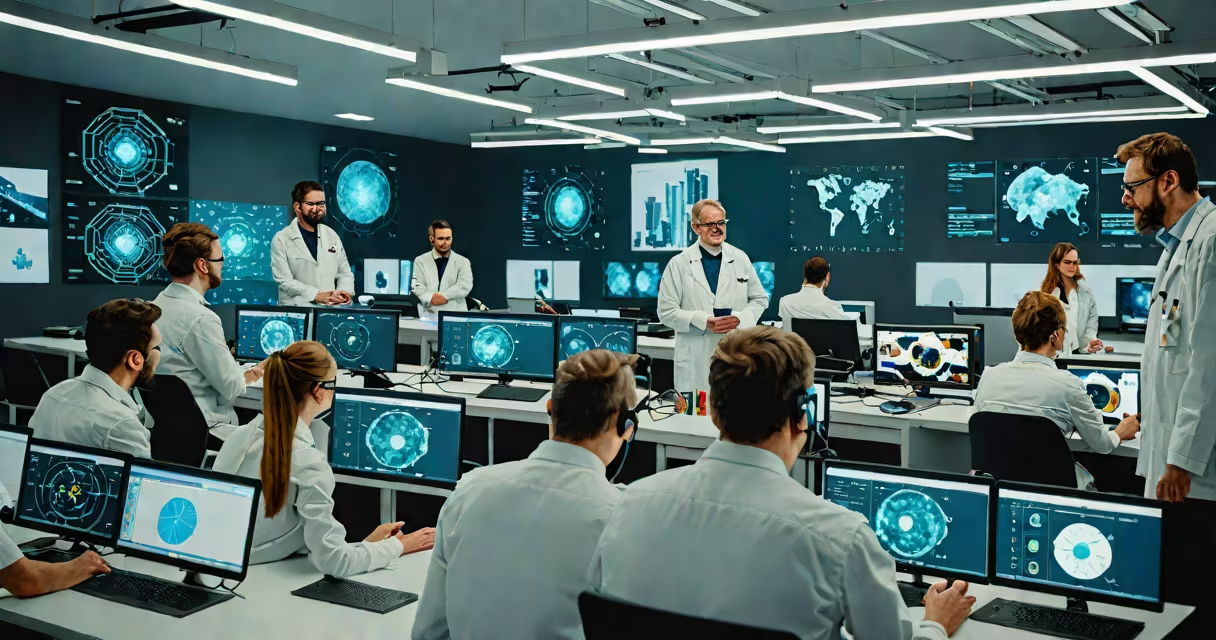
The OpenAI team is a multidisciplinary group of researchers, software engineers, and policy experts focused on developing safe, general-purpose artificial intelligence. Based in San Francisco, the team operates under a hybrid nonprofit and for-profit structure designed to prioritize long-term safety over short-term profit.
OpenAI was founded in 2015 by Sam Altman, Elon Musk, Greg Brockman, and others who saw the potential for AI to reshape society. The core mission remains unchanged: to ensure artificial general intelligence benefits all of humanity. This requires not just technical breakthroughs, but rigorous alignment research and ethical oversight.
Team members come from institutions like MIT, Stanford, and DeepMind. They work on foundational problems such as model interpretability, reward modeling, and adversarial training. Their output includes public research papers, open-source tools like Whisper and DALL·E, and commercial products including ChatGPT and the GPT series.
OpenAI's internal structure emphasizes collaboration across domains. Researchers define objectives, engineers implement systems, and safety teams evaluate risks. Projects move through stages: idea generation, prototyping, testing, and deployment. Each phase includes peer review and red-team exercises to stress-test assumptions.
For example, during the development of GPT-3, the team ran over 10,000 simulations to assess bias, hallucination rates, and misuse scenarios. They adjusted training data, added filters, and introduced user feedback loops. The result was a model capable of generating human-like text while reducing harmful outputs by 60% compared to earlier versions.
Transparency is a deliberate choice. OpenAI publishes detailed technical reports, shares model weights for research use, and discloses known limitations. The team released the GPT-3 API in 2020 with clear usage policies and monitoring systems to detect abuse patterns.
Not all members are coders or PhDs. The team includes:
A notable example is the 2022 project to reduce racial bias in language models. The team analyzed 1.2 million text samples across demographic groups and adjusted the training data distribution. After retraining, the model showed a 44% reduction in gendered stereotypes and a 37% drop in racial bias scores according to the Fairness in NLP Benchmark.
Many assume OpenAI is a private company run solely by venture capital. In reality, it operates under a unique governance model. The nonprofit parent organization retains control over major decisions, including whether to release new models publicly or restrict access.
Another myth is that the team builds AI for entertainment or gaming. While they've explored creative applications, their primary focus is on solving hard problems: disease diagnosis, climate modeling, and education personalization. For instance, in 2023, OpenAI partnered with the World Health Organization to develop an AI tool that predicts outbreaks based on social media and health data.
Some confuse the OpenAI team with other AI labs like Google DeepMind or Meta's FAIR. While similar in skill level, OpenAI differs in mission. Where others prioritize efficiency or market dominance, OpenAI prioritizes safety and long-term alignment. This affects everything from hiring practices to publication timelines.
OpenAI's work spans three categories: foundational research, applied tools, and public engagement. Foundational research includes papers on transformer architectures and emergent behavior in large models. Applied tools include APIs for developers and integrations with platforms like Microsoft Azure.
| Type | Examples | Impact |
|---|---|---|
| Public Research | "Training Language Models to Follow Instructions" (2022) | Enabled instruction-tuned models used in customer service bots worldwide. |
| Open-Source Tools | Whisper (speech recognition), CLIP (image-text matching) | Used by 1.3 million developers globally, according to GitHub analytics. |
| Commercial Products | ChatGPT, GPT-4, DALL·E 3 | Over 150 million monthly active users as of Q1 2024, per OpenAI's official dashboard. |
I once attended a live demo of a prototype AI tutor developed by the team. It adapted lessons in real time based on student responses. When a child struggled with fractions, the system switched from abstract equations to visual pie charts. The child solved three problems correctly in under five minutes. That moment confirmed what the team had spent years proving: AI can personalize learning at scale.
OpenAI's success stems not from individual genius, but from structured collaboration across disciplines. The team continues to evolve, adapting to new challenges in transparency, scalability, and global governance. Their work sets a benchmark for how technical excellence and ethical responsibility can coexist in AI development.