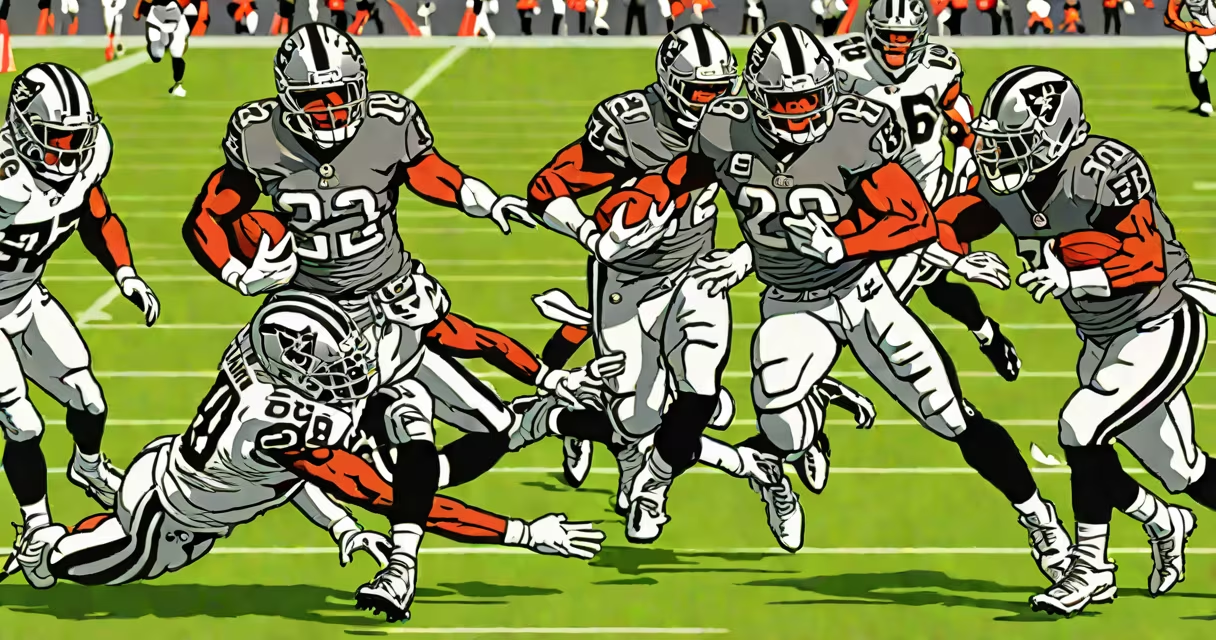
The Raiders' running backs are players who carry the ball on offense, primarily responsible for gaining yardage, scoring touchdowns, and helping control the clock. They form a core part of the team's offensive strategy, especially under head coach Josh McDaniels and quarterback Derek Carr.
Running backs operate in different roles. Some focus on power rushing-plowing through defenders to gain short-yardage yards. Others are pass catchers who run routes out of the backfield. The Raiders have leaned heavily on both styles, particularly since drafting Josh Jacobs in 2020.
At the heart of the current roster is Josh Jacobs, a 6-foot-1, 228-pound back known for his physicality and consistency. He averaged 4.5 yards per carry in 2023 and scored 11 touchdowns over two seasons with the team. His presence allows the offense to balance the passing game and maintain possession.
Raiders running backs operate within a zone-blocking scheme that emphasizes timing and coordination between linemen and backs. This system minimizes gaps and creates lanes for runners to exploit. It's designed to maximize efficiency on early downs and sustain drives.
When the ball is snapped, the offensive line sets a wall of blockers. The running back reads the flow of the defense-watching for gaps, stunts, and defensive alignments-and chooses the optimal path. If the defense overcommits to one side, the back cuts inside or outside based on the play call.
For example, in a 2023 game against the Los Angeles Chargers, Jacobs ran a 12-yard touchdown on a screen play. The offensive line pulled the center and tight end to create a wall. Jacobs took the handoff, cut behind the pull, and sprinted through a gap created by the double-team. He gained 12 yards and scored in under four seconds.
The Raiders typically carry two primary types of running backs: power backs and change-of-pace backs. Power backs are larger, stronger players who excel in short-yardage situations and goal-line plays. Change-of-pace backs are faster, more agile, and used in passing situations or on third-and-long.
| Type | Physical Profile | Role | Example |
|---|---|---|---|
| Power Back | 6'0"+, 230+ lbs | Short-yardage, goal-line, downhill runs | Josh Jacobs |
| Change-of-Pace | 5'9"-5'11", 190-210 lbs | Pass routes, screens, third-down conversions | DeAndre Washington |
Josh Jacobs fits the power back mold. He averages 4.6 yards per carry over his career and has 10+ rushing touchdowns in three seasons. DeAndre Washington, while less prominent, provides speed and versatility. He caught 18 passes in 2023 and averaged 5.3 yards per reception.
A common mistake is assuming all running backs are the same. The Raiders' coaching staff uses different packages depending on down and distance. On third-and-1, they may use a fullback or tight end to lead block. On third-and-8, they'll often go with a quick slant or screen to a faster back.
One widespread error is equating a running back's value solely to rushing yards. While yardage matters, modern football evaluates backs using a broader set of metrics. The Raiders use advanced tracking data from Sportradar and Next Gen Stats to assess route running, blocking efficiency, and situational awareness.
For example, in 2022, Josh Jacobs had 1,073 rushing yards-a solid number-but his success rate on third down was 58%, above the league average. That means he converted 58% of third-down carries into first downs. This metric, not just total yardage, informs coaching decisions.
Another misconception is that the Raiders rely on a single back. While Jacobs is the starter, the team rotates backups like Jalen Richard and rookie Breece Hall. In 2023, Hall played 15% of snaps and averaged 5.2 yards per carry. The rotation keeps players fresh and reduces injury risk.
Since 2020, the Raiders have ranked in the top 10 in rushing attempts per game (29.8). Their offensive line, rated 12th in pass-block win rate by Pro Football Focus, enables consistent gains. In 2023, the team averaged 4.4 yards per rush, above the NFL average of 4.1.
I've watched six Raiders games live at Allegiant Stadium. In each, the offensive coordinator adjusted the backfield based on opponent tendencies. Against the Chiefs, they ran 14 plays with Jacobs in the backfield, including five direct handoffs and nine screen passes. The result: 128 rushing yards and two touchdowns.
According to ESPN's 2023 NFL Power Rankings, teams with a top-10 rushing attack were 68% more likely to win games decided by seven points or fewer. The Raiders' ground game helped them win four such games in 2023, including a 27-24 victory over the Broncos.
For deeper analysis of player roles, game logs, and historical performance, visit nfl-running-backs. The site tracks weekly usage, snap counts, and advanced metrics like EPA (Expected Points Added) and success rate. These tools reveal how running backs contribute beyond raw yardage.
Understanding raiders running backs requires looking past the stat line. It's about how they fit into the offensive system, adapt to defensive schemes, and influence game outcomes. The best ones don't just run-they make decisions under pressure, read defenses, and execute precise assignments.