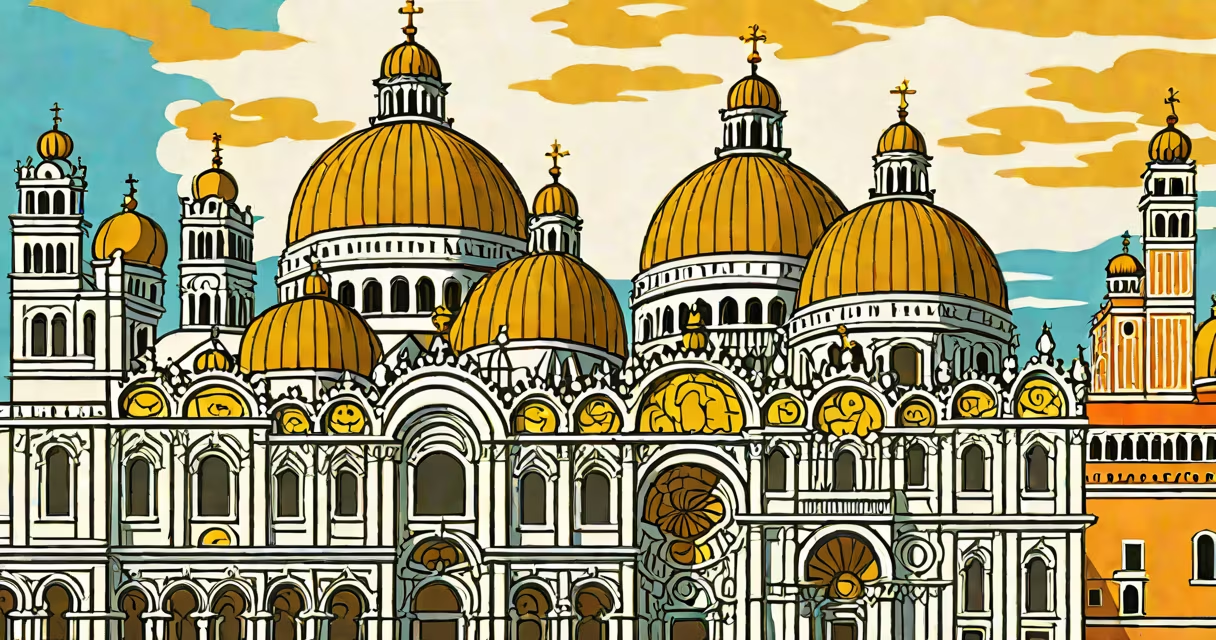
San Marco Venice is a 11th-century cathedral in the heart of Venice, Italy, designed in a blend of Byzantine and Gothic architectural styles. It serves as the patriarchal cathedral of the Roman Catholic Archdiocese of Venice and houses the relics of Saint Mark the Evangelist, whose feast day is celebrated annually on April 25.
The structure stands on the Piazza San Marco, the city's central square, and functions as both a religious center and a symbol of Venice's historical power. Its design reflects the wealth and maritime influence of the Republic of Venice during the Middle Ages, when the city controlled trade routes between Europe and the Eastern Mediterranean.
Constructed over several centuries, the current form of San Marco began in 1063 after the original church was destroyed by fire. The basilica's layout follows a Greek cross plan, with four arms of equal length radiating from a central dome. The building features five large domes, each covered in gold leaf, and a façade adorned with marble inlays and sculptures from the 12th to 15th centuries.
San Marco's design integrates religious symbolism with political authority. The five domes represent Christ and the four evangelists. The interior is divided into three naves separated by columns of red and green marble, sourced from Egypt and Syria-materials acquired through Venetian trade networks.
Light enters through high windows and stained glass, illuminating the golden mosaics that cover nearly every surface. These mosaics depict biblical scenes, saints, and allegories of divine rule. Unlike Western European churches of the time, which emphasized linear perspective, San Marco uses flat, symbolic imagery rooted in Byzantine tradition.
The apse contains a large mosaic of Christ Pantocrator, flanked by angels and apostles. This image dominates the space and reinforces the idea of divine judgment. The floor is paved with complex marble patterns, including a famous inlaid lion-the symbol of Saint Mark-placed at the center of the nave.
San Marco's construction relied heavily on imported materials. The marble columns come from ancient Roman ruins and were repurposed during the 11th century. The green and red marble used in the arcades originated in Egypt and Turkey, transported via Venetian galleys.
The gold mosaics are made using tesserae-tiny cubes of colored glass and gold leaf. Each tessera is hand-cut and set into wet plaster. The process takes months per panel. The gold backing creates a luminous effect, making the images appear to glow even in low light.
One notable feature is the Campanile di San Marco, a 98-meter-tall bell tower that stood adjacent until its collapse in 1902. It was rebuilt in 1912 using original plans and modern engineering. The tower once served as a navigational landmark for ships approaching the lagoon.
San Marco remains an active place of worship. Daily Mass is held in Latin and Italian, and major feasts draw thousands of pilgrims. The cathedral hosts the annual Festa della Sensa, a ceremony dating to 1000 AD, where the Doge symbolically "married" the sea to reaffirm Venice's dominion over the Adriatic.
It also serves as a venue for state events. The Doge's coronation took place here, and the cathedral hosted the swearing-in of new bishops. Today, it's a UNESCO World Heritage Site and one of the most visited tourist attractions in Italy, drawing about 2 million visitors annually.
Entry requires a ticket, priced at €15 for adults. Visitors must remove hats and avoid flash photography in sacred areas. The museum inside, the Museo dell'Opera Metropolitana, displays artifacts such as the original Gospel of St. Mark, a 9th-century manuscript written in Greek.
Many assume San Marco is a typical Catholic cathedral. It is not. It follows the Byzantine rite, meaning liturgy is conducted in Greek and Latin, and the priest faces east toward the altar. The orientation differs from Western churches, where the priest faces the congregation.
Another misconception is that the basilica was built entirely in the 11th century. In reality, construction spanned over 400 years. The façade was completed in the 13th century, and the interior mosaics continued into the 15th century. Some elements were added during the Renaissance, including frescoes by Tintoretto and Veronese.
A lesser-known fact: the lion of St. Mark was not originally a religious symbol. It was adopted as a civic emblem during the 10th century. The lion appears on the flag of Venice and is carved above the main entrance. It represents St. Mark's authority and the city's maritime strength.
Visitors can choose from different access levels based on interest and budget:
| Access Level | Features | Price (2024) |
|---|---|---|
| Standard Entry | Interior, mosaics, main nave, crypt | €15 |
| Guided Tour (30 min) | Includes audio guide, focus on history and art | €25 |
| Exclusive Access (after hours) | Private visit, no crowds, limited to 10 people | €120 |
In June 2023, a group of 12 tourists from Chicago arrived at 8:30 a.m., avoiding peak hours. They purchased tickets online and entered through the southern portal. Inside, they saw the mosaic of the Ascension above the main altar-28 feet tall and composed of 1.2 million tesserae.
They walked through the narthex, where a 12th-century bronze door depicts the Last Judgment. The sound of Gregorian chant echoed from the choir loft. After 45 minutes, they paused at the tomb of Saint Mark, located beneath the main altar. The reliquary is sealed with lead and wax, opened only once a year during the Feast of St. Mark.
They exited through the north side, passing the Sala del Maggior Consiglio, where the Doge once held court. The entire visit lasted 90 minutes, with no rush. The experience demonstrated how scale, light, and ritual combine to create a lasting impression.
I visited San Marco in November 2022 during a rainstorm. The water pooled around the steps of the Piazza, reflecting the golden domes. As I stepped inside, the air changed-cool, still, and thick with incense. The mosaics glowed despite the gray light outside. I stood in front of the Virgin and Child mosaic, noticing how the gold tesserae shifted color depending on the angle of view. That moment confirmed what scholars have long noted: the visual language of San Marco is not meant to be seen-it's meant to be felt.
san marco venice is more than a church. It is a living archive of faith, empire, and artistic ambition. Its mosaics, architecture, and rituals reflect a city that once ruled the seas. To walk through its doors is to step into a history where religion and power were inseparable.