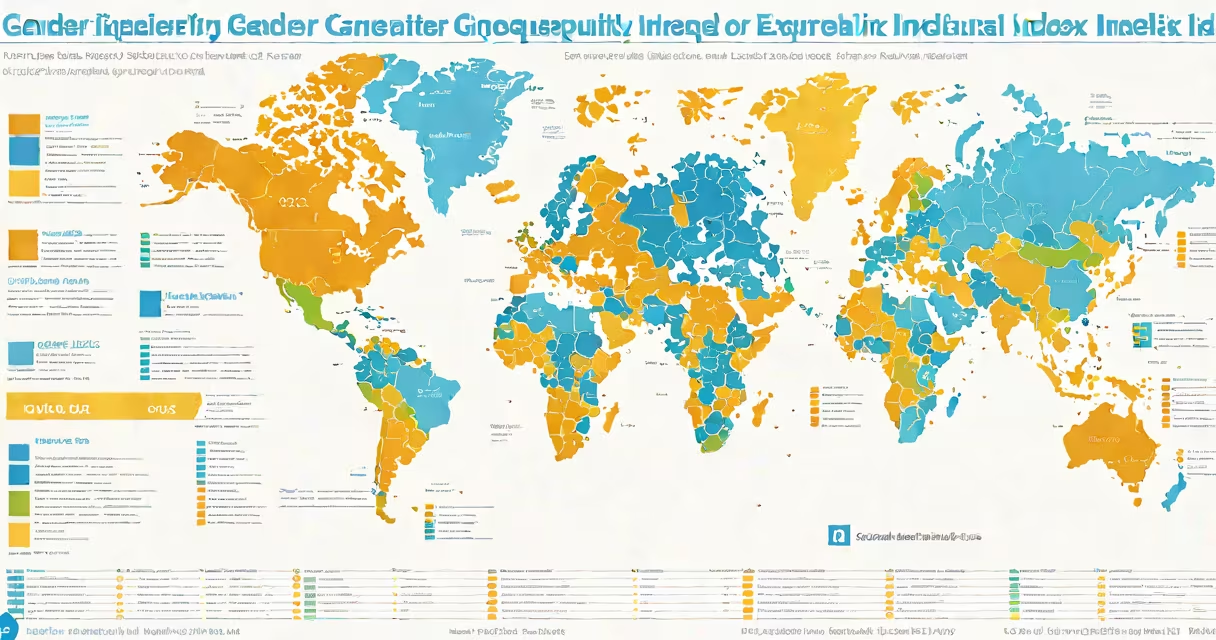
The UNDP Gender Inequality Index (GII) quantifies disparities between women and men in reproductive health, empowerment, and labor market participation using national data. It ranges from 0 (perfect equality) to 1 (maximum inequality), with lower scores indicating better gender equity.
Developed by the United Nations Development Programme (UNDP), the GII integrates three core dimensions: maternal mortality ratio, adolescent birth rate, and proportion of parliamentary seats held by women. It also includes education and labor force participation indicators. The index is updated annually in the Human Development Report, offering a standardized measure across 189 countries.
Unlike simple gender gap metrics, the GII weights outcomes based on their impact on human development. For example, a high maternal mortality rate contributes more to the index than a small difference in educational attainment. This reflects the UNDP's focus on well-being rather than mere statistical parity.
The GII calculates a composite score by normalizing each indicator to a 0-1 scale, then averaging them with adjusted weights. Maternal mortality and adolescent birth rates are weighted more heavily because they reflect life-threatening inequities. Women's share of parliamentary representation and tertiary education enrollment are also included, but with less weight due to their lower direct impact on survival and autonomy.
Each country's performance is compared against the maximum possible inequality (1.0) and minimum (0.0). A score of 0.5 means gender disparities are halfway between complete equality and maximum inequality. Countries with scores below 0.2 are considered to have low gender inequality, while those above 0.6 face severe challenges.
For example, in 2021, Norway scored 0.047, reflecting near-equal access to healthcare, political power, and employment. In contrast, Niger scored 0.621, driven by high maternal mortality (578 deaths per 100,000 live births), low female parliamentary representation (5%), and limited secondary education access for girls.
The GII combines five key indicators:
| Indicator | Weight | Source |
|---|---|---|
| Maternal mortality ratio | 30% | WHO/UNICEF/UNFPA/World Bank |
| Adolescent birth rate (ages 15-19) | 20% | UNICEF |
| Proportion of parliamentary seats held by women | 15% | Inter-Parliamentary Union |
| Proportion of women with secondary or higher education | 15% | UNESCO Institute for Statistics |
| Proportion of women in the labor force | 20% | ILO Labour Force Survey |
These values are normalized using the country's maximum and minimum observed values across all nations. The normalization helps differences in absolute levels don't distort comparisons between countries with vastly different income levels or population sizes.
A common misconception is that the GII measures gender pay gaps. It does not. While labor force participation is included, the index focuses on structural barriers to opportunity, not wage differentials. Pay equity is tracked separately by the World Economic Forum's Global Gender Gap Report.
Nations use the UNDP gender inequality index to benchmark progress toward Sustainable Development Goal 5 (Gender Equality). It informs policy design, budget allocation, and international aid targeting. For example, the European Commission uses GII data to assess gender responsiveness in EU-funded programs.
Development agencies like USAID and the World Bank reference the GII when evaluating grant applications. A country with a GII above 0.5 may receive priority funding for maternal health or girls' education initiatives. In 2022, Bangladesh received $12 million in targeted support after its GII rose from 0.49 to 0.53, signaling worsening conditions.
Academic researchers use the GII to study long-term trends. A 2020 analysis by the University of Oxford found that countries with declining GII scores over 10 years saw a 2.3% average increase in GDP growth, suggesting gender equity supports economic resilience.
Many assume the GII is a single survey. It is not. It aggregates existing national data from multiple sources, including censuses, health registries, and legislative records. The UNDP does not collect primary data itself.
Another error is equating a high GII with poor treatment of women. While a high score indicates systemic issues, it doesn't capture individual experiences or cultural context. A country with a GII of 0.5 may still have strong legal protections for women, even if implementation lags.
The GII does not account for intersectionality. It treats gender as a binary variable, ignoring how race, disability, class, or sexual orientation compound disadvantage. For example, Indigenous women in Latin America often face higher maternal mortality than the national average, but this is not captured in the index.
As someone who reviewed GII reports for a regional NGO in 2021, I noticed that countries with similar scores could have very different underlying causes. One nation had high maternal mortality due to lack of clinics; another had high rates due to early marriage. The index flags the outcome but not the root cause.
The GII differs from the World Economic Forum's Global Gender Gap Index (GGI), which measures gaps in health, education, economic participation, and political empowerment. The GGI is more focused on economic outcomes and includes wage data. The GII emphasizes survival and autonomy.
Also distinct is the Gender Development Index (GDI), which compares male and female HDI scores. The GDI shows relative achievement, while the GII shows relative deprivation. A country can have a high GDI (equal human development) but a high GII (unequal opportunities).
For example, in 2021, Iceland had a GII of 0.055 and a GDI of 0.987. Its high GDI reflects equal access to education and health, but the low GII confirms minimal gender-based disparities in outcomes. In contrast, Saudi Arabia had a GDI of 0.943 but a GII of 0.482, highlighting that despite development, women face significant structural barriers.
The UNDP gender inequality index is not a standalone metric. It functions best when paired with qualitative research and local context. A score of 0.3 in a rural African nation may stem from transportation barriers to clinics, while the same score in an urban Asian city may reflect social stigma around contraception. Understanding the "why" behind the number requires deeper investigation.
When interpreting the UNDP gender inequality index, remember: it measures structural gaps in power, health, and opportunity-not personal choices. A low score doesn't mean women are passive; it means systems fail to deliver equitable outcomes.