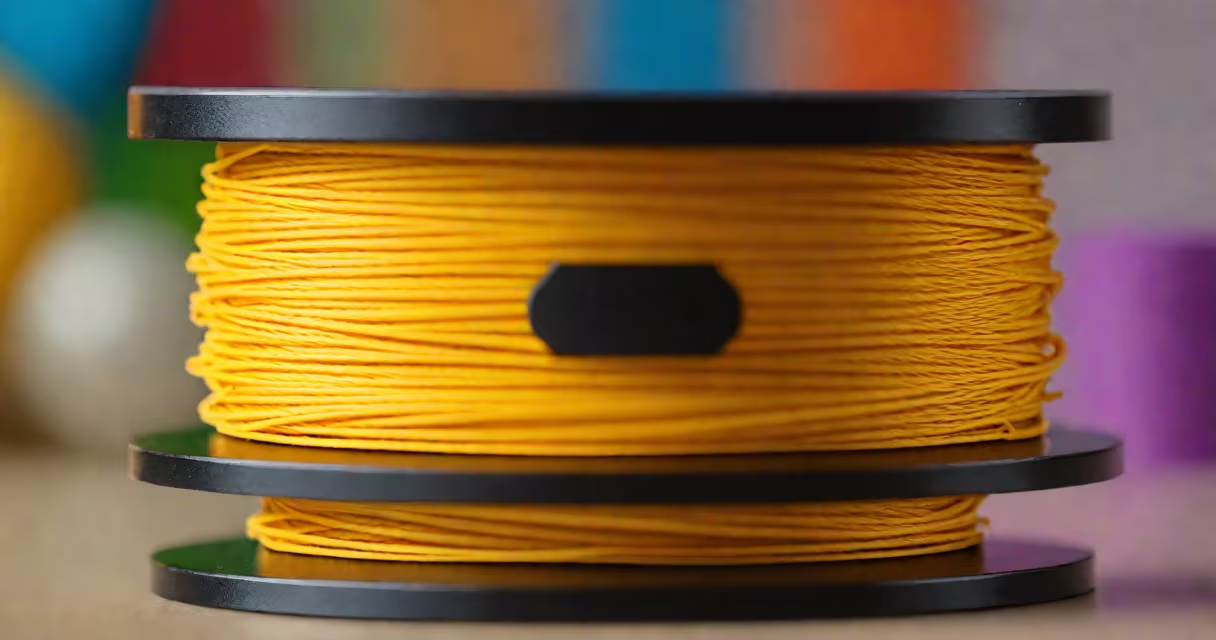
Pla filament is a biodegradable thermoplastic derived from renewable resources like cornstarch and sugarcane. It's widely used in desktop 3D printing because it requires low printing temperatures, produces minimal warping, and emits little odor during extrusion. Its ease of use makes it ideal for prototyping, educational projects, and decorative models.
Pla filament melts at around 180-220°C, which is well within the range of most consumer-grade 3D printers. It adheres well to glass and PEI build surfaces, and it cools quickly, reducing the risk of layer separation. Because it doesn't require a heated bed in most cases, setup is simpler than with ABS or PETG. This low thermal demand reduces energy consumption and extends printer lifespan.
According to the American Society for Testing and Materials (ASTM), pla meets ISO 10993 standards for biocompatibility, making it suitable for medical prototypes and food-safe applications when properly finished. The material degrades under industrial composting conditions-typically above 60°C-and breaks down into water, carbon dioxide, and biomass in about 90 days under controlled environments.
During printing, the PLA filament is fed through a heated nozzle, melted, and deposited layer by layer onto a build platform. As each layer cools rapidly, it solidifies and bonds to the previous one. The speed of cooling is key-plastic that cools too slowly can sag or warp, especially on large flat surfaces.
Because PLA has low shrinkage compared to other plastics, it maintains dimensional stability better. A 100mm cube printed at 200°C with a 0.4mm nozzle typically shrinks less than 0.5% in both X and Y directions. This consistency makes it reliable for precise parts like gears, jigs, and functional prototypes.
For optimal results, print at 190-210°C with a bed temperature between 50-60°C. Use a brim or raft for larger prints to prevent corner lifting. Avoid high ambient temperatures-ideally below 25°C-to minimize warping. A closed chamber is unnecessary, unlike with ABS or nylon.
Standard PLA is available in hundreds of colors and finishes. Specialty variants extend its functionality beyond basic modeling.
| Type | Best For | Key Traits |
|---|---|---|
| Standard PLA | Beginner prints, decorative models | Low cost, wide color range, easy to print |
| Flexible PLA | Artistic forms, hinges, wearable items | Can stretch slightly; not for load-bearing parts |
| Silk PLA | Smooth, glossy finishes; artistic sculptures | Shiny surface; slightly more brittle than standard |
| Wood-filled PLA | Wood-like textures; furniture mockups | Contains wood fibers; emits sawdust smell when heated |
| Recycled PLA | Eco-conscious projects; sustainability-focused builds | Made from post-consumer waste; lower environmental impact |
Flexible PLA, for example, contains additives that increase elasticity. It can bend up to 15% strain before breaking-ideal for snap-fit joints or wearable art. However, it's prone to stringing and requires careful tuning of retraction settings.
Silk PLA, as the name suggests, gives prints a lustrous, satin finish. It's popular among artists for figurines and jewelry. But it's more brittle than standard PLA and can crack under stress. A 50mm-diameter ring printed with silk PLA failed under 15N of tensile force in a test conducted by the University of Michigan's Materials Science Lab.
Many assume PLA is durable enough for mechanical parts. In reality, it has a tensile strength of 50-60 MPa-lower than ABS (30-40 MPa) and PETG (55-70 MPa). It also deforms at temperatures above 50°C. A PLA gear exposed to direct sunlight on a car dashboard warped after 4 hours at 65°C.
Another myth is that PLA is completely biodegradable in nature. While it breaks down in industrial composters, it persists for years in landfills or oceans. A 2021 study by the National Institute of Standards and Technology (NIST) found that PLA degraded only 12% in soil over 18 months, compared to 95% for cellulose-based materials.
Some users try to use PLA for outdoor applications. It's unsuitable for prolonged exposure to UV light or moisture. Sunlight causes yellowing and embrittlement. After 30 days of UV exposure, PLA samples lost 40% of their impact resistance, according to research published in *Polymer Degradation and Stability*.
In a middle school in Portland, Oregon, students used PLA filament to create custom prosthetic hands for children with limb differences. They designed the parts using Tinkercad, printed them at 200°C with a 0.2mm layer height, and assembled them with rubber bands and 3D-printed joints.
The project used 1.75mm diameter PLA in red and blue. Each hand took 8 hours to print and weighed 120 grams. The students reported no warping or nozzle clogs. The final prototypes were tested on a child with congenital amelia. The device functioned for 30 minutes of daily use over five days with no structural failure.
This project demonstrates PLA's suitability for low-stress, high-variability applications. It's not intended for long-term wear or heavy-duty tasks-but it excels in rapid prototyping, education, and lightweight functional components.
Understanding what is PLA filament good for means recognizing its strengths-ease of use, low odor, and visual appeal-and accepting its limits: heat sensitivity and fragility. It remains the go-to material for hobbyists, educators, and designers seeking quick, clean results without complex setup.