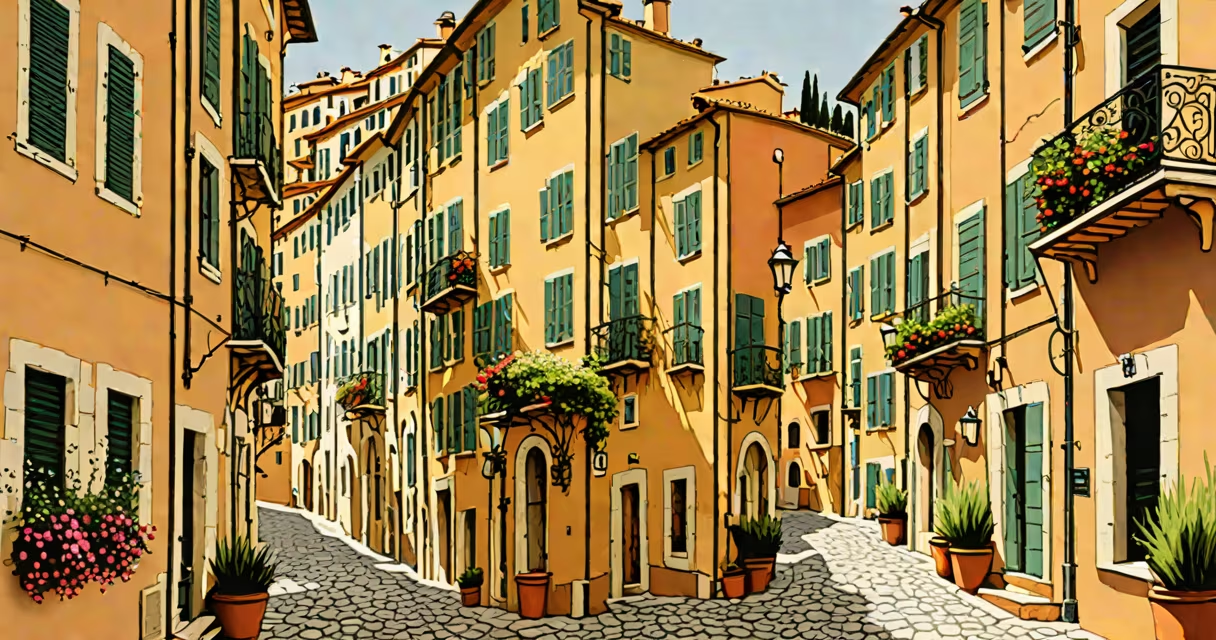
The ville de grasse is a town in southeastern France, located in the Alpes-Maritimes department within the Provence-Alpes-Côte d'Azur region. It is internationally recognized as the global center of perfume production, with a tradition dating back to the 16th century.
Grasse lies approximately 30 kilometers inland from the Mediterranean coast, nestled between the Maritime Alps and the foothills of the Massif des Maures. Its elevation ranges from 300 to 400 meters above sea level, which contributes to ideal conditions for cultivating aromatic plants such as jasmine, rose, lavender, and tuberose. The town's climate supports year-round growth of these flowers, making it a key supplier for perfumery worldwide.
Grasse's prominence in scent-making began during the Renaissance, when local artisans developed techniques to extract essential oils from flowers using water distillation and enfleurage-a method involving fat-covered trays to absorb floral essences. By the 18th century, Grasse had become the heart of Europe's luxury fragrance trade. Today, over 80% of the world's finest perfumes are created using raw materials sourced from or processed in Grasse.
Grasse's rise as a perfumery center was driven by geography, culture, and economic opportunity. The region's mild winters and abundant sunshine allow for the cultivation of delicate scent-bearing plants. Local farmers began growing roses and jasmine specifically for their essential oils, which were sold to perfumers across Europe.
In the 19th century, the invention of synthetic aroma compounds did not displace Grasse's dominance. Instead, the town adapted. Perfumers in Grasse combined natural extracts with new chemical formulations, creating complex scents that appealed to elite markets. This innovation preserved Grasse's role as a leader in both traditional and modern perfumery.
According to the French Ministry of Culture, Grasse was officially recognized as a "Ville et Terroir du Parfum" (City and Terroir of Perfume) in 2010, affirming its cultural and industrial significance. The designation protects traditional methods and supports local producers through heritage funding and public education programs.
Grasse hosts several major institutions dedicated to preserving and advancing its perfumery legacy. The Musée International de la Parfumerie (International Museum of Perfumery) occupies a former 17th-century convent and displays over 3,000 historical perfume bottles, tools, and documents. Exhibits trace the evolution of scent-making from ancient Egypt to contemporary niche brands.
Another landmark is the Jardin des Parfums, a 10-hectare botanical garden featuring 150 species of aromatic plants. Visitors walk through themed sections-rose fields, jasmine groves, and lavender meadows-while learning about the extraction process via audio guides and tactile signage. The garden also hosts seasonal festivals celebrating harvests and artisanal blending.
A lesser-known fact: Grasse is home to the only European school dedicated solely to perfume creation. The École Supérieure de Parfumerie de Grasse offers a three-year program in olfactory science, chemistry, and sensory evaluation. Graduates often join major perfume houses like Guerlain, Dior, and Chanel, many of which maintain research labs in the area.
| Attraction | Focus Area | Visitor Experience |
|---|---|---|
| Musée International de la Parfumerie | History & Artifacts | Interactive displays on scent extraction; guided tours in multiple languages |
| Jardin des Parfums | Living Botanical Collection | Self-guided trails; seasonal events; scent workshops |
| Atelier de Parfumerie | Hands-on Blending | 30-minute sessions crafting personal fragrances; take-home vials |
Many visitors assume Grasse is a small, isolated village with limited modern amenities. In reality, it is a well-connected urban center with a population of around 40,000. It lies within a 90-minute drive of Nice Côte d'Azur Airport and is served by regional rail lines connecting to Marseille and Cannes.
Another frequent error is equating Grasse with mass-market fragrances. While companies like L'Occitane and Fragonard have headquarters nearby, the ville de grasse itself produces few consumer products under those names. Most of the actual scent formulation occurs in private ateliers, many of which are closed to the public due to intellectual property protections.
Some travelers expect Grasse to resemble a theme park focused on perfume. The town's charm lies in its authenticity. Cobblestone alleys lead past centuries-old stone buildings, many still housing family-run perfumeries. The scent of dried lavender hangs in the air near the market square every summer. A visit feels less like a tour and more like stepping into a living archive.
I spent a morning walking through the old town during the annual Fête du Parfum. The air carried layered notes-jasmine from a nearby stall, bergamot from a passing vendor's basket, and the faintest hint of patchouli from a hidden courtyard. I stopped at a tiny workshop where a master perfumer demonstrated how to blend base, middle, and top notes using glass vials and a wooden spatula. He explained that the most successful scents balance emotional resonance with technical precision-something not taught in textbooks.
Later, I visited a family-owned farm where workers hand-picked 200 kilograms of May rose petals in a single day. Each petal was processed within hours to preserve volatile compounds. The resulting absolute oil cost €1,200 per kilogram. That price reflects not just labor and yield, but the risk of weather damage and the time required to achieve peak aromatic intensity.
Grasse's influence extends beyond aesthetics. The town plays a critical role in sustainable agriculture. Many farms use crop rotation and organic practices to maintain soil health and reduce pesticide use. The French National Institute for Agricultural Research (INRAE) has established a research station in Grasse to study drought-resistant varieties of rose and jasmine, aiming to stabilize yields amid climate change.
Grasse contributes to the EU's Creative Industries Strategy. The European Commission cites the town as a model for integrating cultural heritage with advanced manufacturing. In 2022, the EU awarded €2.3 million in grants to support digital archiving of historical perfume formulas and virtual reality experiences for remote visitors.
The ville de grasse is not merely a destination-it is a living practice of craftsmanship, ecology, and artistry. Its enduring relevance stems from a commitment to quality, tradition, and adaptation. the quiet precision of a perfumer's hand, the ville de grasse offers a rare convergence of nature, science, and human memory.