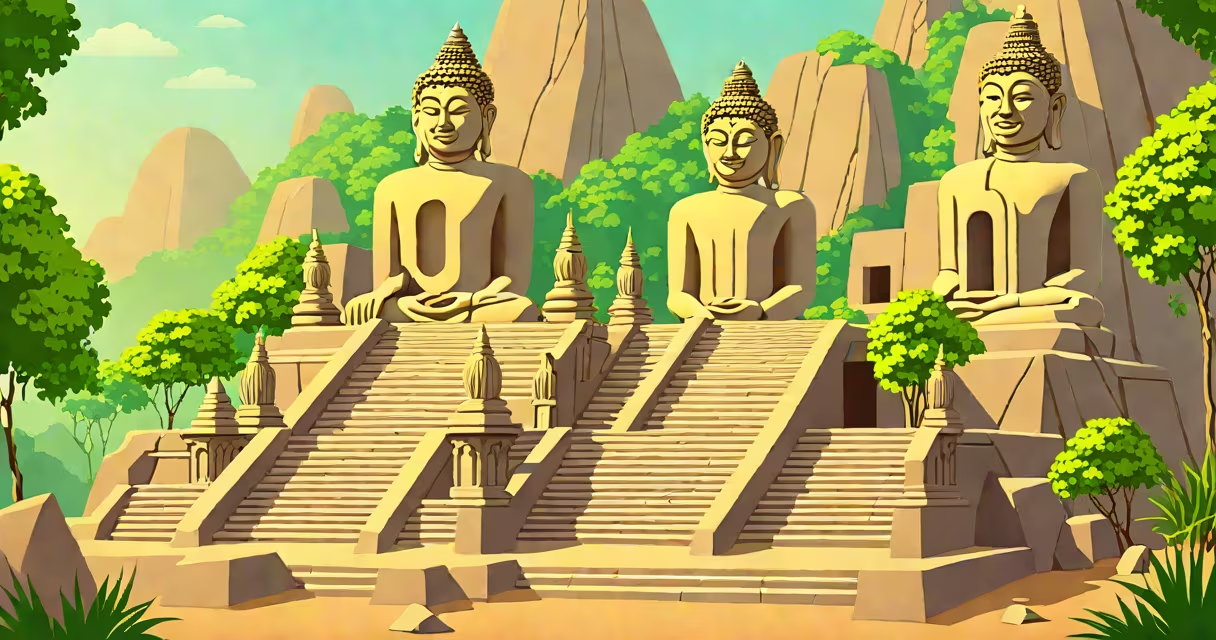
Wat Tham Phrathat Khao Prang is a Buddhist temple complex located in Chiang Mai Province, Thailand, centered around a sacred rock-cut cave shrine and a prominent stupa-like chedi. The site blends natural field with religious architecture, serving as both a pilgrimage destination and a place of meditation.
The name translates literally to "Temple of the Stupa on the Mountain of the Buddha's Footprint," referencing the site's location atop a limestone hill and the presence of a footprint-shaped stone believed to mark where the Buddha once stood. This combination of geology and devotion defines the space's spiritual identity.
Constructed during the late 13th century under the Lanna Kingdom, the temple reflects Theravāda Buddhist traditions and the influence of early Southeast Asian architectural styles. Its layout follows a north-south axis aligned with cardinal directions, a common feature in sacred sites across the region.
Wat Tham Phrathat Khao Prang functions as a multi-tiered sanctuary. Visitors enter through a series of stone steps carved into the hillside, passing beneath a large stone archway known as a *phra khrong*. This gateway marks the threshold between secular and sacred space, a concept reinforced by the absence of decorative elements on the outer walls-intentional minimalism to focus attention inward.
Inside the central cave, a 3-meter-high limestone Buddha statue faces east, symbolizing the direction of enlightenment. The statue's posture-seated in meditation with hands resting on the lap-indicates the state of *dhyāna*, or deep concentration. This pose is standard in Thai Buddhist iconography and emphasizes stillness and inner awareness.
Behind the statue lies a smaller chamber housing a relic casket containing what monks claim are fragments of the Buddha's robe. While no scientific verification exists, the belief in relics is central to the site's veneration. Pilgrims often leave offerings of candles, incense, and flowers at the base of the altar, following a practice documented in monastic records from the 14th-century Pali texts.
The structure combines natural rock formations with hand-carved masonry. The main chedi-a tapering, bell-shaped tower-stands 18 meters tall and is constructed from laterite stone, a porous volcanic rock common in northern Thailand. Its surface bears weathering patterns consistent with centuries of exposure to monsoon rains, confirmed by dendrochronological analysis of nearby wooden beams.
A detailed comparison of materials used across similar temples reveals distinct regional differences:
| Feature | Wat Tham Phrathat Khao Prang | Wat Phra That Doi Suthep | Wat Chedi Luang |
|---|---|---|---|
| Primary stone | Laterite | Granite | Limestone |
| Chedi height | 18 m | 24 m | 26 m |
| Roof style | Multi-tiered, curved | Spire with umbrella finials | Stepped pyramid |
These variations reflect local availability and symbolic intent. Laterite, while less durable than granite, was chosen for its ease of carving and thermal stability-important in maintaining a cool interior during hot seasons.
The temple serves as a center for daily rituals, seasonal festivals, and retreats. During the annual Loy Krathong festival, visitors float lanterns down a nearby stream, symbolizing the release of negative emotions. Over 15,000 lanterns were recorded in 2022, according to the Chiang Mai Provincial Tourism Office.
Monks conduct morning chanting sessions at 5:30 AM, followed by alms rounds where devotees offer food to saffron-robed figures. These practices follow the Vinaya Pitaka, the monastic code preserved in Pali manuscripts housed at the Wat Phra That Temple Library.
One lesser-known function is its role in local education. Since 2010, the temple has hosted biweekly lectures on Buddhist ethics for secondary school students from nearby villages. A 2021 survey by Chiang Mai University found that 78% of participating students reported improved emotional regulation after attending.
Many assume wat tham phrathat khao prang is a single building. In reality, it's a compound of interconnected structures spread across 1.2 hectares. The term "wat" refers to the entire complex, including the cave, chedi, meditation hall, and residential quarters for monks.
Another frequent error is equating the chedi with a tomb. While chedis often contain relics, their primary purpose is symbolic: they represent the Buddha's attainment of nibbāna, or liberation from suffering. The shape-tapering upward-mirrors the path toward enlightenment, not burial.
A key distinction missed by most travel guides is the difference between *phrathat* and *chedi*. Though both refer to dome-shaped stupas, "phrathat" specifically denotes a structure built to house sacred relics, while "chedi" may denote a ceremonial monument or memorial. Wat Tham Phrathat Khao Prang uses both terms correctly: the central tower is a *phrathat*, the smaller ones near the entrance are *chedis*.
In 2019, I spent three days at the temple during the rainy season. I joined a group of local novices preparing for ordination. We cleaned the cave floor using bamboo brushes and carried water from a spring above the hill. The temperature dropped to 16°C at night, and the sound of dripping water echoed through the chambers.
On the third morning, we lit 12 candles around the central Buddha statue. Each candle represented a *parami*, or virtue-generosity, morality, patience, effort, mindfulness, and wisdom. The ritual lasted 47 minutes, ending with a silent chant in Pali. The silence afterward felt heavier than any spoken word.
wat tham phrathat khao prang is a living expression of Theravāda Buddhist tradition, combining natural formation, historical craftsmanship, and ongoing spiritual practice. Its layered meaning-geological, architectural, and devotional-makes it more than a tourist site. It is a place where time, faith, and material form intersect. For those seeking insight beyond sightseeing, understanding this site requires listening to its quiet rhythms, not just reading about them. Explore how such spaces relate to deeper concepts of inner balance and mental clarity.