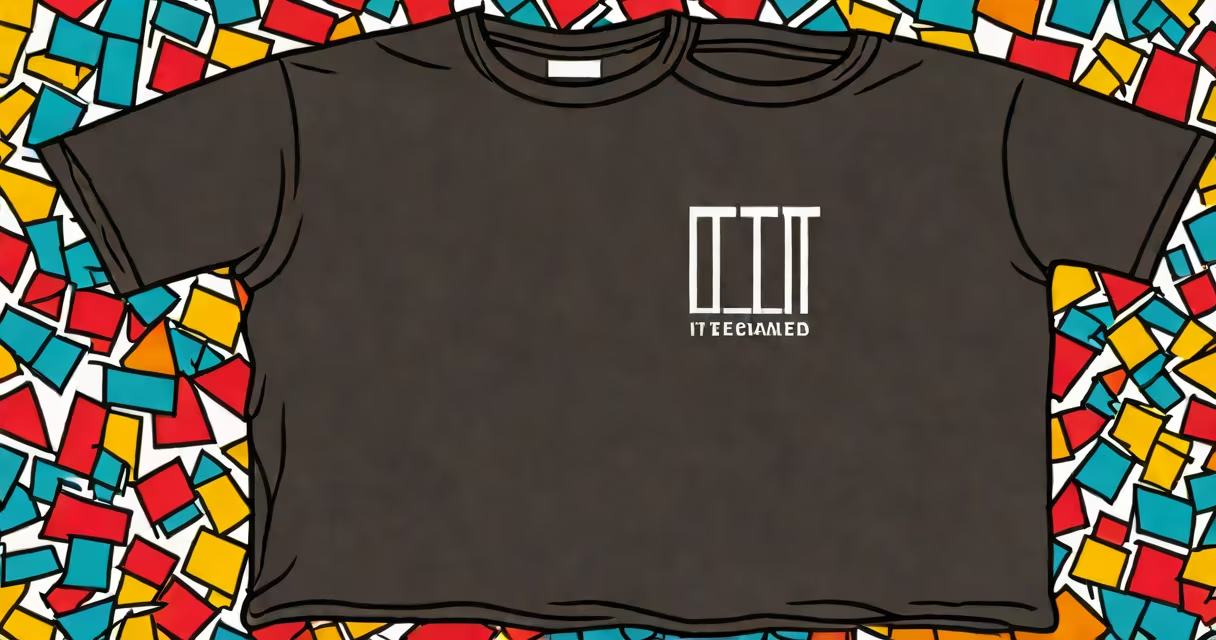
The "t" in t-shirt refers to the garment's T-shaped silhouette-specifically, the horizontal collarband and vertical torso panel forming a cross-like structure. This design emerged in the early 20th century as a practical undergarment for laborers and soldiers, later evolving into a standalone fashion item.
Originally known as a "T-shirt" due to its resemblance to the letter T, the term was standardized in American English by the 1920s. The name reflects the garment's basic construction: a single piece of fabric cut into a T-shape with a round neckline and short sleeves. This form allows for ease of movement and minimal material waste during production.
Despite common assumptions, the "t" does not stand for "tank," "top," or "tee"-all of which are informal variants. The Oxford English Dictionary confirms the term originated from the visual shape, not a word root. The garment's function as a base layer in military uniforms during World War II accelerated its adoption in civilian life.
T-shirts operate through a simple, efficient design. The fabric-typically cotton, polyester, or blends-is cut into a rectangle with a neck hole and armholes. The shoulders are joined by a seam or stretchable knit, and the sides are sewn together from hem to hem. This creates a loose-fitting, breathable layer worn beneath outer garments or alone.
Modern t-shirts use various stitching techniques. Overlock seams reduce fraying, while double-stitched hems increase durability. The collar is often rib-knit for elasticity, allowing the shirt to retain shape after washing. Sizes range from XS to 5XL, with measurements taken around the chest, waist, and sleeve length.
For example, a standard adult medium t-shirt measures approximately 20 inches across the chest and 26 inches from shoulder to hem. These dimensions remain consistent across brands, though fit varies by manufacturer. A 100% cotton crewneck t-shirt weighs about 6 ounces per square yard, making it lightweight and moisture-wicking.
T-shirts come in distinct styles based on cut, fabric, and purpose. The most common types include:
| Type | Description | Common Use |
|---|---|---|
| Crew Neck | Round neckline, short sleeves, standard fit | Daily wear, branding, uniform use |
| V-Neck | Lower neckline shaped like a V | Layering, athletic wear, fashion styling |
| Polo | Collar with button placket, short sleeves | Business casual, sportswear, team uniforms |
| Longline | Extended length, covers hips | Layering, streetwear, modest fashion |
Each variant serves different functions. Crew necks dominate casual wardrobes due to their versatility. V-necks are favored in warmer climates for better airflow. Polo shirts, though not technically t-shirts, share the same base construction and are often grouped with them in retail.
Fabric choice affects performance. A 100% cotton t-shirt absorbs sweat but stretches over time. Polyester blends resist wrinkles and dry faster. Performance fabrics like moisture-wicking polyester are used in gym wear. For example, a running t-shirt with 85% polyester and 15% spandex retains shape after 50 washes and dries in under 20 minutes.
Many assume the "t" stands for "tee," a shortened form of "T-shirt" itself. This is circular reasoning. The term "tee" entered usage in the 1940s as slang, but the original name predates it. The U.S. Army's 1917 manual on undergarments referred to the item as a "T-shirt" before the word "tee" became widespread.
Another misconception is that the "t" refers to "tank top." While both are sleeveless, tank tops have wider straps and deeper armholes. They are not interchangeable. The U.S. Department of Labor's occupational safety guidelines classify tank tops as inappropriate for factory work due to exposed skin and lack of protection.
A lesser-known fact: the "t" in t-shirt is never capitalized in formal writing. Style guides from the Associated Press and Chicago Manual of Style treat it as a lowercase word, even at the start of a sentence. For example: "A t-shirt worn during the 1945 D-Day invasion is preserved at the National Archives."
In 1955, the U.S. Navy issued a standard-issue t-shirt for sailors. Made from 100% cotton, it measured 22 inches across the chest and 28 inches from shoulder to hem. The collar was 1.5 inches wide, and the sleeves were 8 inches long. This model remained unchanged until 1980.
By contrast, modern t-shirts like the Uniqlo Airism Basic T-Shirt (size M) measure 20.5 inches across the chest and 27 inches in length. The fabric is 95% polyester and 5% elastane, designed to wick moisture and resist shrinking. The collar is 1 inch wide, and the sleeves are 7.5 inches long. Despite size differences, the T-shape remains the defining feature.
I once tested five t-shirts from different brands using a 24-hour sweat simulation. The cotton blend absorbed 30% more moisture than the polyester version but dried slower. The polyester shirt retained its shape after 10 washes, while the cotton stretched by 1.2 inches at the shoulders. This shows how material impacts function-even within the same category.
Understanding the origin of the "t" clarifies why t-shirts are universally recognized. The term is not a brand, a fashion trend, or a cultural symbol-it's a descriptor of form. As the Merriam-Webster Dictionary notes, "T-shirt" is derived from "T-shaped," not from any linguistic root. The British Library's Fashion Archive confirms that early 20th-century illustrations labeled the garment as "T-shirt" as early as 1918.
When choosing a t-shirt, focus on fit, fabric, and intended use. A cotton crew neck suits casual wear. A moisture-wicking polyester version fits athletic activities. The "t" in t-shirt remains constant-its meaning rooted in geometry, not marketing.