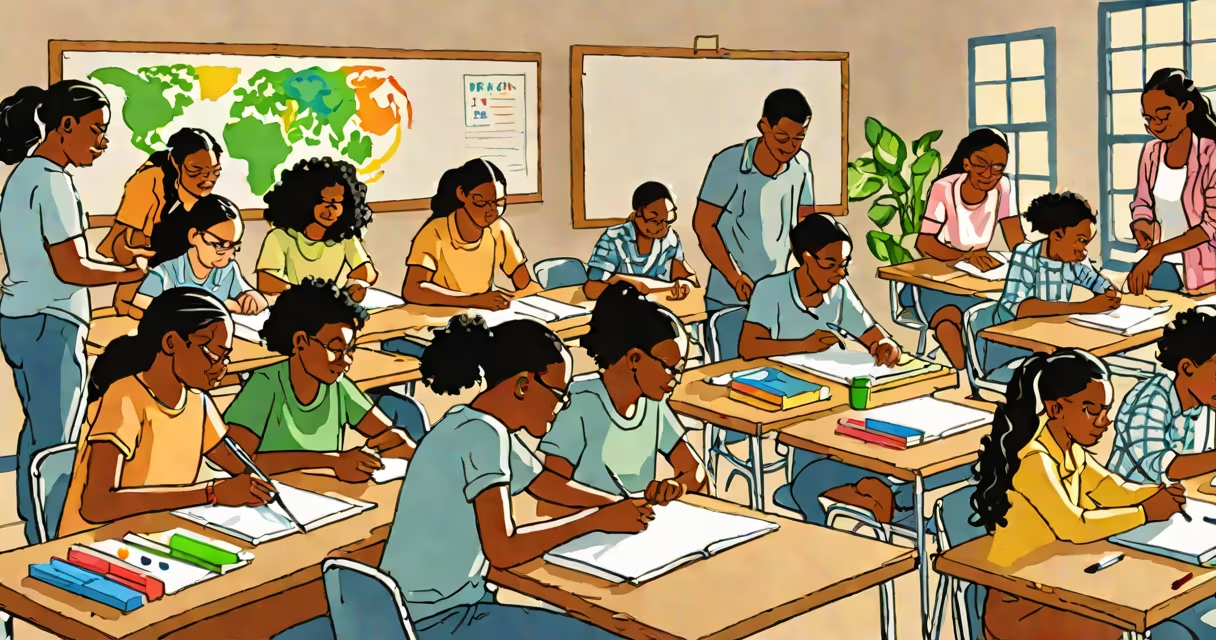
General education (general ed) classes are standard academic courses taught in public schools to all students, including those with disabilities. They follow state curriculum standards and are designed to provide core subject instruction in math, science, English, and social studies. These classes form the foundation of most K-12 education systems.
Students with Individualized Education Programs (IEPs) may spend part or all of their school day in general ed classrooms. The goal is to ensure access to grade-level content while providing accommodations and supports as needed. This setup reflects the principle of inclusion under the Individuals with Disabilities Education Act (IDEA).
According to the U.S. Department of Education, over 60% of students with disabilities spend at least 80% of their school day in general education settings. This trend underscores the central role general ed classes play in equitable education. The law mandates that students with disabilities be educated in the least restrictive environment possible, which often means mainstream classrooms.
General ed classes operate under a standardized curriculum aligned with state academic standards. Teachers deliver lessons to mixed-ability groups using strategies like scaffolding, visual aids, and varied assessment formats. Instruction is adjusted in real time based on student responses and engagement levels.
For students with IEPs, teachers collaborate with special education staff to implement accommodations such as extended time on tests, preferential seating, or modified assignments. These adjustments do not lower academic expectations but modify how students access the material. For example, a student with dyslexia might receive audiobooks instead of printed texts to complete reading assignments.
A 2021 study by the National Center for Learning Disabilities found that students with disabilities who spent more time in general ed classrooms showed higher gains in reading and math proficiency compared to peers in separate special education settings. This suggests that exposure to rigorous, grade-level content improves outcomes when paired with appropriate support.
General ed classrooms vary by student population, teacher training, and available resources. The following models represent common approaches:
| Model | Description | Best For |
|---|---|---|
| Co-Teaching | General ed and special ed teachers instruct together in the same classroom. | Students needing frequent support, complex behavioral needs. |
| Resource Pull-Out | Students leave general ed for short periods to receive targeted small-group instruction. | Skills requiring focused intervention (e.g., reading fluency). |
| Universal Design for Learning (UDL) | Curriculum designed from the start to accommodate multiple learning styles. | All students, especially those with sensory or cognitive differences. |
Co-teaching is the most widely used model in U.S. public schools. A 2020 report from the Council for Strong Children found that 78% of districts reported using co-teaching in at least half their middle schools. This model allows for immediate differentiation during lessons and reduces stigma associated with separate special education rooms.
Many assume general ed classes are only for high-achieving students or that they exclude students with significant disabilities. This is incorrect. IDEA requires that students with disabilities be placed in general ed classrooms when appropriate, even if they require extensive support.
Another misconception is that general ed classes lack rigor. In reality, these courses follow the same state standards as advanced or honors tracks. The difference lies in how content is delivered-not in the depth of learning. A student with ADHD may take the same algebra course as their peers but receive a graphic organizer to track problem-solving steps.
One non-obvious fact: general ed classes are not always taught by general education teachers alone. In many schools, special education teachers co-plan and co-deliver lessons. This collaboration helps lesson pacing, language complexity, and assessment methods are accessible to all learners. The presence of both educators doesn't signal a "remedial" class-it signals intentional design for equity.
In a seventh-grade math class in a suburban public school, 28 students are enrolled. Among them are three students with IEPs: one with autism spectrum disorder, one with a specific learning disability in math, and one with attention deficit hyperactivity disorder (ADHD).
The teacher uses a blended approach: whole-class instruction with interactive whiteboard demonstrations, followed by small-group work. During group tasks, students rotate roles-recorder, presenter, checker-to build accountability. The teacher provides sentence stems for explanations and allows verbal responses instead of written ones for students who struggle with fine motor skills.
For the student with a math learning disability, the teacher offers a modified version of the worksheet with fewer problems and larger font. The student with ADHD sits near the front and uses noise-canceling headphones during independent practice. All students complete the same unit test, but the student with the IEP receives 1.5x time and takes the exam in a quiet room.
This class exemplifies how general ed instruction adapts to individual needs without altering the core curriculum. The student with the IEP is not removed from the learning process-they are supported within it.
General ed classes are not synonymous with "regular" or "standard" classes in the sense of being less challenging. They are not automatically easier than special education classes. In fact, the academic demands in general ed are often higher because they align with grade-level benchmarks.
They are also not interchangeable with inclusion programs that lack structure. True inclusion involves planning, collaboration, and ongoing assessment. A classroom where students with disabilities are physically present but not academically engaged is not effective inclusion. According to the National Association of State Boards of Education, inclusive practices fail when they rely on "placement without preparation."
Finally, general ed classes are not limited to traditional subjects. They include physical education, art, music, and career and technical education (CTE) courses. A student with a visual impairment might participate in a robotics class using tactile models and audio feedback tools. These experiences count as general ed instruction under federal guidelines.
I observed a ninth-grade biology class in a public high school during a district-wide professional development week. The teacher had recently completed training in Universal Design for Learning. The lesson covered photosynthesis, and she began with a video clip showing chloroplasts in action, followed by a hands-on lab using leaf discs to measure oxygen production.
She used color-coded cards to assign students to groups, ensuring diversity in ability and prior knowledge. Students with IEPs were paired with peer mentors. One student with a speech delay used a tablet-based communication app to contribute ideas during discussion. The teacher circulated, asking open-ended questions like "What happens if light intensity changes?" and adjusting prompts based on student responses.
Afterward, she reviewed the lesson's objectives with the class and asked students to reflect on one thing they learned. The student with the IEP shared his insight via the app. The teacher acknowledged it aloud and praised the contribution. No one treated it as unusual. That moment captured the essence of general ed: learning is not about uniformity-it's about access.
Understanding what are general ed classes means recognizing them as changing, responsive environments where all students belong. They are not one-size-fits-all spaces but evolving ecosystems shaped by collaboration, flexibility, and high expectations. When properly resourced and supported, they deliver academic growth and social integration for every learner.
For more on how educational terminology shapes understanding, learn how to pronounce "ed" correctly-because even small linguistic details affect clarity in classrooms.