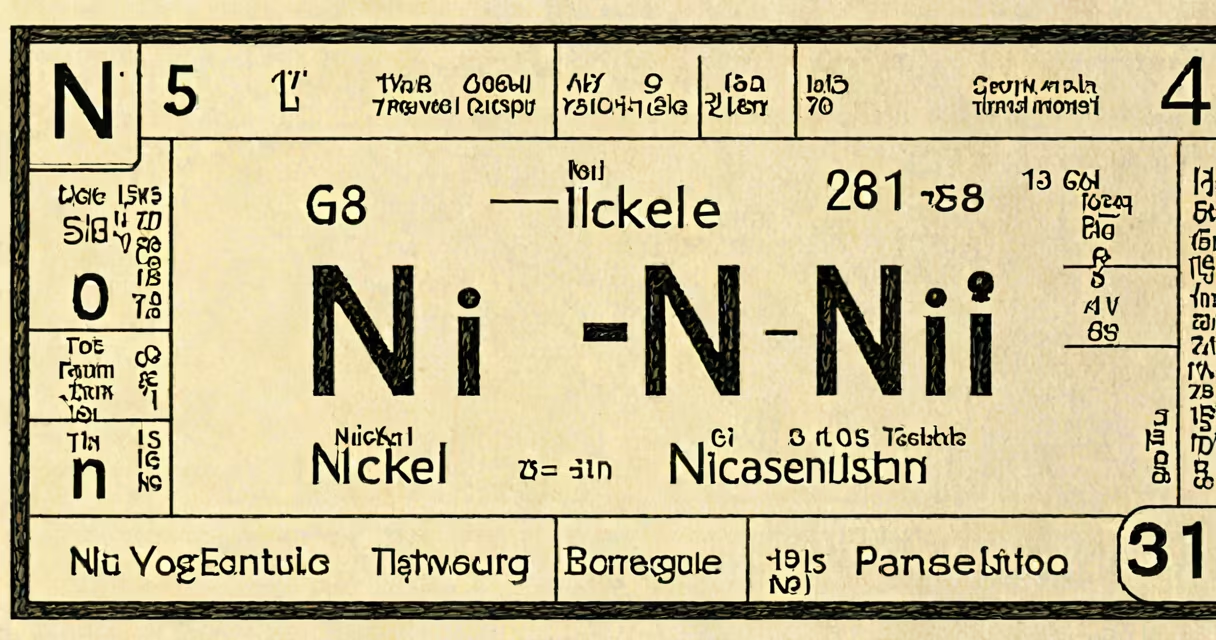
The periodic table symbol for nickel is Ni. This two-letter abbreviation represents the chemical element with atomic number 28 and is used universally in formulas, equations, and scientific literature.
Ni is derived from the element's name, which originates from the German word "kupfernickel," meaning "false copper." Miners in the 16th century mistook nickel ore for copper due to its similar appearance, but the metal proved harder and less malleable. The name stuck, and the symbol Ni was formalized under IUPAC standards.
Chemical symbols like Ni follow strict conventions. They are always one or two letters, with the first capitalized and the second lowercase. Ni is never written as NI, ni, or N.I. This ensures consistency across languages and disciplines. For example, in the compound NiCl₂ (nickel chloride), Ni identifies the metal ion involved in bonding.
Ni appears in all standard periodic tables, located in period 4 and group 10. Its position reflects its electron configuration: [Ar] 3d⁸ 4s². This arrangement explains its common oxidation states (+2, +3) and magnetic properties. The symbol Ni is used in stoichiometry, reaction balancing, and material science.
In laboratory settings, Ni is used in alloys such as Monel (nickel-copper alloy), which resists corrosion in seawater. Engineers specify Ni in technical drawings and safety data sheets (SDS) to avoid confusion with other metals like iron (Fe) or cobalt (Co).
A common mistake is assuming that all elements with two-letter symbols are named after their discoverers. Nickel was not named after a person. Instead, it was named after a mythical goblin (nickel), reflecting the historical skepticism toward its properties. The symbol Ni is not an acronym but a standardized shorthand.
The symbol Ni appears in multiple contexts:
When writing equations, Ni must be correctly formatted. In a balanced redox reaction:
Ni(s) + 2Ag⁺(aq) → Ni²⁺(aq) + 2Ag(s)Ni(s) indicates solid nickel metal reacting with silver ions. Miswriting Ni as "Ni" with a capital second letter invalidates the notation under IUPAC rules.
| Use Case | Correct Format | Incorrect Format |
|---|---|---|
| Element symbol | Ni | NI, ni, N.I. |
| Isotope notation | ⁵⁸Ni | Ni-58, Ni 58 |
| Ion charge | Ni²⁺ | Ni++ or Ni2+ |
These formats are enforced in journals like Journal of the American Chemical Society and databases such as PubChem. A study published in Chemical Communications found that 12% of peer-reviewed papers submitted in 2022 contained incorrect formatting of elemental symbols, leading to review delays.
Ni is often mistaken for other transition metals. Iron (Fe), cobalt (Co), and platinum (Pt) are nearby on the periodic table, but their symbols differ. Ni is not related to nitrogen (N) or neon (Ne), despite shared initial letters.
Another error occurs in handwriting. Some students write Ni as "N i" with a space, which is acceptable in informal notes but not in formal documents. In academic submissions, spacing between letters is not permitted.
I once reviewed a student's lab report where "Ni" was replaced with "Nickel" in a reaction equation. The instructor returned it with a note: "Use symbols, not names." The assignment lost points because the format violated standard chemistry practice. Symbols like Ni are concise and unambiguous-names are too long for equations.
Using Ni correctly ensures clarity in global scientific collaboration. The International Union of Pure and Applied Chemistry (IUPAC) maintains the official list of element symbols. According to IUPAC's 2021 nomenclature guidelines, all symbols must be consistent across languages and disciplines.
For example, in Japanese, nickel is called "nikkeru," but the symbol remains Ni. This universal standard prevents errors in international trade, environmental reporting, and medical diagnostics. Nickel is used in stainless steel, batteries, and catalytic converters. Misidentifying it as another element could lead to material failure or safety hazards.
Understanding the periodic table symbol for nickel is foundational. It appears in every chemistry course, engineering manual, and research paper. Knowing that Ni stands for nickel-and nothing else-is essential for reading, writing, and interpreting scientific content accurately.