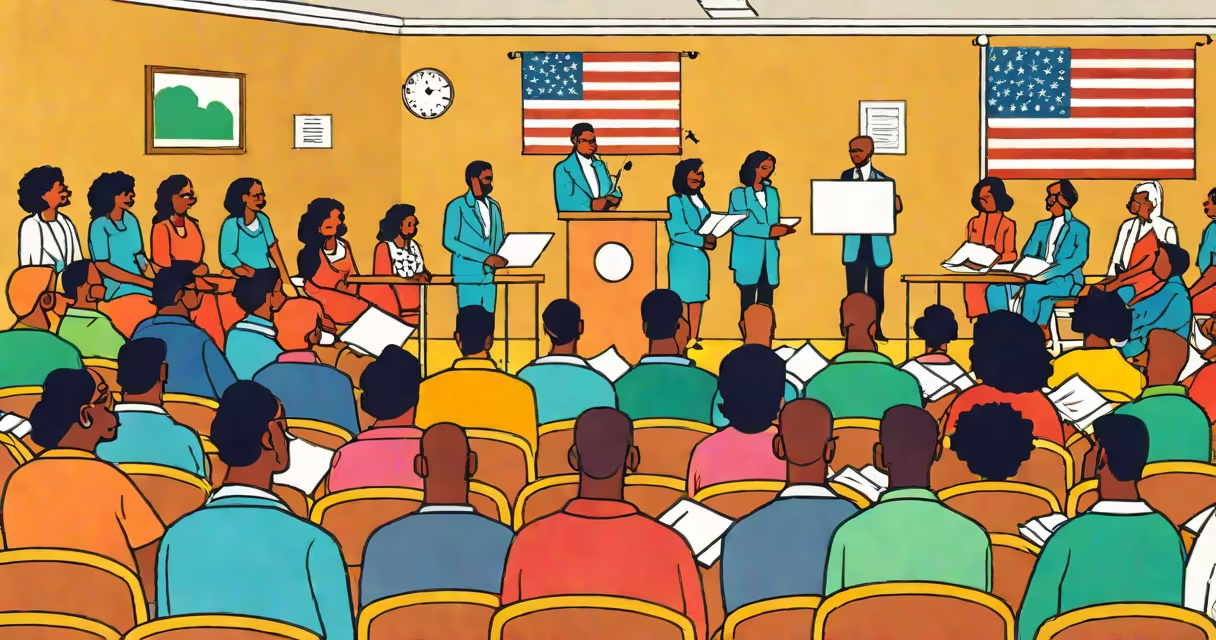
Civic literacy is the understanding of how government works, the rights and responsibilities of citizens, and the mechanisms for influencing public policy. It enables individuals to participate effectively in democratic processes such as voting, advocacy, and community decision-making.
It is not simply knowing facts about elections or the branches of government. True civic literacy involves critical thinking about power structures, recognizing misinformation, and acting on civic knowledge. A person with civic literacy can analyze a proposed law, assess its impact on different groups, and contribute to public debate with evidence-based reasoning.
According to the National Assessment of Educational Progress (NAEP), only 24% of U.S. eighth-graders demonstrated proficiency in civics in 2022. This gap highlights the urgency of building civic literacy across age groups and communities. Without it, democratic institutions weaken under apathy and disinformation.
Civic literacy operates through three interconnected layers: knowledge, skills, and dispositions. Knowledge includes understanding foundational documents like the Constitution and Bill of Rights, as well as current events and local governance. Skills involve analyzing policy proposals, engaging in respectful dialogue, and using legal channels to influence outcomes. Dispositions refer to values such as fairness, accountability, and respect for diverse perspectives.
For example, when a city proposes a new zoning law that affects housing density, a civically literate resident would research the proposal's legal basis, attend the public hearing, review data on traffic and school capacity, and submit a written comment based on neighborhood concerns. They wouldn't just react emotionally-they'd act with informed intent.
The Center for Information & Research on Civic Learning and Engagement (CIRCLE) at the University of Maryland found that students exposed to structured civic education programs were 30% more likely to vote in their first eligible election. This shows that civic literacy isn't passive-it produces measurable civic behavior.
Civic literacy consists of five core components:
These elements are not isolated. For instance, during the 2020 U.S. presidential election, many voters misinterpreted mail-in ballot deadlines because they lacked familiarity with state-specific procedures. This wasn't a failure of individual responsibility-it was a systemic gap in civic literacy that led to disenfranchisement.
A 2021 study by the Pew Research Center showed that 64% of Americans couldn't name all three branches of government. Yet those who could were twice as likely to follow national politics and report feeling confident in their ability to influence government decisions.
Civic literacy is essential in schools, workplaces, and community organizations. In classrooms, it forms the foundation of social studies curricula. In workplaces, it supports employee engagement in corporate governance and ethical decision-making. In neighborhoods, it fuels volunteerism and local problem-solving.
Consider the city of Minneapolis's 2021 budget process. Residents were invited to prioritize spending through online forums and public meetings. Those who participated had higher levels of civic literacy and were more likely to suggest long-term solutions rather than short-term fixes. Their input shaped funding allocations for youth programs and mental health services.
Nonprofits and libraries often host "civic literacy workshops" focused on going through voter registration, interpreting ballot measures, and understanding local ordinances. These sessions are not theoretical-they produce tangible results. In 2022, a library-led initiative in Portland, Oregon, helped 1,200 residents register to vote, with 78% reporting increased confidence in their ability to engage with city council meetings.
Civic literacy is often confused with political partisanship. People assume that being civically literate means supporting a specific party or ideology. That's incorrect. Civic literacy is neutral-it equips people to evaluate policies regardless of personal beliefs.
Another misconception is that civic literacy is only for adults. In reality, children as young as 8 can grasp basic concepts like fairness, rules, and shared responsibility. The National Council for the Social Studies recommends introducing civic topics early, using age-appropriate materials such as classroom debates on playground rules or school recycling programs.
There's also a false belief that civic literacy is synonymous with patriotism. While pride in one's country can coexist with civic literacy, the two are distinct. Patriotism is emotional; civic literacy is analytical. You can love your country and still critique its failures-this is not disloyalty, but responsible citizenship.
One non-obvious fact: Civic literacy reduces polarization. A 2023 study published in Political Psychology found that individuals with high civic literacy were less likely to view opposing political views as morally wrong. They were more likely to see disagreement as a difference in priorities, not a threat to identity.
In 2020, Seattle voters faced Initiative 106, which sought to redirect $10 million from the police department to community safety programs. The campaign included detailed reports on crime rates, mental health response data, and alternative models from other cities.
Residents who engaged with the referendum had access to official summaries, fact-checks from local news outlets, and town halls hosted by city staff. Those with higher civic literacy were more likely to read the full text of the measure, compare it to similar initiatives in Oakland and Denver, and vote based on evidence-not emotion.
After the vote, researchers from the University of Washington analyzed turnout and demographic patterns. They found that neighborhoods with prior civic education programs had 42% higher voter turnout on the issue. More, 68% of voters in those areas supported the initiative, compared to 51% in areas without such programs.
This case shows that civic literacy doesn't just inform-it changes outcomes. It turns passive citizens into active participants in shaping their communities.
Developing civic literacy begins with accessible, accurate information and consistent practice. Schools, libraries, and community centers play a important role in offering tools and spaces for learning. When people understand how systems work and how they can affect them, democracy becomes functional, not symbolic.
For deeper insights into how people build foundational knowledge, this guide.