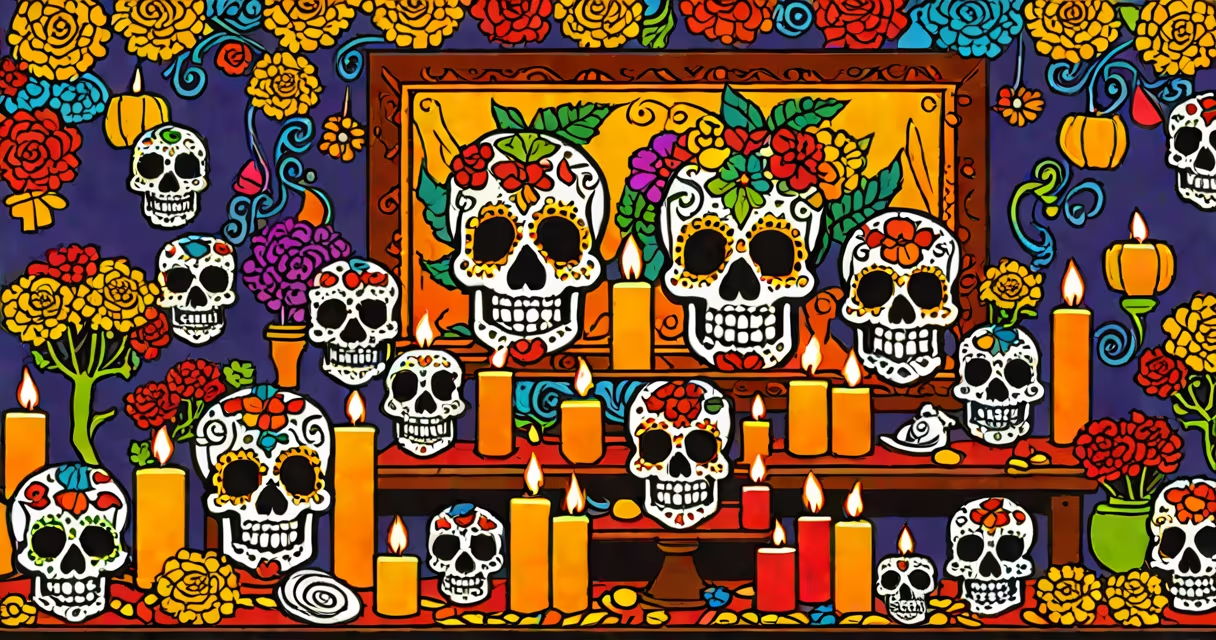
Día de Muertos en México is a multi-day tradition observed on November 1 and 2, where families honor deceased relatives through altars called ofrendas, decorated with marigolds, sugar skulls, photographs, and favorite foods. The holiday blends Indigenous Mesoamerican beliefs with Catholic All Saints' and All Souls' Days.
The celebration centers on the belief that the souls of the dead return to visit the living during this time. Families clean gravesites, prepare traditional dishes like mole and tamales, and place offerings such as pan de muerto and water to quench spirits' thirst. This practice reflects a worldview where death is not an end but a continuation of connection.
According to the National Institute of Anthropology and History (INAH), Día de Muertos was recognized as Intangible Cultural Heritage of Humanity by UNESCO in 2008. The designation highlights its role in preserving indigenous identity and community cohesion across regions like Oaxaca, Michoacán, and Puebla.
Families begin preparing days in advance. They clean and decorate gravesites, often placing candles and flowers along paths leading to tombs. In urban areas, neighborhoods host public ofrendas in plazas and schools. These altars follow a symbolic structure: layers represent earth, sky, and the spiritual area.
Each element holds meaning. Marigolds (cempasúchil) guide spirits with their scent and color. Calaveras (sugar skulls) are handcrafted with colorful icing and names written on the forehead. Pan de muerto-a sweet bread with bone-shaped dough-is baked in round loaves with orange zest and anise. Water is left out to hydrate spirits after their long process.
In Oaxaca, the Danza de los Viejitos features dancers in old-age costumes performing ritual dances. In Michoacán, families gather at cemeteries for vigils, singing songs and sharing stories. These acts reinforce intergenerational memory and emotional continuity.
While core elements remain consistent, regional practices differ. In Puebla, artisans create elaborate papel picado banners with complex cutouts. In Chiapas, families use copal incense and traditional textiles to adorn altars. In rural communities, some still perform the "velorio" - a wake-like ceremony lasting until dawn.
| Region | Distinctive Practice | Key Symbol |
|---|---|---|
| Oaxaca | Elaborate ofrendas with hand-carved wooden figures | La Catrina figurines |
| Mexico City | Public parades with giant skeletons and music | Calaveras de azúcar with names |
| Michoacán | Overnight cemetery vigils with food and song | Candles and marigold pathways |
| Puebla | Hand-cut papel picado with religious motifs | Colorful paper banners |
These differences reflect local histories and spiritual influences. For example, in Mixteca communities, ancestors are believed to return in animal form, so offerings may include corn husks shaped like birds or deer.
Día de Muertos is often mistaken as a "Mexican Halloween." That's incorrect. While both involve masks and costumes, Halloween focuses on fear and supernatural scares. Día de Muertos is rooted in remembrance, love, and ancestral continuity. It is not about celebrating death-it's about honoring life through memory.
Another error is assuming all ofrendas are identical. In reality, they vary by family, region, and personal history. A child's altar might include toys and drawings. An elder's may feature books, musical instruments, or religious icons. The altar is deeply personal, not a generic template.
A lesser-known fact: the term "calavera" originally referred to a skull in Aztec mythology, particularly in the goddess Mictecacihuatl, the Lady of the Dead. Her name appears in many ofrendas as a central figure. The modern sugar skull evolved from this ancient symbolism, not from Western Halloween imagery.
In 2023, my family hosted a Día de Muertos celebration in San Juan Teotihuacán, near Mexico City. We built a three-tiered altar using a wooden table covered in red cloth. The bottom layer held salt and water. The middle had photos of my grandmother and grandfather, a small statue of La Catrina, and a plate of tamales. The top tier featured a bowl of atole, a glass of pulque, and five sugar skulls labeled with names of family members who had passed.
We lit seven candles-one for each day of the week-and placed marigolds around the base. My cousin played a traditional son jarocho tune on a guitar. After sunset, we sang "Las Mañanitas" and shared stories. The atmosphere wasn't somber-it was joyful, intimate, and deeply human.
This experience confirmed what INAH documents: Día de Muertos is not a performance for tourists. It's a lived ritual of belonging. When I saw my younger cousin draw a picture of his great-grandmother and place it on the altar, I understood the cycle of memory in action.
Día de Muertos is celebrated nationwide, especially in states with strong Indigenous populations. According to INAH, 72% of surveyed households in Oaxaca and Puebla reported building ofrendas annually. Urban centers like Guadalajara and Monterrey hold city-wide events, including art exhibitions and live music.
Outside Mexico, communities in Los Angeles, Chicago, and Toronto observe the holiday with processions and public altars. In 2022, the Smithsonian American Art Museum featured a traveling exhibition titled "Día de Muertos: Memory and Immortality," which included work by Mexican-American artists.
Why do people continue this tradition? Because it offers a way to grieve without despair. As anthropologist Ruth Behar wrote in her book *The Vulnerability of Miracles*, "Death is not the opposite of life-it is part of it. Día de Muertos teaches us to hold both together."
Día de muertos en México is not a festival of fear. It is a ceremony of presence. Through food, song, and memory, families maintain bonds beyond the grave. The holiday persists because it answers a fundamental human need: to remember, to belong, and to love across time.