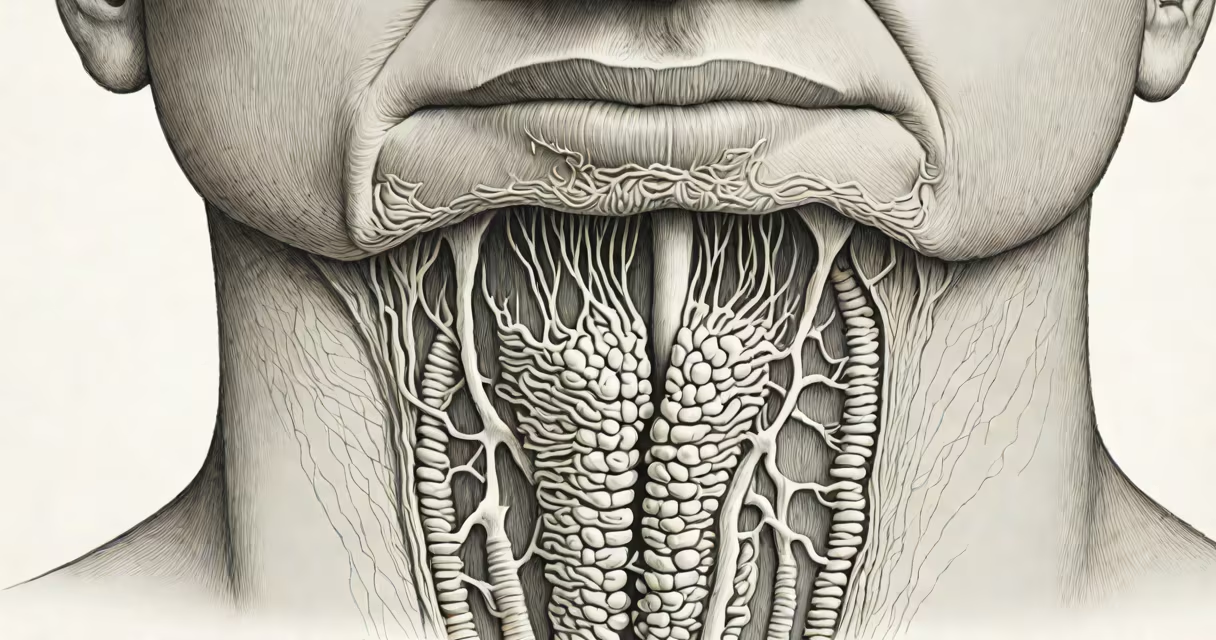
A goitre is an abnormal enlargement of the thyroid gland, often visible as a swelling in the front of the neck. It occurs when the thyroid grows larger than normal due to underlying medical causes such as iodine deficiency, autoimmune disorders, or genetic factors.
The thyroid gland sits at the base of the neck, just below the Adam's apple. It produces hormones that regulate metabolism, heart rate, body temperature, and energy levels. When it enlarges, it may press on nearby structures, causing hoarseness, difficulty swallowing, or breathing issues. Not all goitres cause symptoms, but they signal an imbalance in thyroid function.
Goitre caused by iodine deficiency remains the leading global cause, especially in regions where soil and water lack sufficient iodine. In contrast, autoimmune diseases like Hashimoto's thyroiditis are the primary cause in countries with iodized salt programs. Other contributors include certain medications, pregnancy, and exposure to goitrogenic substances in food.
The thyroid gland enlarges when it cannot produce enough thyroid hormone efficiently. The pituitary gland detects low hormone levels and releases thyroid-stimulating hormone (TSH), which signals the thyroid to grow larger in an attempt to compensate. This growth leads to a goitre.
Iodine is essential for making thyroid hormones. Without enough iodine, the thyroid cannot synthesize thyroxine (T4) and triiodothyronine (T3). The body responds by increasing TSH, which stimulates thyroid tissue to proliferate. Over time, this results in diffuse or multinodular goitre.
Autoimmune conditions disrupt this process differently. In Hashimoto's thyroiditis, the immune system attacks the thyroid gland, causing chronic inflammation and fibrosis. As the gland loses functional tissue, TSH rises, prompting compensatory growth. This form accounts for over 90% of goitres in the United States, according to the American Thyroid Association.
Goitres fall into several categories based on their origin. The most common types are classified by whether they involve normal or reduced thyroid function.
| Type | Primary Cause | Thyroid Function | Prevalence |
|---|---|---|---|
| Endemic goitre | Iodine deficiency | Normal or low | Common in mountainous or inland areas |
| Diffuse toxic goitre | Graves' disease (autoimmune hyperthyroidism) | High | Less than 10% of cases |
| Hashimoto's goitre | Autoimmune destruction | Low (hypothyroidism) | Most common in high-income nations |
| Nodular goitre | Benign thyroid nodules | Variable | Increases with age; affects ~50% of adults over 60 |
Endemic goitres occur in regions where dietary iodine intake falls below 10 micrograms per day, according to the World Health Organization. These areas include parts of sub-Saharan Africa, Central Asia, and the Andes. In contrast, nodular goitres are more prevalent in older populations and are often detected incidentally during imaging for unrelated reasons.
Some foods contain goitrogens-substances that interfere with iodine uptake or thyroid hormone synthesis. Cruciferous vegetables like broccoli, kale, and cabbage have mild goitrogenic effects, but cooking reduces their activity. Raw consumption in large amounts, especially in iodine-deficient individuals, can worsen thyroid function.
Many assume that all goitres are linked to iodine deficiency. That's incorrect. While iodine deficiency remains the top cause worldwide, it accounts for less than 20% of cases in the U.S. and Western Europe. In these regions, autoimmune disease is the dominant factor.
Another misconception is that goitres always indicate hyperthyroidism. In reality, most are associated with hypothyroidism or euthyroid status. A goitre caused by Graves' disease is rare compared to Hashimoto's, despite popular belief. Graves' disease typically presents with eye bulging (ophthalmopathy), tremors, and weight loss-not just a neck swelling.
Not all thyroid enlargement is a goitre. Some patients develop localized nodules that don't cause gland enlargement. These are diagnosed separately and may require fine-needle aspiration biopsy to rule out cancer. The presence of a single nodule doesn't equate to a goitre unless the entire gland is enlarged.
In 2019, a 42-year-old woman in Portland, Oregon, presented with a visible neck swelling and fatigue. Blood tests showed elevated TSH (12.4 mIU/L) and low free T4 (0.8 ng/dL), indicating hypothyroidism. An ultrasound revealed a diffusely enlarged thyroid with heterogeneous echotexture-classic signs of Hashimoto's thyroiditis.
She had no history of iodine restriction and consumed iodized salt daily. Her family history included autoimmune thyroid disease. After testing positive for anti-thyroid peroxidase (TPO) antibodies (titer >1000 IU/mL), the diagnosis was confirmed. She began levothyroxine therapy and experienced symptom resolution within six weeks.
This case illustrates that goitre caused by autoimmune mechanisms can develop even in iodine-sufficient environments. It also shows that symptoms like fatigue and swelling aren't always tied to iodine levels.
During my clinical rotation at a community health center in rural Idaho, I saw five patients with goitres over a three-month period. Four had Hashimoto's thyroiditis. One had a multinodular goitre with a suspicious nodule. All were women aged 35-60. None had dietary iodine deficiency. The patient with the nodule required surgical evaluation, which confirmed benign follicular adenoma.
This experience reinforced that goitre causes vary by region and population. In areas with adequate iodine, autoimmune disease dominates. Screening for TPO antibodies and TSH should be standard in suspected cases, regardless of diet.
Goitre caused by iodine deficiency is still widespread globally, but in developed nations, autoimmune conditions like Hashimoto's thyroiditis are far more common. Recognizing the difference guides treatment: iodine supplementation helps in deficiency-related cases, while autoimmune goitres require hormone replacement and monitoring.
Understanding the root cause prevents misdiagnosis. A goitre is not a single condition-it's a sign of dysfunction with multiple origins. Accurate identification ensures effective management and avoids unnecessary interventions.
For those concerned about thyroid health, especially with a family history or persistent neck swelling, testing for TSH, free T4, and TPO antibodies is essential. Early detection improves outcomes and prevents complications like compressive symptoms or thyroid failure.